Acculturation stress is the extra mental and emotional pressure that comes from adapting to a new country, language, and way of life all at once, including learning English, navigating unfamiliar systems, missing family, facing discrimination, and worrying about immigration status. Researchers have documented that this kind of stress is real and can raise the risk for depression and anxiety over time. It is not a personal weakness; it is a predictable response to an objectively difficult situation, and it is something that mental health providers in the United States understand and can help with.
Many people who move to a new country carry a heavy load: a new language, a new system, being far from family. It is normal to feel stress. Sometimes, though, the feelings last longer or grow heavier, and that can be a sign of a health condition you can get help for. This guide helps you notice the difference.
- Distress that lasts about two weeks or more, or gets in the way of daily life, is a sign to get help.
- Mental health conditions are common and treatable; more than 1 in 5 adults in the United States lives with a mental illness.
- Distress often shows up in the body, and you have the right to a free, qualified interpreter.
What mental health means
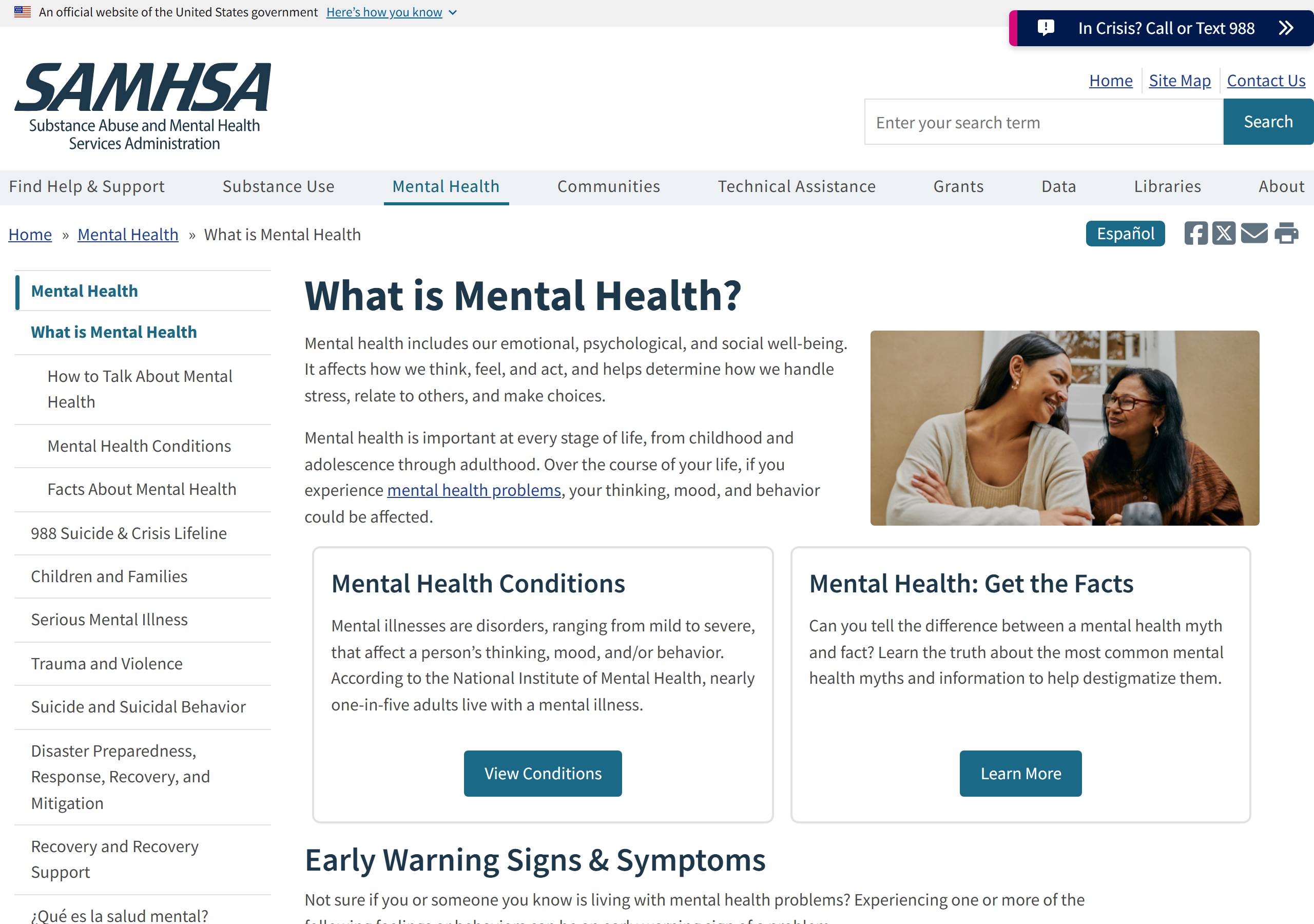
Mental health is your emotional, psychological, and social well-being. It affects how you think, feel, handle stress, and relate to other people, according to the U.S. Substance Abuse and Mental Health Services Administration (SAMHSA) and the U.S. Centers for Disease Control and Prevention (CDC). It is part of your overall health, like your heart or your blood pressure.
These conditions are common and treatable
Conditions like depression and anxiety are common, and they can be treated. More than 1 in 5 adults in the United States lives with a mental illness, according to the National Institute of Mental Health (NIMH). This is ordinary. It is not rare, and it is not a personal or moral failure. Asking for help is a sign of strength.
Warning signs to watch for
You do not need to have all of these. Watch for changes that last or that get in the way of daily life:
- Sleeping much more or much less than usual, or a big change in appetite
- Pulling away from people you usually see
- Sadness or hopelessness that does not lift
- Worry or fear that is hard to turn off
- Trouble doing everyday tasks at home or work
- Using alcohol or drugs to cope
- Thoughts of harming yourself
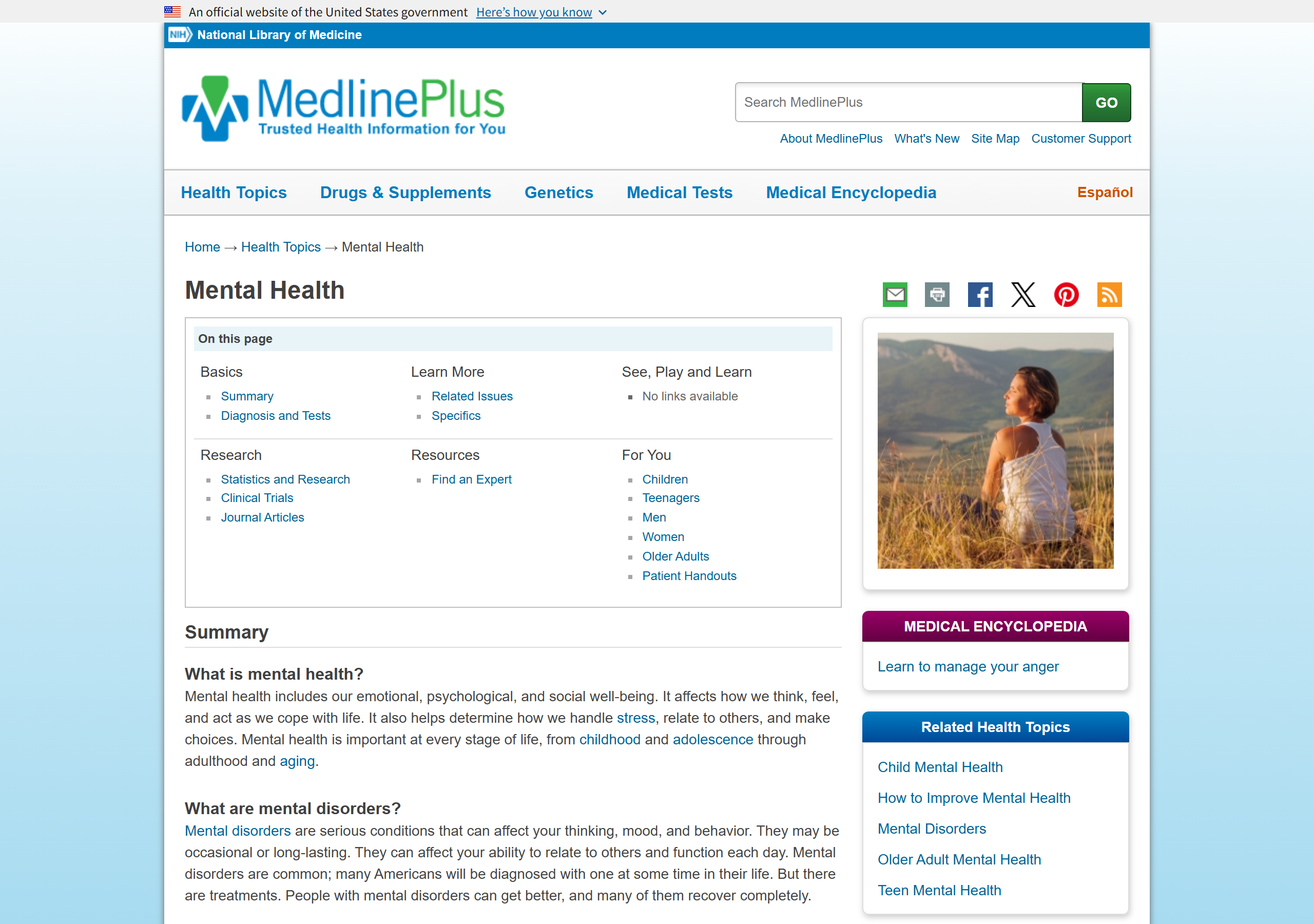
The National Library of Medicine’s MedlinePlus page on mental health lists similar signs and points to where to go for help.
When distress shows up in the body
Stress, depression, and anxiety do not always feel like sadness or worry. Very often they show up in the body. You might notice headaches, feeling tired all the time, stomach pain, dizziness, muscle aches, or changes in how you sleep or eat. This is common, and it is valid. In many cultures around the world, distress is felt and described first as a physical problem, and researchers have long documented that emotional pain often presents through the body (Kirmayer, 2001). Your symptoms are real, whether you feel them in your mood or in your body.
Because of this, it is completely fine to start by telling a provider about the physical symptoms. You can say, “I have had headaches and trouble sleeping for weeks,” and let the conversation grow from there. A good provider will listen to the whole picture, body and mind together, and help you find what is going on.
It is completely fine to begin by telling a provider about physical symptoms. You can say, "I have had headaches and trouble sleeping for weeks," and let the conversation grow from there. A good provider listens to body and mind together.
When to seek help
A simple rule of thumb: if distressing symptoms last about two weeks or more, or if they get in the way of your work, your family, or your daily life, it is time to talk to someone. A good first step is your primary care provider, who can check how you are doing and refer you to a mental health professional. When you talk to a provider, they may ask you a few short questions about your mood, sleep, worry, and energy over the past two weeks. These questions are normal and private, and they help the provider understand what kind of support could help. The National Institute of Mental Health (NIMH) has a short guide called “My Mental Health: Do I Need Help?” that walks through this.
You do not have to wait until things feel unbearable. If you are thinking about harming yourself, get help now: call or text 988 at any time.
Immigration stress is real
Being separated from family, facing discrimination, and carrying the strain of a new language and a new system can all affect your mental health (Berry, 1997; Kirmayer et al., 2011; Williams & Mohammed, 2009). These pressures are real, and they are not your fault. Feeling worn down by them does not mean you are weak. It means you are human, and help is available.
Culture, stigma, and the people around you
Every culture understands mental health a little differently, and there is no single right way to talk about it. In some communities, people are taught to keep these struggles private, or to feel that “I should handle this alone,” and stigma like this can keep people, especially in some immigrant communities, from seeking care (Nadeem et al., 2007). Those feelings are common, and they are nothing to be ashamed of. But carrying everything by yourself is not the only way. Reaching out for help is a sign of strength, and what you share with a provider is confidential.
The people around you can be part of your support, too. Family, friends, community members, and faith or religious leaders can listen, walk beside you, and sometimes help connect you to care; immigrants often turn first to exactly these people when distress arises (Derr, 2016). You get to decide who you bring in and how much you share. If you want to understand how different communities think about emotional well-being, see Mental health across cultures.
Treatment works
Most people feel better with care. Talk therapy, medication, or a combination of both helps many people, MedlinePlus explains. And you do not need to speak English well to get good care. Limited English proficiency can make it harder to reach mental health services and can lower the quality of care (Kim et al., 2011; Bauer & Alegría, 2010), which is why you have the right to a free, qualified interpreter, so you can talk about how you feel in your own language.
When you are ready, the next guides explain how care works in the United States and how to find a provider who speaks your language.
First steps you can take
You do not have to figure this out alone, and you do not need perfect English to begin. Any one of these is a good first move:
- Talk to your primary care provider. Tell them, in plain words, what you have noticed: “I have felt down and had trouble sleeping for a few weeks.” They can check you, start simple treatment, and refer you to a mental health professional. Ask for a free interpreter when you book.
- Find a low-cost clinic. Community health centers offer care no matter your income, insurance, or immigration status, on a sliding fee scale that lowers the cost to what you can pay. Find one near you at findahealthcenter.hrsa.gov. To search specifically for mental health or substance use care, use findtreatment.gov.
- Call 211. Dial 211 or visit 211.org to reach someone, often in your language, who can connect you to local mental health services, counseling, food, and housing help.
- Reach the NAMI HelpLine. The National Alliance on Mental Illness offers free, confidential information and support. Call 1-800-950-6264 or visit nami.org.
- In a crisis, call or text 988. The 988 Suicide & Crisis Lifeline is free, private, and open 24 hours a day, with interpreters in many languages. If someone is in immediate danger, call 911.
At every one of these, you have the right to a free, qualified interpreter, so you can speak about how you feel in your own language. See Your right to a free interpreter.
How depression and anxiety can feel different
Depression and anxiety are two of the most common conditions, and they can feel different from each other. You do not need to name the exact condition. Knowing the difference just helps you describe what is happening to a provider.
Depression often feels heavy and low. NIMH lists signs that show up most of the day, nearly every day, for at least two weeks: a sad, anxious, or “empty” mood that does not lift; feeling hopeless or worthless; losing interest in things you used to enjoy; feeling tired or slowed down; sleeping too little or too much; eating more or less than usual; trouble concentrating or making decisions; and physical aches, headaches, or stomach problems with no clear cause (NIMH, Depression). Some people also have thoughts of death or suicide, which is always a reason to get help right away.
Anxiety often feels like worry or fear that is hard to turn off. NIMH describes signs such as worrying too much about everyday things, feeling restless or “on edge,” getting tired easily, trouble concentrating, feeling irritable, and muscle tension. Anxiety also shows up in the body: a pounding heart, sweating, trembling, feeling lightheaded or short of breath, an upset stomach, or a dry mouth (NIMH, Generalized anxiety disorder). With generalized anxiety, this worry happens on most days and lasts for months.
Many people have both at the same time, and that is common too. What matters is that you notice the change and tell someone.
Signs of trauma (common after hard journeys)
If you lived through war, violence, the loss of loved ones, a dangerous journey, or the fear of being sent back, your mind and body may still carry that. This is common, and it is not a weakness. Refugees are much more likely than others to live with the effects of trauma; a review of surveys found that refugees resettled in Western countries were about ten times more likely to have post-traumatic stress than the general population (Fazel et al., 2005).
Trauma can show up in ways you might not connect to the past. NIMH describes four kinds of signs that can last more than a month after a frightening event:
- Reliving it. Flashbacks that feel like it is happening again, bad dreams or nightmares, or frightening thoughts you cannot stop.
- Staying away. Avoiding places, people, or things that remind you of what happened, or trying hard not to think or talk about it.
- Feeling on guard. Being easily startled, feeling tense or “on edge,” trouble sleeping, or sudden anger.
- Changes in mood and thinking. Trouble remembering parts of the event, ongoing fear, guilt, or shame, losing interest in things, or feeling cut off from other people.
This is drawn from the NIMH page on post-traumatic stress disorder. These signs can appear months or even years later. If they get in the way of your daily life, a provider can help, and you have the right to talk about it through a free interpreter in your own language.
When it is grief, and when it is more
Losing someone or something you love brings deep sadness, and grief is a normal, healthy part of being human. Grief often comes in waves: you may feel a little better, then a memory brings the pain back. MedlinePlus notes that the strongest phase of grief may last up to two months, and milder feelings can last a year or longer, and for most people these feelings slowly ease with time and support (MedlinePlus, Grief).
Sometimes grief does not lift, and it turns into depression. MedlinePlus says to reach out to a provider if you cannot cope with the loss, if you feel deeply depressed for a long time in a way that gets in the way of daily life, if you are using more alcohol or drugs, or if you have any thoughts of harming yourself (MedlinePlus, Grief). Getting help does not mean you are grieving the wrong way. It means you deserve support while you heal.
When it is an emergency
Call or text 988 any time, or chat at 988lifeline.org. It is free, confidential, and open 24 hours a day, with interpreters in many languages. If someone is in immediate danger, call 911.
Some signs mean you should get help right away. NIMH lists warning signs that someone may be at immediate risk: talking about wanting to die, feeling great guilt or shame, or feeling like a burden to others; feeling empty, hopeless, or trapped, or like there is no reason to live; feeling unbearable pain; making a plan or looking for a way to die; giving away important belongings; saying goodbye to people; pulling away from others; extreme mood swings; or using drugs or alcohol more often (NIMH, Warning signs of suicide). If any of these are true for you or someone you know, get help as soon as possible.
The 988 Suicide & Crisis Lifeline is there for exactly this. It is free, confidential, and open 24 hours a day, every day (988 Lifeline, What to expect). You can reach it in more than one way:
- Call or text 988, or chat online at 988lifeline.org (988 Lifeline, What to expect).
- For Spanish, press 2 when you call, or text the word AYUDA to 988 (988 Lifeline, other languages).
- For other languages, call 988 and ask for an interpreter; the Lifeline offers interpreters in more than 240 languages, usually connecting in about 20 seconds (988 Lifeline, other languages).
- If you are Deaf or hard of hearing, reach 988 through a videophone, or dial 711 (relay) then 988 (988 Lifeline, Deaf and hard of hearing).
- Veterans and service members can press 1 after dialing 988 to reach the Veterans Crisis Line (988 Lifeline, What to expect).
You do not have to be certain it is an “emergency” to reach out. If someone is in immediate danger, call 911.
Helping someone you love
If someone in your family or community is struggling, you can help, even if you are not a professional. NIMH offers five simple steps (NIMH, 5 action steps):
- Ask directly. It is okay to ask, “Are you thinking about suicide?” Asking does not put the idea in someone’s head or make things worse; it opens the door and can bring relief.
- Be there. Listen without judging. You do not need the perfect words. Just letting someone know you hear them can lower their pain.
- Help keep them safe. If they may be in danger, help put distance between them and anything they could use to hurt themselves.
- Help them connect. Save 988 in their phone, and help them reach a trusted person, a spiritual leader, or a mental health provider.
- Stay connected. Check in after the hard moment. A simple call or message in the days that follow can make a real difference.
You can also help in everyday ways: sit with them, help them book an appointment, remind them to ask for a free interpreter, or come along for support. See Your right to a free interpreter. Caring for someone else is heavy, so take care of yourself too, and lean on others when you need to.
Sources
- 988 Suicide & Crisis Lifeline. Deaf, hard of hearing, and hearing loss. https://988lifeline.org/help-yourself/deaf-hard-of-hearing/
- 988 Suicide & Crisis Lifeline. Is the 988 Lifeline available in other languages for non-English speakers? https://988lifeline.org/faq/calling-the-988-lifeline/faq-is-the-988-lifeline-available-in-other-languages-for-non-english-speakers/
- 988 Suicide & Crisis Lifeline. What to expect. https://988lifeline.org/get-help/what-to-expect/
- Bauer, A. M., & Alegría, M. (2010). Impact of patient language proficiency and interpreter service use on the quality of psychiatric care: A systematic review. Psychiatric Services, 61(8), 765-773. https://doi.org/10.1176/ps.2010.61.8.765
- Berry, J. W. (1997). Immigration, acculturation, and adaptation. Applied Psychology: An International Review, 46(1), 5-34. https://doi.org/10.1111/j.1464-0597.1997.tb01087.x
- Centers for Disease Control and Prevention. About mental health. https://www.cdc.gov/mental-health/about/index.html
- Derr, A. S. (2016). Mental health service use among immigrants in the United States: A systematic review. Psychiatric Services, 67(3), 265-274. https://doi.org/10.1176/appi.ps.201500004
- Fazel, M., Wheeler, J., & Danesh, J. (2005). Prevalence of serious mental disorder in 7000 refugees resettled in western countries: A systematic review. Lancet, 365(9467), 1309-1314. https://doi.org/10.1016/S0140-6736(05)61027-6
- Kim, G., Worley, C. B., Allen, R. S., Vinson, L., Crowther, M. R., Parmelee, P., & Chiriboga, D. A. (2011). Vulnerability of older Latino and Asian immigrants with limited English proficiency. Journal of the American Geriatrics Society, 59(7), 1246-1252. https://doi.org/10.1111/j.1532-5415.2011.03483.x
- Kirmayer, L. J. (2001). Cultural variations in the clinical presentation of depression and anxiety: Implications for diagnosis and treatment. Journal of Clinical Psychiatry, 62(Suppl 13), 22-28. https://pubmed.ncbi.nlm.nih.gov/11434415/
- Kirmayer, L. J., Narasiah, L., Munoz, M., Rashid, M., Ryder, A. G., Guzder, J., Hassan, G., Rousseau, C., & Pottie, K. (2011). Common mental health problems in immigrants and refugees: General approach in primary care. CMAJ, 183(12), E959-E967. https://doi.org/10.1503/cmaj.090292
- MedlinePlus (National Library of Medicine). Grief. https://medlineplus.gov/ency/article/001530.htm
- MedlinePlus (National Library of Medicine). Mental health. https://medlineplus.gov/mentalhealth.html
- Nadeem, E., Lange, J. M., Edge, D., Fongwa, M., Belin, T., & Miranda, J. (2007). Does stigma keep poor young immigrant and U.S.-born Black and Latina women from seeking mental health care? Psychiatric Services, 58(12), 1547-1554. https://doi.org/10.1176/ps.2007.58.12.1547
- National Institute of Mental Health. 5 action steps to help someone having thoughts of suicide. https://www.nimh.nih.gov/health/publications/5-action-steps-to-help-someone-having-thoughts-of-suicide
- National Institute of Mental Health. Depression. https://www.nimh.nih.gov/health/publications/depression
- National Institute of Mental Health. Generalized anxiety disorder: When worry gets out of control. https://www.nimh.nih.gov/health/publications/generalized-anxiety-disorder-gad
- National Institute of Mental Health. Mental illness (statistics). https://www.nimh.nih.gov/health/statistics/mental-illness
- National Institute of Mental Health. My mental health: Do I need help? https://www.nimh.nih.gov/health/publications/my-mental-health-do-i-need-help
- National Institute of Mental Health. Post-traumatic stress disorder. https://www.nimh.nih.gov/health/publications/post-traumatic-stress-disorder-ptsd
- National Institute of Mental Health. Warning signs of suicide. https://www.nimh.nih.gov/health/publications/warning-signs-of-suicide
- Substance Abuse and Mental Health Services Administration. What is mental health? https://www.samhsa.gov/mental-health/what-is-mental-health
- Williams, D. R., & Mohammed, S. A. (2009). Discrimination and racial disparities in health: Evidence and needed research. Journal of Behavioral Medicine, 32(1), 20-47. https://doi.org/10.1007/s10865-008-9185-0
LINC is a research prototype, not a medical or legal service. Translation can be wrong; you have the right to a free, qualified interpreter. For anything high-stakes, do it with a community health worker or someone you trust. In a crisis, call or text 988, or 911 for immediate danger.