Costs, coverage, and eligibility vary by plan and by state, and the rules change. Use this as a general guide, and confirm the details with your insurance plan, the clinic, or a community health worker before you rely on them.
An Explanation of Benefits (EOB) is a document your insurance plan sends after a medical visit. It shows what the provider charged, what the plan agreed to pay, and what you may owe. It is not a bill. Do not pay from it. Wait for a separate bill from the doctor's office or clinic, and compare the two.
After a doctor or counseling visit, your health plan often mails or emails you papers full of numbers and codes. They can feel frightening, especially in a new language. The good news is that most of these letters are simple once you know what each one is for. This guide walks you through the most common ones.
- An Explanation of Benefits is not a bill. Wait for a separate bill from the clinic and compare the two before you pay.
- If a service is denied, you can appeal: first an internal appeal (usually within 180 days), then an outside external review (within 4 months).
- Free help with an appeal is available from your state's Consumer Assistance Program.
An Explanation of Benefits (EOB) is not a bill
The paper you will see most often is an Explanation of Benefits, or EOB. It is a summary your health plan sends after a visit to show how the claim was handled. The most important thing to know is this: an EOB is not a bill. You do not pay anything from it. Many EOBs even print the words “This is not a bill” near the top.
The U.S. government has a plain guide on how to read an Explanation of Benefits from the Centers for Medicare & Medicaid Services (CMS). The columns usually read in this order:
- Provider charges or amount billed: the full price the provider asked for.
- Allowed amount or approved amount: the lower price your plan and the provider agreed on.
- Paid by plan: how much your insurance paid.
- What you may owe or your responsibility: your share, such as a copay or deductible amount.
A real bill comes separately from the doctor’s office or clinic, usually later. When that bill arrives, compare it to your EOB. The “what you may owe” on the EOB should match the bill. If the two do not match, call the phone number on your plan card before you pay anything.
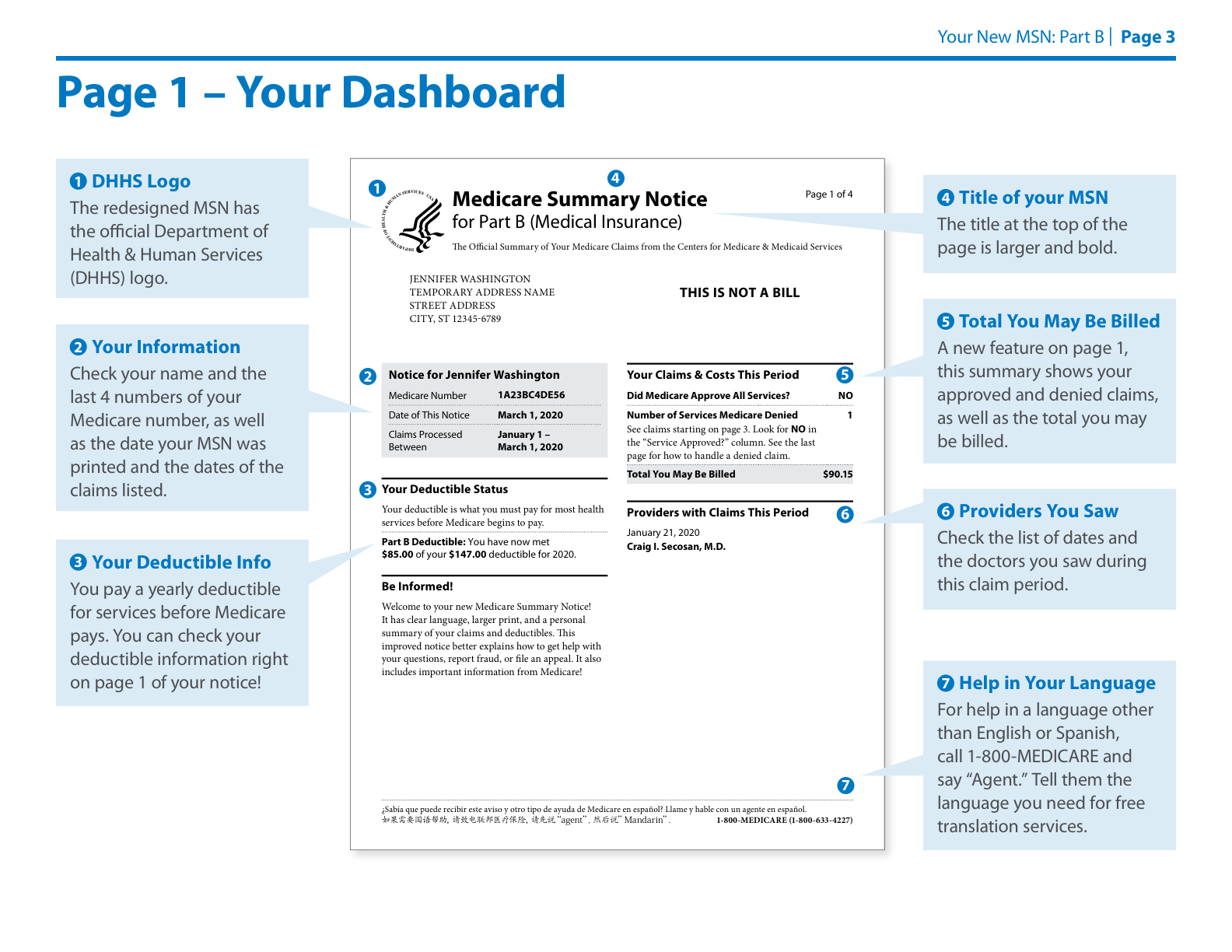
CMS also shares a sample Explanation of Benefits with the parts labeled, so you can hold it next to your own and see where each number belongs.
- Explanation of Benefits
- a summary your plan sends after a visit to show how a claim was handled; it is not a bill
- Allowed amount
- the lower price your plan and the provider agreed on
- Denial
- a letter saying the plan will not cover a service, or will cover only part of it
- Internal appeal
- asking your own plan to look at the decision again
- External review
- an independent reviewer outside the plan takes a fresh look and has the final say
- Prior authorization
- the plan's approval before you get a service
- Balance billing
- when a provider bills you for the leftover amount after your plan pays; not allowed in protected situations
- Grievance
- a complaint about how you were treated, such as a long wait or poor care
Denial letters: you can appeal
Sometimes a plan sends a letter saying it will not cover a service, or will only cover part of it. This is a denial. A denial is not the end. You have the right to appeal, which means asking the plan to look again (HealthCare.gov).
First, find the reason. The letter must say why the plan said no. Most denials come down to a few common reasons, and one of them should be printed in the letter (CMS):
- Not medically necessary. The plan decided the care was not needed, or not needed in that form. A letter from your doctor saying why you need it is the strongest answer to this.
- Out of network. The provider is not on your plan’s list of approved providers.
- Prior authorization required. The service needed the plan’s approval before you got it, and that approval was not on file.
- Not a covered benefit. The plan says this service is not included in your coverage.
You can appeal any of these. There are two steps, and you move through them one at a time: an internal appeal, where your own plan takes a full, fair second look; and, if that fails, an external review, where an independent reviewer outside the plan looks with fresh eyes. At the external stage, the insurance company no longer gets the final say.
The appeal clock: dates that matter
Denial letters run on a clock. If you miss a deadline, you can lose the chance to appeal, so act as soon as the letter arrives. Keep the denial letter and your EOB together in one place.
Filing your internal appeal. You usually have 180 days, about six months, from the date on the denial notice to ask your plan for an internal appeal (HealthCare.gov).
How fast the plan must answer. Once you file, your plan has a set time to decide:
- 30 days if the care is something you have not gotten yet, so you are asking before the service.
- 60 days if the care already happened and the question is about payment.
- For urgent cases you can ask for a faster “expedited” appeal. The plan must decide as quickly as your health requires, and at least within 4 business days (HealthCare.gov).
External review, if the plan still says no. You must send a written request for an external review within 4 months of the date on the final denial notice. A standard external review is decided as soon as possible and no later than 45 days after you ask; an urgent one no later than 72 hours (HealthCare.gov). The outside reviewer has the final say, and if they side with you, the plan must cover the care or pay the claim. If your case is urgent, you can ask for the external review at the same time as the internal appeal, so you do not have to wait for one to finish.
What to put in your appeal
Keep it simple and complete. In a written appeal, include your name, your health plan ID number, and the claim number from the denial letter or EOB. Say plainly that you are appealing, and what you want covered. Add anything that supports you, especially a short letter from your doctor explaining why the care is needed (CMS).
Make a copy of everything before you send it. Keep the denial letter, your EOB, the appeal you wrote, and any doctor’s letter together in one folder. If you mail it, keep the receipt; if you send it online or by fax, save the confirmation. You may need to show later that you filed on time.
- Your name, your health plan ID number, and the claim number from the denial letter or EOB.
- A plain statement that you are appealing and what you want covered.
- A short letter from your doctor explaining why the care is needed.
- A copy of everything, kept together, plus your mailing receipt or online confirmation.
Free help with an appeal
You do not have to do this alone, and help is free. Many states run a Consumer Assistance Program (CAP) that will explain your rights and can even file an appeal for you. If your state does not have one, your state Department of Insurance can help (HealthCare.gov; CMS).
A clinic financial counselor, a community health worker, or the Marketplace Call Center at 1-800-318-2596 (TTY 1-855-889-4325) can also walk you through it (HealthCare.gov). Ask for a free interpreter in your language; that is your right.
Prior authorization: a yes before your care
Some services need the plan’s approval before you get them. This is called prior authorization. It is sometimes written as preauthorization, prior approval, or precertification, and it all means the same thing: the plan agrees ahead of time that the care is covered (HealthCare.gov).
You may get a letter saying a service was approved, or that it needs prior authorization first. If a service you need requires it, ask your doctor’s office to send the request to your plan and to include why the care is necessary. If prior authorization is denied, that denial can be appealed in the same way as any other denial, using the steps above.
Surprise bills: the No Surprises Act
A federal law called the No Surprises Act protects you from many surprise bills. In most emergencies, and when an out-of-network provider treats you at an in-network hospital or clinic, you cannot be charged more than your normal in-network share (CMS). Emergency care is covered as if it were in-network, and no prior authorization is needed for it.
“Balance billing” is when a provider bills you for the leftover amount after your plan pays its part. In these protected situations, that is not allowed. So if you get a bill that looks like a surprise, do not assume you owe it. You can call the free No Surprises Help Desk at 1-800-985-3059, open 7 days a week, with help in more than 350 languages (CMS).
In these protected situations, balance billing is not allowed. If a bill looks like a surprise, do not assume you owe it; call the free No Surprises Help Desk at 1-800-985-3059.
Grievance or appeal: which one to file
These two words sound alike but do different jobs. An appeal challenges a coverage or payment decision, like a denial. A grievance is a complaint about how you were treated, such as a long wait, rude service, or poor quality of care. If the problem is that the plan said no to a service, you file an appeal; if the problem is how the plan or a provider behaved, you file a grievance (Medicare.gov).
| Which to file | What it is for |
|---|---|
| Appeal | Challenges a coverage or payment decision, like a denial; file this when the plan said no to a service. |
| Grievance | A complaint about how you were treated, such as a long wait, rude service, or poor quality of care; file this when the problem is how the plan or a provider behaved. |
Coverage and approval letters
Other letters confirm good news: that you are enrolled, what your plan covers, your member ID number, and the dates your coverage starts and ends. These are worth keeping in a safe folder. You may need the member ID when you book an appointment or pick up medication.
If you have Medicare: the Medicare Summary Notice
If you have Original Medicare, your version of the EOB is called the Medicare Summary Notice (MSN). Like an EOB, the MSN is not a bill. It lists the Part A and Part B services that were billed to Medicare, what Medicare paid, and what you may owe. Medicare mails it at least twice a year when you have used services, and you can also choose to get it electronically (Medicare.gov). The MSN also shows the deadline to appeal if you disagree with a decision. For questions, call 1-800-MEDICARE (1-800-633-4227, TTY 1-877-486-2048) (Medicare.gov).
When a word does not make sense
Insurance uses many special words. The government keeps a free Glossary of Health Coverage and Medical Terms, also called the Uniform Glossary, that explains terms like deductible, copay, and coinsurance in plain language. You can also ask your plan to send you a copy. If you are unsure how a charge was figured out, MedlinePlus has a short page on understanding your hospital bill.
Let LINC help, and confirm the big things with a person
You can use Ask Chatbot to photograph one of these letters and get a plain-language explanation of what it means. The chatbot is an AI reading, so it can be wrong. For anything high-stakes, like filing an appeal, paying a confusing bill, or any insurance decision, confirm it with a community health worker, a clinic financial counselor, or the number printed on the letter, with a qualified interpreter if you need one.
Sources
- Centers for Medicare & Medicaid Services. Call the No Surprises Help Desk. https://www.cms.gov/medical-bill-rights/help/plan/call-help-desk.
- Centers for Medicare & Medicaid Services. Consumer Assistance Program. https://www.cms.gov/cciio/resources/consumer-assistance-grants.
- Centers for Medicare & Medicaid Services. Has your health insurer denied payment for a medical service? You have a right to appeal. https://www.cms.gov/cciio/resources/fact-sheets-and-faqs/appeals06152012a.
- Centers for Medicare & Medicaid Services. How to read an explanation of benefits. https://www.cms.gov/medical-bill-rights/help/guides/explanation-of-benefits.
- Centers for Medicare & Medicaid Services. No Surprises: understand your rights against surprise medical bills. https://www.cms.gov/newsroom/fact-sheets/no-surprises-understand-your-rights-against-surprise-medical-bills.
- Centers for Medicare & Medicaid Services. Reading your Explanation of Benefits (sample EOB, annotated). https://www.cms.gov/files/document/11819-sample-explanation-benefits-508.pdf.
- HealthCare.gov. Contact us. https://www.healthcare.gov/contact-us/.
- HealthCare.gov. External review. https://www.healthcare.gov/appeal-insurance-company-decision/external-review/.
- HealthCare.gov. Glossary of Health Coverage and Medical Terms (Uniform Glossary). https://www.healthcare.gov/sbc-glossary/.
- HealthCare.gov. How can I get consumer help if I have insurance? https://www.healthcare.gov/how-can-i-get-consumer-help-if-i-have-insurance/.
- HealthCare.gov. How to appeal an insurance company decision. https://www.healthcare.gov/appeal-insurance-company-decision/.
- HealthCare.gov. Internal appeals. https://www.healthcare.gov/appeal-insurance-company-decision/internal-appeals/.
- HealthCare.gov. Prior authorization (glossary). https://www.healthcare.gov/glossary/prior-authorization/.
- Medicare.gov. Contact Medicare. https://www.medicare.gov/about-us/contact-medicare.
- Medicare.gov. Filing a complaint (grievance) about your quality of care. https://www.medicare.gov/claims-appeals/file-a-complaint-grievance/filing-a-complaint-about-your-quality-of-care.
- Medicare.gov. Medicare Summary Notice (MSN). https://www.medicare.gov/basics/forms-publications-mailings/mailings/costs-and-coverage/medicare-summary-notice.
- MedlinePlus (U.S. National Library of Medicine). Understanding your hospital bill. https://medlineplus.gov/ency/patientinstructions/000881.htm.
LINC is a research prototype, not a medical or legal service. Translation can be wrong; you have the right to a free, qualified interpreter. For anything high-stakes, do it with a community health worker or someone you trust. In a crisis, call or text 988, or 911 for immediate danger.