Informed consent means you have the legal right to understand your treatment fully before you agree to it. The provider must explain what they plan to do, why, what the risks are, and what other options exist. You can ask questions, take time to think, or say no to a treatment you are not ready for.
At your first mental health visit, the front desk will hand you a small stack of forms to fill out and sign. This is normal, and you are allowed to take your time. This guide explains the most common forms, what each one means, and your right to understand a form before you sign it.
- Expect a few forms: an intake form, an informed consent, a Notice of Privacy Practices, and maybe a release of information.
- You have the right to a free interpreter and translated forms before you sign. Never sign a blank form or one you do not understand.
- Take your time, ask what each form is for, and keep a copy of everything you sign.
- Intake form
- collects your basic information, such as your name, insurance, and the reason for your visit; also called a registration form
- Informed consent
- your right to understand your treatment and agree to it before it begins
- Notice of Privacy Practices
- explains how the clinic may use and share your health information; you sign only to confirm you received it
- Release of Information
- lets the clinic share your records with a person or place you name; it is your choice and you can cancel it
- HIPAA
- a federal law that limits how your health information is shared and gives you rights over your own records
- Psychotherapy notes
- mental health notes with extra protection; a provider usually needs your specific permission to share them
- Good Faith Estimate
- a written estimate of what your care will cost before you get it, if you are paying yourself
- Screening questionnaire
- a short form about how you have felt lately; it helps the provider but is not a diagnosis
The intake or registration form
The intake form (sometimes called a registration form) collects your basic information. Most intake forms ask for the same kinds of things, so it helps to know them before you go:
- Your name, date of birth, address, and phone number.
- Insurance details, or a note that you will pay yourself. It helps to bring your insurance card and a photo ID.
- An emergency contact. This is a person the clinic can call if something happens to you during your care.
- A short health history: past and current illnesses, surgeries, and any mental health care you have had before.
- The medicines you take, with the dose if you know it. You can bring the bottles or take photos of the labels.
- Any allergies.
- The reason for your visit, in a few words. You can keep this short.
It is okay to ask for help filling it out, and it is okay to ask why a piece of information is needed. If a question does not apply to you, or you are not ready to answer it, you can leave it blank and ask the staff. Nothing bad happens for asking.
The informed consent form
Informed consent means you have the right to understand your condition and your treatment choices, and to agree to care before it begins. Before you sign, the provider should explain the purpose of the treatment, its benefits, its risks, and any other options you have. You are allowed to ask questions and to take time to think. The U.S. government’s MedlinePlus has a clear page on informed consent for adults that describes what you should expect to be told. Giving consent is your decision, and you can change your mind.
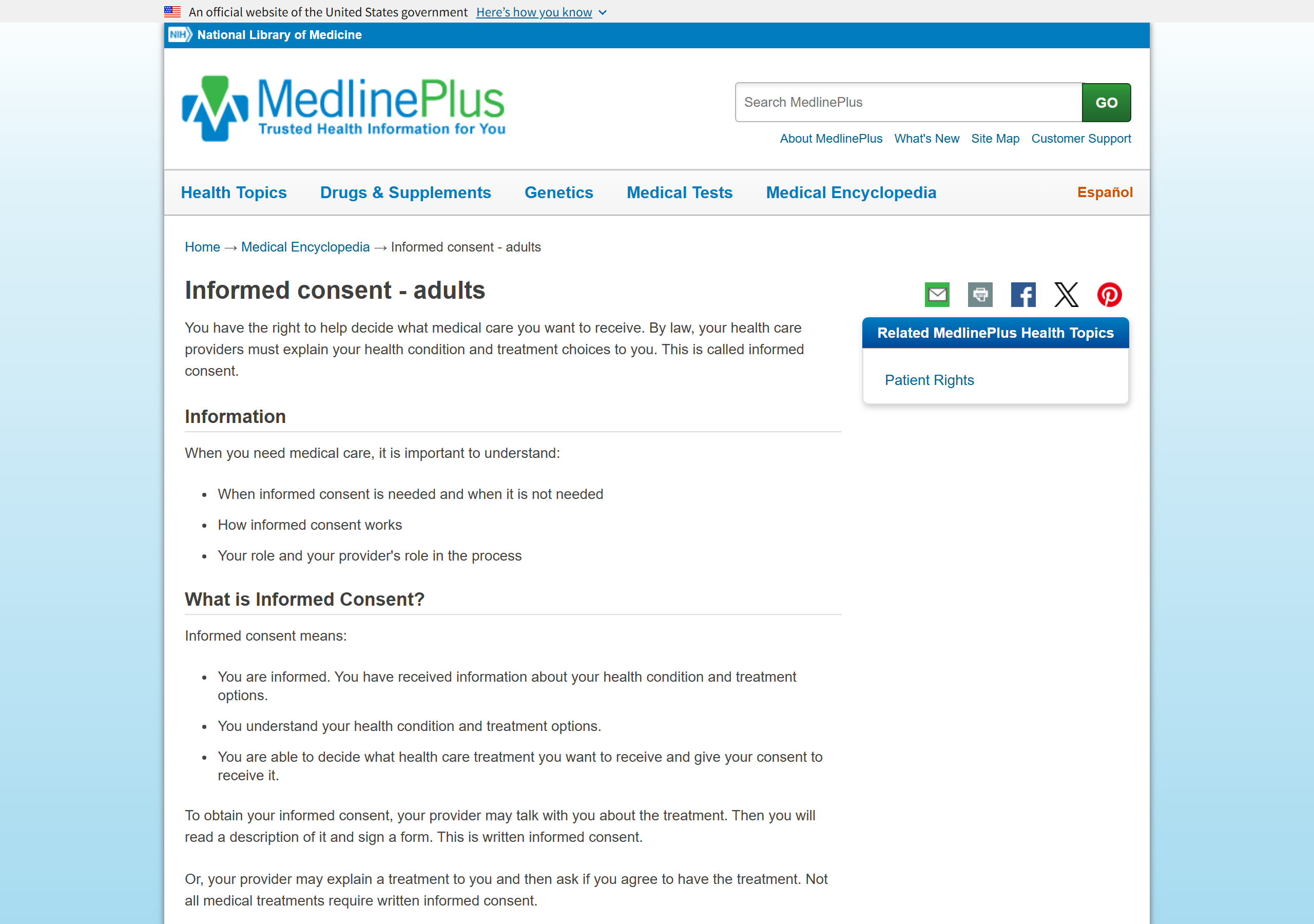
A written consent form usually puts these things on paper for you to read and sign:
- What the treatment is and what will happen, for example talk therapy, medicine, or both.
- The expected benefits and the possible risks or side effects.
- Other choices you have, including the choice to wait or to do nothing for now.
- Your right to ask questions, say no, or stop treatment later, even after you sign.
- How your information is kept private, and the few situations where it may be shared. Those limits are explained further below.
Consent is not one signature that lasts forever. You give it step by step, and you can change your mind at any point.
Consent is not one signature that lasts forever. You can ask questions, take time to think, say no, or stop treatment later, even after you sign.
The Notice of Privacy Practices
The Notice of Privacy Practices explains how the clinic may use and share your health information and lists your privacy rights under a federal law called HIPAA. You usually sign a paper that says you received this notice. Signing it does not give away your rights; it only confirms that the clinic gave you the notice. You can read more on the HHS page about your rights under HIPAA.
HIPAA does more than limit how the clinic shares your information. It also gives you rights over your own records. You have the right to see and get a copy of your health records, including your medical, billing, and test information. When you ask in writing, the clinic must usually give you the copy within 30 days. They can take one more 30-day period, but only if they tell you in writing why they need it. You can also ask them to fix information that is wrong, such as a wrong birth date or a mistake in your history. You can read more on the HHS page about your right to access your health information.
HIPAA gives you the right to see and get a copy of your health records, usually within 30 days of a written request, and to ask the clinic to fix information that is wrong.
The limits of privacy your provider should explain
What you tell a mental health provider is private. Even so, there are a few narrow situations where the law lets or requires a provider to share, and a good provider will explain these to you before you start. Knowing them ahead of time can make it easier to speak openly.
- If a provider believes there is a serious and imminent threat to your safety or someone else’s, HIPAA lets them warn the people who can help prevent harm, such as family or emergency services (HHS).
- Health workers are usually required by state law to report a reasonable suspicion that a child, an older adult, or a vulnerable adult is being abused or neglected.
- A court can order records through a legal process.
These limits exist to keep people safe, and they are narrow. They do not mean a provider will share your story with your family, your employer, or immigration. If privacy worries you, it is completely fair to ask, “Who will see this, and when would you ever have to share it?” The National Institute of Mental Health lists this as a normal question to ask a new therapist: are there limits to confidentiality? (NIMH).
Extra protection for substance use treatment records
If your care includes treatment for alcohol or drug use, those records get an extra layer of federal protection beyond HIPAA, under a rule called 42 CFR Part 2. In general, a program cannot share these records without your written permission, with only narrow exceptions such as a medical emergency. Your substance use treatment information is held more tightly than most other health information (SAMHSA).
The release of information form
A Release of Information, or authorization, lets the clinic share your records with a person or place you name, such as another doctor or a family member. This is your choice. You decide who receives your information and what they may see, and you can cancel the release later. Mental health records and psychotherapy notes get extra protection, so a provider usually needs your specific permission to share them, even with another provider.
It is fine to make a release narrow. You can name exactly who receives it, list what they may see, say why, and set an end date. You can also cancel (revoke) a release later. Put it in writing, date it, give it to the clinic, and keep a copy. One thing to understand: canceling stops future sharing, but it cannot undo information that was already sent while the release was active (HHS).
Screening questionnaires you may be asked to fill out
At intake you may be handed one or more short questionnaires that ask how you have felt over the past one or two weeks. These are screening tools, and they are a normal part of a first visit. One common form, the PHQ, asks about signs of depression; another, the GAD, asks about anxiety. You mark how often you have felt each thing, from “not at all” to “nearly every day.” Some forms also ask a direct question about thoughts of hurting yourself. Answering that honestly helps the provider keep you safe.
Two things help here:
- Answer honestly and completely. Honest answers help the provider understand what you are going through and how to help (MedlinePlus).
- A screen is not a diagnosis. A high score does not by itself mean you have a disorder. It only tells the provider whether to look more closely. If a screening shows signs of a disorder, more testing is usually needed to diagnose a specific condition, and there is no single lab test that diagnoses depression (MedlinePlus).
Other forms you might be given
Depending on the clinic and how you pay, you may also see:
- A Good Faith Estimate. If you do not have insurance, or you choose not to use it, the clinic must give you a written estimate of what your care will likely cost before you get it. You can ask for one, and you should get it when you schedule at least a few business days ahead. It is an estimate, not a bill. If your final bill ends up at least $400 more than the estimate, you can dispute it, and you have 120 days from the bill to start (CMS).
- A financial responsibility form. This says you agree to pay any part of the cost your insurance does not cover, such as a copay. It is fair to ask what you are likely to owe before you sign.
- A telehealth consent. If you will meet the provider by video or phone, you may sign a form that says you agree to care this way and understand how it works. You can still ask for a free interpreter for a telehealth visit.
If the forms are for a child or a teen
If you are signing for your child, a parent or legal guardian usually gives consent. For teenagers, the rules about who must agree, and what can stay private between the teen and the provider, can differ from state to state, especially for mental health and substance use care. If this matters to your family, ask the clinic to explain how it works where you live, with an interpreter.
Your right to understand before you sign
You have the right to read these forms in a language you understand. Under Section 1557 of the Affordable Care Act, you can ask for the forms to be translated and for a qualified interpreter to go through them with you, at no cost to you. Do not sign anything you do not understand. Ask the staff to wait while an interpreter is arranged. Once you have signed, ask for a copy of every form to keep for yourself.
Let LINC help, and sign the real thing with a person
You can use Ask Chatbot to photograph a blank or sample form and get a plain-language explanation of what it is asking. The chatbot is an AI reading, so it can be wrong. For your own forms, especially a consent or a release of information, sign them with a community health worker or someone you trust present, and with a qualified interpreter, so you can confirm anything important before you put your name on it.
A quick checklist before you sign
These are your rights as a patient, and using them is normal and expected (MedlinePlus). Before you sign any form, run through this short list:
- Read it in your language; ask for a translated form and a free interpreter.
- Ask what each form is for: "What am I signing, and why?"
- Never sign a blank form or one with empty spaces someone can fill in later.
- Take your time; you can say, "I would like to read this first."
- Ask before you share; you choose who sees your records, and you can say no.
- Ask about privacy limits: "Who sees this, and when might you ever have to share it?"
- Answer screening questions honestly; a screen is not a diagnosis.
- Keep a copy of everything you sign, and store it with your other papers.
If anything feels rushed or unclear, it is fine to pause. You can always say, “I am not ready to sign this yet.”
Sources
- Centers for Medicare & Medicaid Services. Know your rights: Without insurance (good faith estimates). https://www.cms.gov/medical-bill-rights/know-your-rights/no-insurance.
- HHS Office for Civil Rights. Authorizations (Frequently Asked Questions). https://www.hhs.gov/hipaa/for-professionals/faq/authorizations/index.html.
- HHS Office for Civil Rights. Individuals’ Right under HIPAA to Access their Health Information. https://www.hhs.gov/hipaa/for-professionals/privacy/guidance/access/index.html.
- HHS Office for Civil Rights. Information Related to Mental and Behavioral Health, including Opioid Overdose. https://www.hhs.gov/hipaa/for-professionals/special-topics/mental-health/index.html.
- HHS Office for Civil Rights. Section 1557: Ensuring Meaningful Access for Individuals with Limited English Proficiency. https://www.hhs.gov/civil-rights/for-individuals/section-1557/fs-limited-english-proficiency/index.html.
- HHS Office for Civil Rights. Your Rights Under HIPAA. https://www.hhs.gov/hipaa/for-individuals/guidance-materials-for-consumers/index.html.
- MedlinePlus (U.S. National Library of Medicine). Depression screening. https://medlineplus.gov/lab-tests/depression-screening/.
- MedlinePlus (U.S. National Library of Medicine). Informed consent - adults. https://medlineplus.gov/ency/patientinstructions/000445.htm.
- MedlinePlus (U.S. National Library of Medicine). Mental health screening. https://medlineplus.gov/lab-tests/mental-health-screening/.
- MedlinePlus (U.S. National Library of Medicine). Patient rights. https://medlineplus.gov/patientrights.html.
- National Institute of Mental Health. Psychotherapies. https://www.nimh.nih.gov/health/topics/psychotherapies.
- Substance Abuse and Mental Health Services Administration. Substance Use Disorders: Statutes, Regulations, and Guidelines. https://www.samhsa.gov/substance-use/treatment/statutes-regulations-guidelines.
LINC is a research prototype, not a medical or legal service. Translation can be wrong; you have the right to a free, qualified interpreter. For anything high-stakes, do it with a community health worker or someone you trust. In a crisis, call or text 988, or 911 for immediate danger.