Costs, coverage, and eligibility vary by plan and by state, and the rules change. Use this as a general guide, and confirm the details with your insurance plan, the clinic, or a community health worker before you rely on them.
A CMHSP (Community Mental Health Services Program) is the public mental health office for your county in Michigan. It is the main place for people without insurance or with Medicaid to start getting mental health care, and you can call yours directly to ask for a screening without needing a doctor to send you.
The U.S. mental health system is really fifty state systems, so the best way to understand how care works is to look at one real state. This guide uses Michigan, the state where LINC is starting. It shows you who runs public mental health care here, the main door to walk through, who pays, and how to find help near you. The names and structure below are Michigan’s; another state will organize and label the same ideas differently, so read this as a worked example, not a national map.
- Public mental health care runs through your county CMHSP, the single door in; you can call it directly, with no doctor's referral.
- No one can be turned away because they cannot afford to pay.
- For a crisis, call or text 988; to find services near you, call 211.
Who runs the system: MDHHS
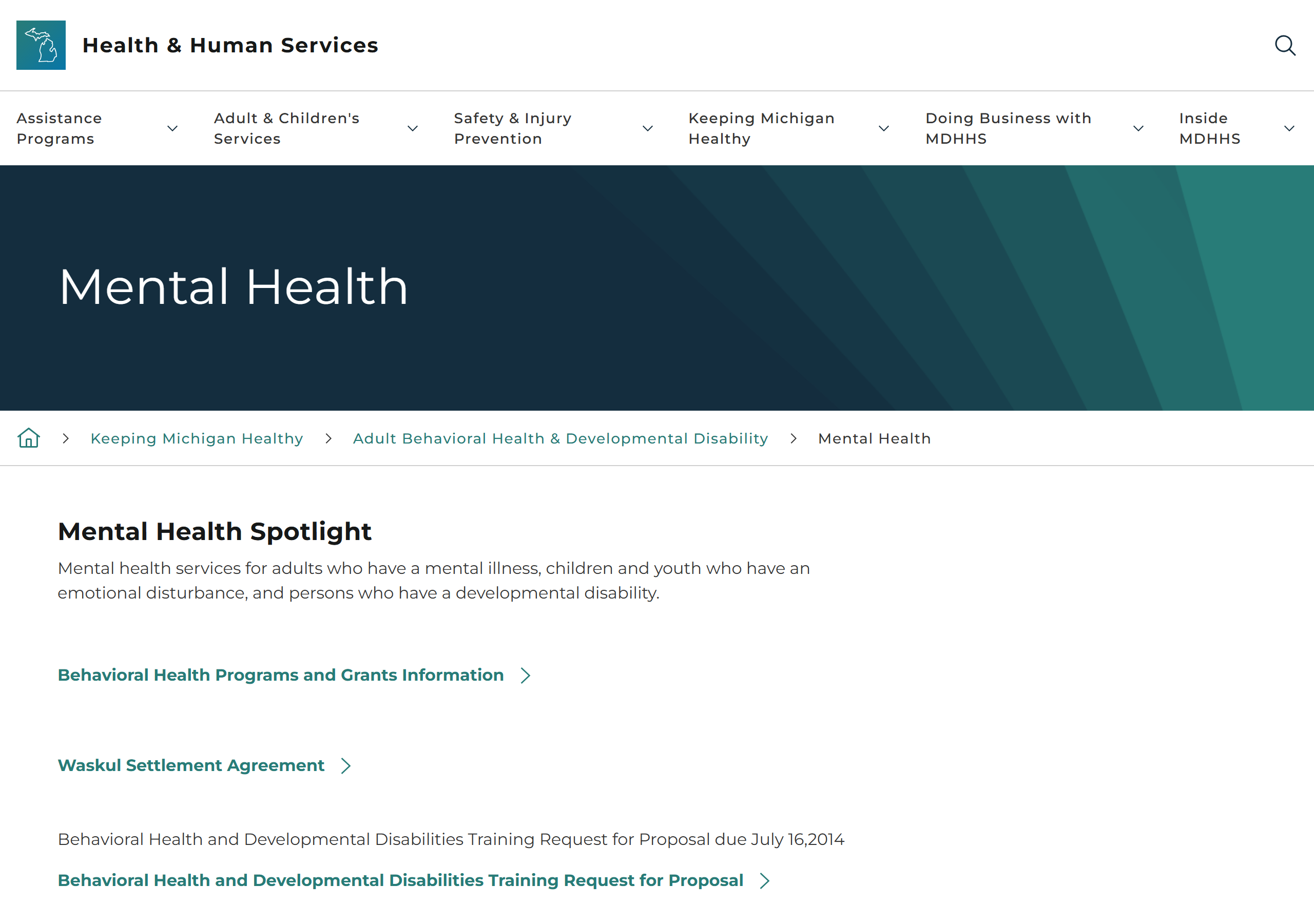
In Michigan, the public behavioral health system is run by the Michigan Department of Health and Human Services (MDHHS). Its mental health office describes its job plainly: services for adults who have a mental illness, children and youth who have an emotional disturbance, and people who have a developmental disability. MDHHS sets the rules and funds the local programs that actually see people.
The main door: your county CMHSP
The clearest place to start is your local Community Mental Health Services Program (CMHSP). As MDHHS puts it, “Mental health services in Michigan are coordinated through local Community Mental Health Services Programs.” A CMHSP is the public mental health authority for your county. It is a main door for people living with serious mental illness, for people who have Medicaid, and for people who have no insurance at all. Each county has one, and you can look up yours on the state’s Local Mental Health Services / CMHSP contact list. You can call your CMHSP directly to ask for a screening and to start care; you do not need a doctor’s referral first.
Michigan has 46 CMHSPs, and together they cover all 83 counties, so there is one for wherever you live (Community Mental Health Association of Michigan). Your CMHSP is the single door into the public mental health system, which means this is where an adult with a serious mental illness, a child or teen with a serious emotional problem, or a person with a developmental disability is meant to start (Community Mental Health Association of Michigan). Two things are worth knowing before you call. No one can be turned away because they cannot afford to pay. And when more people need help than there are open spots, the most serious situations and true emergencies are helped first, so it helps to be honest about how hard things have gotten (Disability Rights Michigan).
Behind the scenes, Michigan groups its 46 CMHSPs into 10 regions, each managed by a Prepaid Inpatient Health Plan (PIHP) (Disability Rights Michigan). A PIHP is the regional entity that manages Medicaid specialty behavioral health and oversees the network of providers, including the CMHSPs. You usually will not contact a PIHP yourself; this is mostly the plumbing that decides which providers your Medicaid coverage pays for. (MDHHS is updating how these regions are run, so the regional map may shift over time.)
What to expect when you call your CMHSP
The first call does not commit you to anything. It usually leads to a short screening, by phone or in person, to understand what kind of help fits you. A little preparation makes it go smoothly.
- Your name, address, and county.
- Your Medicaid or insurance ID, if you have one; if you have none, say so and you can still be served.
- A few words about what has been hard lately, such as sleep, mood, worry, or a recent crisis.
You can use these exact sentences:
"I would like to ask for a mental health screening."
"I need a free interpreter in [your language], please."
"I do not have insurance. What are my options?"
It is fair to ask the person on the phone: How long is the wait for a first appointment? Is there a cost, and is it based on my income? Can the first visit be by phone or video? If you feel unsafe or in danger while you wait, say so clearly, because crises are handled right away, not put on a waitlist.
The screening is mostly questions to understand your situation and to figure out what level of care fits. After it, one of a few things happens. If the CMHSP is the right place for you, they schedule your services, which may include talk therapy, a psychiatrist for medicine, case management, peer support, or a group. If your needs are a better match somewhere else, such as a community health center or a private therapist, they should tell you where to go.
If you are told there is a wait, you still have moves. Ask to be put on a cancellation list so you can take an earlier opening. Ask if there is a walk-in or same-day option nearby, or a Certified Community Behavioral Health Clinic, described under Who pays below. You can also call 211 or ask a community health worker to look for another opening while you wait. And if you begin to feel unsafe at any time, call or text 988; a crisis is helped right away.
If you are in crisis
Call or text 988 any time to reach the Michigan Crisis and Access Line (MiCAL), day or night. For immediate physical danger, call 911.
For any mental health crisis, call or text 988. In Michigan, 988 calls are answered by the Michigan Crisis and Access Line (MiCAL), the statewide crisis and access line, which answers calls day and night and connects you to local help. Your county CMHSP also runs a local crisis line and, in many areas, a mobile crisis team that can come to you. For immediate physical danger, call 911.
Who pays
Two situations cover most people.
If you have Michigan Medicaid or the Healthy Michigan Plan (Michigan’s Medicaid expansion for adults with low income), your CMHSP and its network provide behavioral health care at no or low cost. The Healthy Michigan Plan covers adults ages 19 to 64 whose income is at or below 138 percent of the federal poverty level (HealthInsurance.org). In 2026 that is roughly $22,000 a year for one person, or about $45,500 a year for a family of four, and there is no asset test, so your savings do not count (CheckMedicaid). Children can often qualify with higher family income than adults, through regular Medicaid or MIChild (HealthInsurance.org). You can apply any time through MI Bridges or learn more on the Michigan Medicaid page; a decision usually comes within about 45 days (Washtenaw Health Project).
If you are uninsured, you still have real options. CMHSPs serve people without insurance, and community health centers charge on a sliding scale based on your income. A Certified Community Behavioral Health Clinic (CCBHC) is another strong choice; these clinics must offer services to anyone who asks, no matter your ability to pay or where you live, and they include 24-hour crisis help (Southwest Michigan Behavioral Health; National Council for Mental Wellbeing). Michigan takes part in the national CCBHC program, so ask your CMHSP or call 211 to find out if there is one near you.
And by law, emergency care is for everyone, regardless of insurance or immigration status. If your immigration status keeps you from full Medicaid, you may still qualify for Emergency Services Only Medicaid, which is free and covers a real emergency (Washtenaw Health Project); there is more on this in the section below. For more on cost, see Understand cost and insurance.
How to find local services
A few reliable starting points:
- The MDHHS mental health site and your county CMHSP (use the contact list above).
- FindTreatment.gov, the federal locator for mental health and substance use care.
- A community health center near you, found at findahealthcenter.hrsa.gov; these serve everyone and offer interpreters.
- Michigan 211, a free, confidential help line. Dial 211 or call 1-844-875-9211 any time, and staff can look up mental health services, food, housing, and more near you, with help in over 180 languages. They are not counselors, so for a crisis call or text 988 instead.
- A community health worker, a trusted person who can help you navigate your local CMHSP and the paperwork. Michigan supports community health workers through the MiCHWA registry, and since January 2024 Michigan Medicaid reimburses their services. In LINC, a community health worker works alongside the AI assistant.
Your right to language help
At every step, from the first phone call to the visit, you have the right to free language help. The federal rule, Section 1557 of the Affordable Care Act, applies in Michigan and requires health programs that receive federal funding to offer a free, qualified interpreter. Michigan Medicaid may also reimburse providers for interpreter services. You should never have to bring your own translator or rely on a child. See Your right to an interpreter.
Remember: this is Michigan
Everything above is how Michigan is built. Another state will use different names, a different front door, and different eligibility rules. To see the same ideas in a different state, read Mental health programs, explained (a New York example), and for the big picture, How mental health care works in the United States. When a rule depends on your state or your situation, a community health worker can help you check it against your local CMHSP instead of guessing.
If you are an immigrant or have no legal status
Being an immigrant, or having no legal status, does not close every door. Some things are true no matter your status.
- In a mental health emergency, you can call or text 988, and you can go to any emergency room; by law, emergency care is for everyone.
- If your immigration status keeps you out of full Medicaid, you may still qualify for Emergency Services Only Medicaid. It is free, you apply through MI Bridges like any Medicaid, and it pays for a true emergency such as an emergency room visit (Washtenaw Health Project). It does not pay for ongoing therapy, but it can cover a crisis.
- Children and pregnant women can often get more coverage than other adults, through regular Medicaid or MIChild (HealthInsurance.org).
- Community health centers and Certified Community Behavioral Health Clinics serve you no matter your ability to pay (Southwest Michigan Behavioral Health).
The rules about who can get public coverage do change, and they can be confusing. Do not guess, and do not give up because of a rumor. A community health worker, a community health center, or a nonprofit legal aid group can check the current rules for your exact situation, and you can start by calling Michigan 211. If you are worried that using health coverage could affect your immigration case, ask a nonprofit legal aid group first; that advice is usually free and confidential.
Your rights once you are getting care
Once you are in the public mental health system, you have legal rights the staff must respect. They come from Michigan’s Mental Health Code, and each CMHSP has an Office of Recipient Rights whose whole job is to protect them (Disability Rights Michigan). Your rights include being treated with dignity and respect, having your privacy and records protected, being free from discrimination, and being safe from abuse and neglect. You also have the right to use this rights system without anyone punishing you for it (Community Mental Health for Central Michigan).
If you feel a right has been broken, you can file a complaint. You can do it out loud or in writing, someone can help you or do it for you, and every CMHSP has a Rights Officer you can ask for (Community Mental Health for Central Michigan). Asking for a free interpreter is part of this too, because you cannot use a right you were never able to understand. If you are not sure how to start, a community health worker can walk through it with you.
Sources
- CheckMedicaid. Michigan Medicaid Income Limits in 2026 (Healthy Michigan Plan). https://checkmedicaid.com/michigan-medicaid-income-limit/.
- Community Mental Health Association of Michigan (CMHAM). CMHSP Directory. https://cmham.org/membership/cmhsp-directory/.
- Community Mental Health for Central Michigan (CMHCM). Recipient Rights. https://www.cmhcm.org/resources/rights.html.
- Disability Rights Michigan. Community Mental Health. https://www.drmich.org/resources/community-mental-health/.
- Health Resources and Services Administration (HRSA). Find a Health Center. https://findahealthcenter.hrsa.gov/.
- HealthInsurance.org. Medicaid eligibility and enrollment in Michigan. https://www.healthinsurance.org/medicaid/michigan/.
- HHS Office for Civil Rights. Section 1557 of the Affordable Care Act. https://www.hhs.gov/civil-rights/for-individuals/section-1557/index.html.
- MI Bridges (State of Michigan). Apply for Benefits. https://newmibridges.michigan.gov/.
- Michigan 211. About 2-1-1. https://mi211.org/about-2-1-1.
- Michigan Department of Health and Human Services (MDHHS). 988 Suicide & Crisis Lifeline and Michigan Crisis and Access Line (MiCAL). https://www.michigan.gov/mdhhs/keep-mi-healthy/mentalhealth/crisis-and-access-line.
- Michigan Department of Health and Human Services (MDHHS). Community Health Workers (Medicaid reimbursement; MiCHWA registry). https://www.michigan.gov/mdhhs/assistance-programs/medicaid/community-health-workers.
- Michigan Department of Health and Human Services (MDHHS). Community Mental Health Services Programs (CMHSPs). https://www.michigan.gov/mdhhs/keep-mi-healthy/mentalhealth/mentalhealth/cmhsp.
- Michigan Department of Health and Human Services (MDHHS). Healthy Michigan Plan. https://www.michigan.gov/mdhhs/assistance-programs/healthcare/healthymichigan.
- Michigan Department of Health and Human Services (MDHHS). Local Mental Health Services / CMHSP Contact List. https://www.michigan.gov/mdhhs/keep-mi-healthy/mentalhealth/mentalhealth/cmhsp/local-mental-health-services.
- Michigan Department of Health and Human Services (MDHHS). Medicaid. https://www.michigan.gov/mdhhs/assistance-programs/medicaid.
- Michigan Department of Health and Human Services (MDHHS). Mental Health. https://www.michigan.gov/mdhhs/keep-mi-healthy/mentalhealth/mentalhealth.
- Michigan Department of Health and Human Services (MDHHS). Specialty Behavioral Health Services (PIHPs). https://www.michigan.gov/mdhhs/keep-mi-healthy/mentalhealth/specialty-behavioral-health-services.
- National Council for Mental Wellbeing. CCBHC Locator. https://www.thenationalcouncil.org/program/ccbhc-success-center/ccbhc-locator/.
- Southwest Michigan Behavioral Health (SWMBH). Certified Community Behavioral Health Clinic (CCBHC) Services. https://www.swmbh.org/certified-community-behavioral-health-clinic-services/.
- Substance Abuse and Mental Health Services Administration (SAMHSA). FindTreatment.gov. https://findtreatment.gov/.
- Washtenaw Health Project. Medicaid for Emergencies (Emergency Services Only). https://washtenawhealthproject.org/medicaid-for-emergencies/.
LINC is a research prototype, not a medical or legal service. Translation can be wrong; you have the right to a free, qualified interpreter. For anything high-stakes, do it with a community health worker or someone you trust. In a crisis, call or text 988, or 911 for immediate danger.