Costs, coverage, and eligibility vary by plan and by state, and the rules change. Use this as a general guide, and confirm the details with your insurance plan, the clinic, or a community health worker before you rely on them.
An EAP (Employee Assistance Program) is a free, confidential benefit some employers offer that gives you a few counseling sessions with a licensed professional. Your employer is not told that you called or what you discussed. Many EAPs also cover members of your household and offer phone interpreters so you can speak in your own language.
If you have a job in the United States, your work may already offer ways to get mental health care that you have not used, because no one tells most people about them. This guide covers three worth asking about: free counseling through an Employee Assistance Program, mental health coverage through your job’s health insurance, and time off that protects your job. These are work benefits you are entitled to use, and using them does not put your job at risk.
- An EAP gives free, confidential counseling sessions, and your employer is not told that you called.
- Your job's health insurance must cover mental health care about the same as physical care under federal parity law.
- FMLA lets eligible workers take up to 12 weeks of unpaid, job-protected leave for a mental health condition.
- To use any of these, ask HR; you do not need to share your diagnosis.
Free, confidential counseling through an EAP
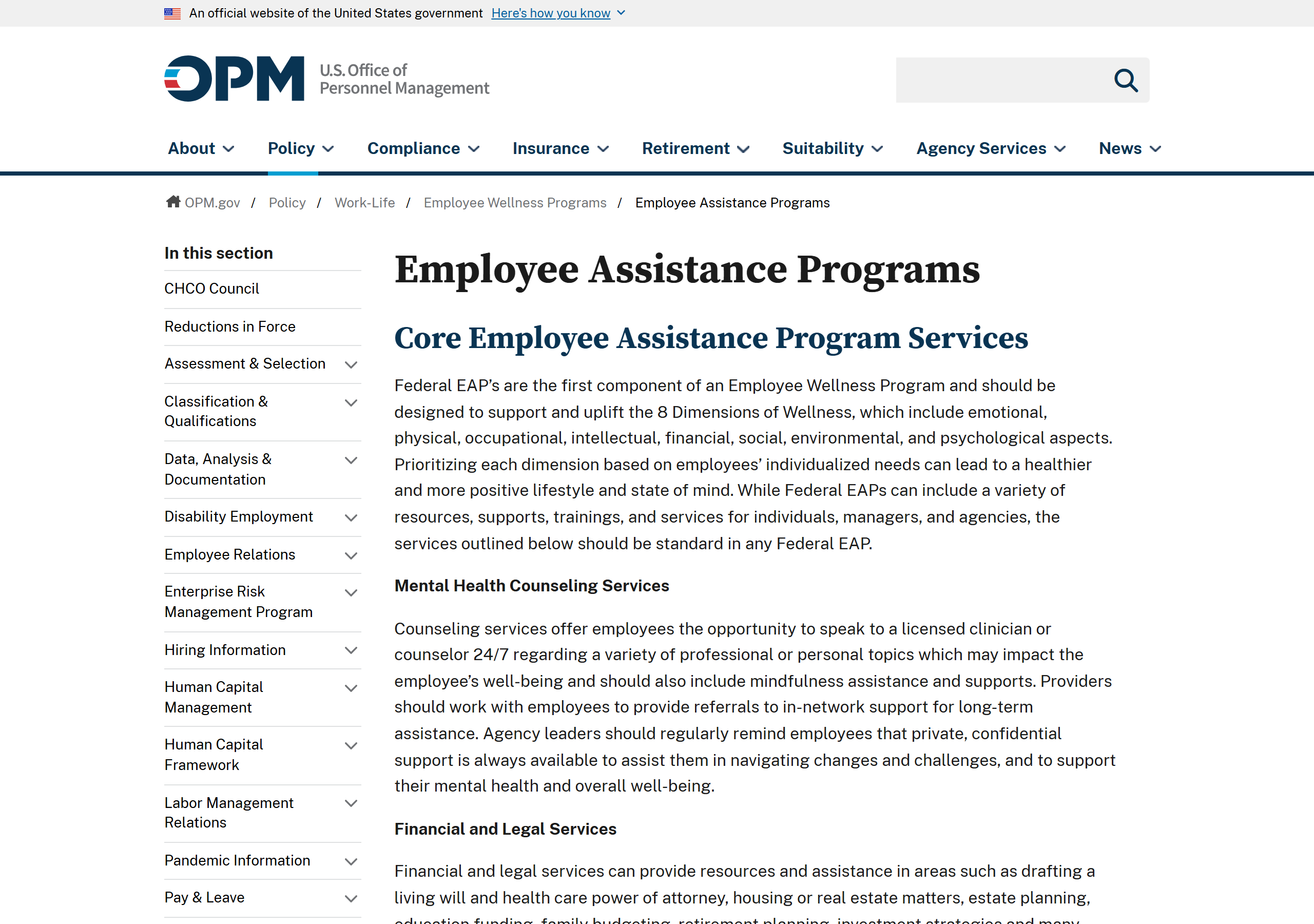
Many employers offer an Employee Assistance Program, usually called an EAP. An EAP is a voluntary, work-based program that gives you a few free, confidential counseling sessions at no cost to you, plus referrals to longer-term care if you need it (U.S. Office of Personnel Management). Many EAPs also cover members of your household, so a spouse or child can use them too.
Programs differ, but most give you a set number of sessions for each concern, often several, and the count usually starts over each year. Check your plan for the exact number. If you need care beyond those sessions, the EAP will help connect you to a longer-term provider, often one who takes your insurance.
Just as important, EAP use is confidential. You speak with a licensed counselor, not with your employer, and your employer is not told that you called or what you discussed. The counselor can help with stress, sadness, anxiety, grief, family problems, sleep, money worries, and drinking or drug use. Beyond counseling, many EAPs also connect you to help with legal questions, financial coaching, child care, and elder care, all at no cost.
You speak with a licensed counselor, not with your employer, and your employer is not told that you called or what you discussed. Many EAPs also cover members of your household and offer phone interpreters so you can speak in your own language.
To find your EAP, look for its name and phone number in your benefits handbook, on your HR or benefits website, on a break-room poster, or sometimes on the back of your insurance card. You can also ask HR, “Do we have an EAP, and what is the number?” You do not need your employer’s permission to call, and the call itself is usually a toll-free number you can dial on your own.
If English is not your first language, ask for an interpreter. Many EAPs offer phone interpreters, so you can use the counseling line in your own language. LINC or a community health worker can help you find and call your EAP.
Ongoing therapy through your job’s health insurance
If your job offers health insurance, that plan usually covers mental health care, such as therapy and psychiatry, for the long term. By federal law, most job-based plans must treat mental health and substance use benefits about the same as physical health benefits. This is called mental health parity: a plan cannot charge you more, or limit your visits more, for mental health than it would for other medical care (U.S. Department of Labor). In practice, parity means your plan should not make you pay a higher copay for a therapist than for a regular doctor, cap the number of therapy visits when it does not cap other visits, or make mental health care harder to get approved. Ask your HR or benefits office for your plan documents, then look for in-network providers so your visits cost less.
If your plan denies mental health care or you think it is treating it worse than physical care, you can appeal. Ask the plan in writing why it was denied and how to appeal, and you can call the Department of Labor’s Employee Benefits Security Administration for help. LINC has separate guides on reading your insurance and finding a provider.
Time off that protects your job
Sometimes you need real time away to recover. The Family and Medical Leave Act (FMLA) lets eligible employees take up to 12 weeks of unpaid, job-protected leave in a year for a serious health condition, including mental health conditions such as anxiety, depression, or a condition that flares up now and then (U.S. Department of Labor). Job-protected means your employer must give you back the same or an equal job and keep your health insurance going during the leave.
You do not have to take all 12 weeks at once. When it is medically necessary, you can take FMLA leave intermittently, in separate blocks of time or as a shorter work schedule, for example a few hours off each week for therapy appointments or a bad stretch (U.S. Department of Labor). Your employer can ask for a certification from your health care provider showing you need the leave, but the form does not have to state your diagnosis (U.S. Department of Labor).
You do not have to take all 12 weeks at once. When it is medically necessary, FMLA leave can be intermittent, such as a few hours off each week for therapy appointments, and the certification from your provider does not have to state your diagnosis.
FMLA does not cover everyone. You must work for a covered employer and meet eligibility rules: in general, at least 12 months and 1,250 hours with the employer, at a location with at least 50 employees within 75 miles (U.S. Department of Labor). If you are not eligible, ask HR about any other paid or unpaid leave, and check whether your state has its own paid family or medical leave program.
Changes at work that help you keep your job
You do not always need to stop working. A federal law called the Americans with Disabilities Act (ADA) protects workers with mental health conditions like depression, anxiety, or PTSD. Your employer cannot fire you, refuse to hire or promote you, or force you to take leave because of your condition (U.S. Equal Employment Opportunity Commission). The ADA covers most employers with at least 15 employees (U.S. Equal Employment Opportunity Commission).
You may also have the right to a reasonable accommodation, which is a change at work that helps you do your job. Examples include a schedule that lets you leave for therapy appointments, time off for treatment, written instructions instead of only spoken ones, a quieter workspace, or working from home (U.S. Equal Employment Opportunity Commission). To ask, you simply tell a supervisor or HR that you need a change at work because of a health condition. You do not have to use special words or name your exact diagnosis.
In most situations you can keep your condition private. An employer may ask medical questions only in limited situations, such as when you ask for an accommodation, and it must keep what you share confidential, even from your coworkers (U.S. Equal Employment Opportunity Commission). If you believe you were treated unfairly because of your condition, you can file a charge with the EEOC, usually within 180 days of what happened. A community health worker or a legal aid group can help you.
Asking HR is safe
To use any of these, you will probably talk to your human resources or benefits office, and you do not have to share clinical details. You can simply ask, “Do we have an EAP, and how do I reach it?” or “What does my health plan cover for mental health?” You do not have to name a diagnosis or describe your symptoms to HR. The Department of Labor’s mental health at work page and SAMHSA have more.
"Do we have an EAP, and how do I reach it?"
"What does my health plan cover for mental health?"
What is available depends on your employer
Not every job offers these benefits. EAPs and insurance depend on your employer, and FMLA eligibility depends on the employer’s size and how long you have worked there. The federal pages above give the general rules, but details vary by workplace and can change. The surest way to know what you have is to ask your HR or benefits office. Nothing here is legal advice; for a specific legal question, talk to a qualified professional.
If your job does not offer these
Many people work jobs with no EAP, no health insurance, or too few hours to qualify for FMLA. You still have ways to get care.
- Community health centers provide counseling on a sliding scale based on what you can pay, and they arrange interpreters. Find one at findahealthcenter.hrsa.gov. They serve you no matter your ability to pay or your immigration status.
- findtreatment.gov is a free federal tool for finding mental health and substance use care.
- Medicaid covers mental health care in every state, and you may qualify even while working. Your state Medicaid office can tell you.
- Dial 211 for free, confidential help finding low-cost counseling in your area, in many languages.
- Call or text 988 any time for the Suicide and Crisis Lifeline, with interpreters in many languages.
Sources
- SAMHSA (Substance Abuse and Mental Health Services Administration). Mental health, drug and alcohol: Support for the workplace. https://www.samhsa.gov/find-support/how-to-cope/workplace
- U.S. Department of Labor. Fact Sheet #28O: Mental health conditions and the FMLA. https://www.dol.gov/agencies/whd/fact-sheets/28o-mental-health
- U.S. Department of Labor. Fact Sheet #28P: Taking leave from work when you or your family member has a serious health condition under the FMLA. https://www.dol.gov/agencies/whd/fact-sheets/28p-taking-leave-when-you-or-family-has-health-condition
- U.S. Department of Labor. Family and Medical Leave Act. https://www.dol.gov/agencies/whd/fmla
- U.S. Department of Labor. Mental health at work. https://www.dol.gov/general/mental-health-at-work
- U.S. Department of Labor, Employee Benefits Security Administration. Mental health and substance use disorder parity. https://www.dol.gov/agencies/ebsa/laws-and-regulations/laws/mental-health-and-substance-use-disorder-parity
- U.S. Equal Employment Opportunity Commission. Depression, PTSD, & other mental health conditions in the workplace: Your legal rights. https://www.eeoc.gov/laws/guidance/depression-ptsd-other-mental-health-conditions-workplace-your-legal-rights
- U.S. Equal Employment Opportunity Commission. Disabilities Act expands to cover employers with 15 or more workers. https://www.eeoc.gov/newsroom/disabilities-act-expands-cover-employers-15-or-more-workers
- U.S. Office of Personnel Management. Employee Assistance Programs. https://www.opm.gov/policy-data-oversight/worklife/employee-wellness-programs/employee-assistance-programs/
- U.S. Office of Personnel Management. What is an Employee Assistance Program (EAP)? https://www.opm.gov/frequently-asked-questions/work-life-faq/employee-assistance-program-eap/what-is-an-employee-assistance-program-eap/
LINC is a research prototype, not a medical or legal service. Translation can be wrong; you have the right to a free, qualified interpreter. For anything high-stakes, do it with a community health worker or someone you trust. In a crisis, call or text 988, or 911 for immediate danger.