A 'qualified interpreter' is a person trained to translate accurately in a medical setting, not just someone who happens to speak both languages. A qualified interpreter understands medical terms and follows rules to protect your privacy. A family member or child is not a qualified interpreter, and you should not be asked to use one for your health care.
Speaking another language should not be a barrier to good care. You do not need to know English to get mental health support in the United States, and you have real rights to language help. This guide gathers the help you can use today and the free, optional ways to keep building English if you want to.
- You have the right to a free, qualified interpreter for your health visits, and you should never be asked to use your child.
- Interpreters can join in person, by phone, or by video, and all of them are free; ask for the kind that works best for you.
- Free plain-language health information is at MedlinePlus, and learning English is optional through libraries, adult ESL, and free sites like USALearns.org.
Your right to a free, qualified interpreter
For important health care, you have the right to a free, qualified interpreter so you can speak in your own language. Health programs and providers that receive federal money must take reasonable steps to give people with limited English proficiency meaningful access to care, including free interpretation. This comes from Section 1557 of the Affordable Care Act. When you book, say which language you speak and ask for an interpreter at no cost to you. You can keep it simple: “I speak [your language]. I need a free interpreter for my visit.” For the full steps, scripts, and what to do if a clinic refuses, see your right to a free, qualified interpreter.
You never have to rely on a child
This is worth saying plainly: you should never be asked to use your child to interpret for your medical visit. A child may step in only for a brief moment in a true emergency, while a qualified interpreter is being found. Interpreting medical information is a heavy job, and it is not a child’s responsibility. A qualified interpreter, who is trained to interpret accurately in a health setting, keeps both you and your child safe. To see how these protections are written into law, read language access laws and policy.
How interpreting works, and which kind to ask for
There is more than one way to get an interpreter, and all of them are free to you. It helps to know the choices so you can ask for what works best.
- In person. The interpreter is in the room with you and your provider. This can feel the most personal, and many people like it for a mental health visit or any hard conversation.
- Over the phone. The interpreter joins by phone. You may use a speaker or pass a handset back and forth. This is fast to set up and can be ready in minutes, even for less common languages.
- By video. The interpreter joins on a screen, so you and the interpreter can see each other. This adds face-to-face cues that a phone call cannot.
Clinics can offer these through in-person interpreters, trained bilingual staff, a phone service, or video (St. Jude Children’s Research Hospital). If one way is hard for you, it is okay to ask for another. You can say, “The phone is hard for me to hear. Can I have an in-person or video interpreter?” For a sensitive visit, ask ahead of time for the kind you want.
Make an interpreted visit go well
A visit with an interpreter goes more smoothly when you know what to expect. These small things help a lot:
- Speak in short pieces. Say a sentence or two, then pause so the interpreter can catch up. That way nothing gets missed (St. Jude Children’s Research Hospital).
- Talk to your provider, not the interpreter. Look at and speak to your doctor or counselor. The interpreter will pass along your words. Speak as you normally would, as if the interpreter were not there (St. Jude Children’s Research Hospital).
- Ask one thing at a time. If you have several questions, ask them one by one so each answer stays clear (St. Jude Children’s Research Hospital).
- It is okay to ask for a repeat. If something goes by too fast, say, “Can you please say that again?” Keep asking until you understand (MedlinePlus).
- What you say is private. A trained interpreter is there only to help you communicate, and follows rules to keep your information private. Say what you need to say.
- Ask for your instructions in writing. Before you leave, you can ask for written instructions, and you can ask for a form or paper to be read to you in your language if it has not been translated (MedlinePlus; St. Jude Children’s Research Hospital).
You can also bring a trusted friend or family member for support and still use the interpreter for the medical part (MedlinePlus).
Plain-language and easy-to-read health information
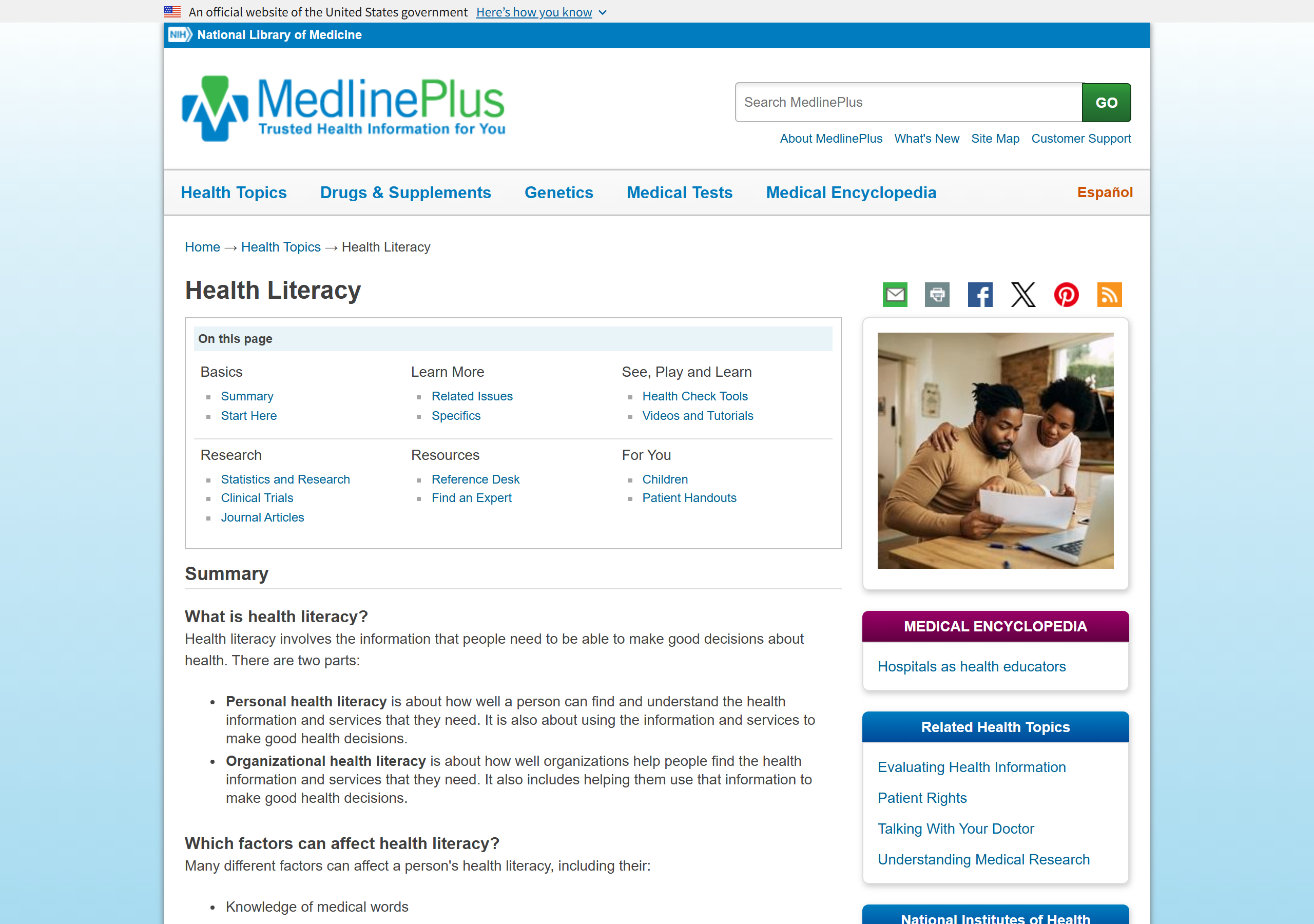
You do not have to wade through complicated medical words. A lot of trusted health information is written in plain, easy-to-read language, and some is available in many languages. MedlinePlus, from the National Library of Medicine, keeps a collection of easy-to-read health materials. The federal Office of Disease Prevention and Health Promotion explains why clear, plain-language health information matters and pushes agencies to write simply. If a form or a website is hard to understand, that is not a failing on your part; you can ask for a plain-language version or for someone to explain it.
Ask them to explain it again: the teach-back method
You do not have to understand everything the first time, and asking for a simpler explanation is not rude. Providers are trained to use a tool called teach-back. After they explain something, they may ask you to say it back in your own words. This checks that they explained it clearly (Centers for Disease Control and Prevention).
You can start teach-back yourself. Try saying, “I want to make sure I understood. Let me tell you what I heard.” Then say it back in your own words. If a part is not clear, ask questions until it is (MedlinePlus). You can also ask, “Can you say that in simpler words?” or “Can I have that in writing?” (MedlinePlus).
"I want to make sure I understood. Let me tell you what I heard."
"Can you say that in simpler words?"
Information you can understand
Finding, understanding, and using health information is called health literacy (Centers for Disease Control and Prevention). When a form or an explanation is too hard to follow, that is not your fault. Health programs are meant to share information in ways people can understand and use to make decisions about their care (Centers for Disease Control and Prevention; Office of Disease Prevention and Health Promotion). So it is always okay to say, “This is hard for me to understand. Can you explain it in plain words?” You can ask for an interpreter, a plain-language version, or written instructions to take home.
Free ways to learn English, if and when you want to
Learning English is optional. It is not required to get care, and your right to an interpreter does not go away as your English grows. That said, if you would like to build English at your own pace, there are good free options. The federal guide USA.gov “Find courses to help you learn English” is a solid map. It points to:
- Public libraries. Many local libraries offer free English classes, conversation groups, and study materials.
- Adult education programs. Free or low-cost English as a Second Language (ESL) classes run in many communities; the USA.gov page links to programs near you.
- Free online lessons. Sites like USALearns.org offer free video and audio lessons you can use from home.
- Your children’s school. If you have children, their school district may offer ESL classes for families.
- Local immigrant organizations. Many immigrant and refugee organizations offer free ESL and English classes. To find ones near you, open the US Immigrant and Refugee Support Dashboard resource map and filter for education or ESL services.
- USAHello. USAHello is a free website for refugees and immigrants. It offers free online English classes and lessons you can take at your own pace on a phone or a computer, with no cost and no ads (USAHello Classroom).
- Find a class near you. The National Literacy Directory lets you search by ZIP code for free local classes in English, adult basic education, and GED preparation (U.S. Department of Education).
Go at the pace that fits your life. Even a few words can feel good, and you can keep using an interpreter for anything important the whole time.
What varies by where you live
Language services and English classes differ from place to place. Some states add their own language-access laws or pay providers through Medicaid for interpreters, which can make interpreters easier to get, and class offerings depend on your local library and adult-education programs. To check what is available to you, ask a local community health center or contact your state Medicaid office. A community health worker can also help you find classes and language help nearby.
Get health information in your language
You do not have to wait for an appointment to read reliable health information in your own language. MedlinePlus, from the U.S. National Library of Medicine, offers health information in more than 40 languages, covering hundreds of topics including depression, anxiety, and stress. You can browse by language or by topic, print a page, or read it on your phone. If you see a word you do not know, bring the page to your provider or your community health worker and ask them to explain it. This is free, and no sign-in is needed.
Sources
- Centers for Disease Control and Prevention. Communication strategies. Health literacy. https://www.cdc.gov/health-literacy/php/research-summaries/communication-strategies.html.
- Centers for Disease Control and Prevention. What is health literacy? Health literacy. https://www.cdc.gov/health-literacy/php/about/index.html.
- MedlinePlus. Easy-to-read health information. U.S. National Library of Medicine. https://medlineplus.gov/all_easytoread.html.
- MedlinePlus. Health information in multiple languages. U.S. National Library of Medicine. https://medlineplus.gov/languages/languages.html.
- MedlinePlus. Health literacy. U.S. National Library of Medicine. https://medlineplus.gov/healthliteracy.html.
- MedlinePlus. Talking with your doctor. U.S. National Library of Medicine. https://medlineplus.gov/talkingwithyourdoctor.html.
- St. Jude Children’s Research Hospital. How to work with a health care interpreter. Together by St. Jude. https://together.stjude.org/en-us/medical-care/navigating-health-care/heath-care-interpreter.html.
- U.S. Department of Education. National Literacy Directory. Literacy Information and Communication System (LINCS). https://lincs.ed.gov/professional-development/resource-collections/profile-986.
- U.S. Department of Health and Human Services, Office for Civil Rights. Section 1557: Ensuring meaningful access for individuals with limited English proficiency. https://www.hhs.gov/civil-rights/for-individuals/section-1557/fs-limited-english-proficiency/index.html.
- U.S. Department of Health and Human Services, Office of Disease Prevention and Health Promotion. Health literacy. https://odphp.health.gov/our-work/national-health-initiatives/health-literacy.
- USA.gov. Find courses to help you learn English. https://www.usa.gov/learn-english.
- USAHello. Learn English for immigrants. https://usahello.org/education/learn-english-language/.
LINC is a research prototype, not a medical or legal service. Translation can be wrong; you have the right to a free, qualified interpreter. For anything high-stakes, do it with a community health worker or someone you trust. In a crisis, call or text 988, or 911 for immediate danger.