NAMI (National Alliance on Mental Illness) is a national nonprofit organization that offers free support groups, education programs, and information for people who have mental health conditions and for their family members. The NAMI Family Support Group is a free, peer-led group specifically for family and caregivers.
When someone you love is struggling, your care matters more than you may realize. You do not need to be an expert or have all the answers. Often the most helpful thing is simply to notice, to listen, and to walk beside them as they find help. This guide offers gentle, practical steps you can take.
- The most helpful actions: notice the signs, have a caring conversation without judgment, and help them take one small step toward care.
- Find services with FindTreatment.gov or findahealthcenter.hrsa.gov, or dial 2-1-1; SAMHSA's helpline is 1-800-662-HELP.
- If they are in danger, call or text 988 or call 911 and stay with them; your own well-being matters too.
Noticing when someone is struggling
People do not always say they are having a hard time. Watch for changes that last or that get in the way of daily life: pulling away from family and friends, sleeping or eating much more or much less, losing interest in things they used to enjoy, seeming sad or worried for weeks, drinking or using substances more, or talking about feeling hopeless or like a burden. Distress can also show up in the body, as headaches, tiredness, or stomach pain. None of this means weakness or a personal failing. These are ordinary, treatable health conditions, as the CDC explains. Our guide on recognizing a mental health problem describes the signs in more detail.
Starting a caring, non-judgmental conversation
You do not need the perfect words. Pick a private, calm moment and speak from love. The U.S. National Institute of Mental Health suggests a few simple steps: ask how they are really doing, be there and listen without judging or rushing to fix, and help them connect to support, as described in NIMH’s guidance on helping someone in emotional pain. You might say, “I have noticed you seem worn down lately, and I care about you. I am here whenever you want to talk.” Avoid blaming or telling them to just think positive. In many families and communities, mental health is hard to talk about, and there can be shame around it. You can help by treating it like any other health matter, the way you would a fever or a sore back.
Helping them find and reach care
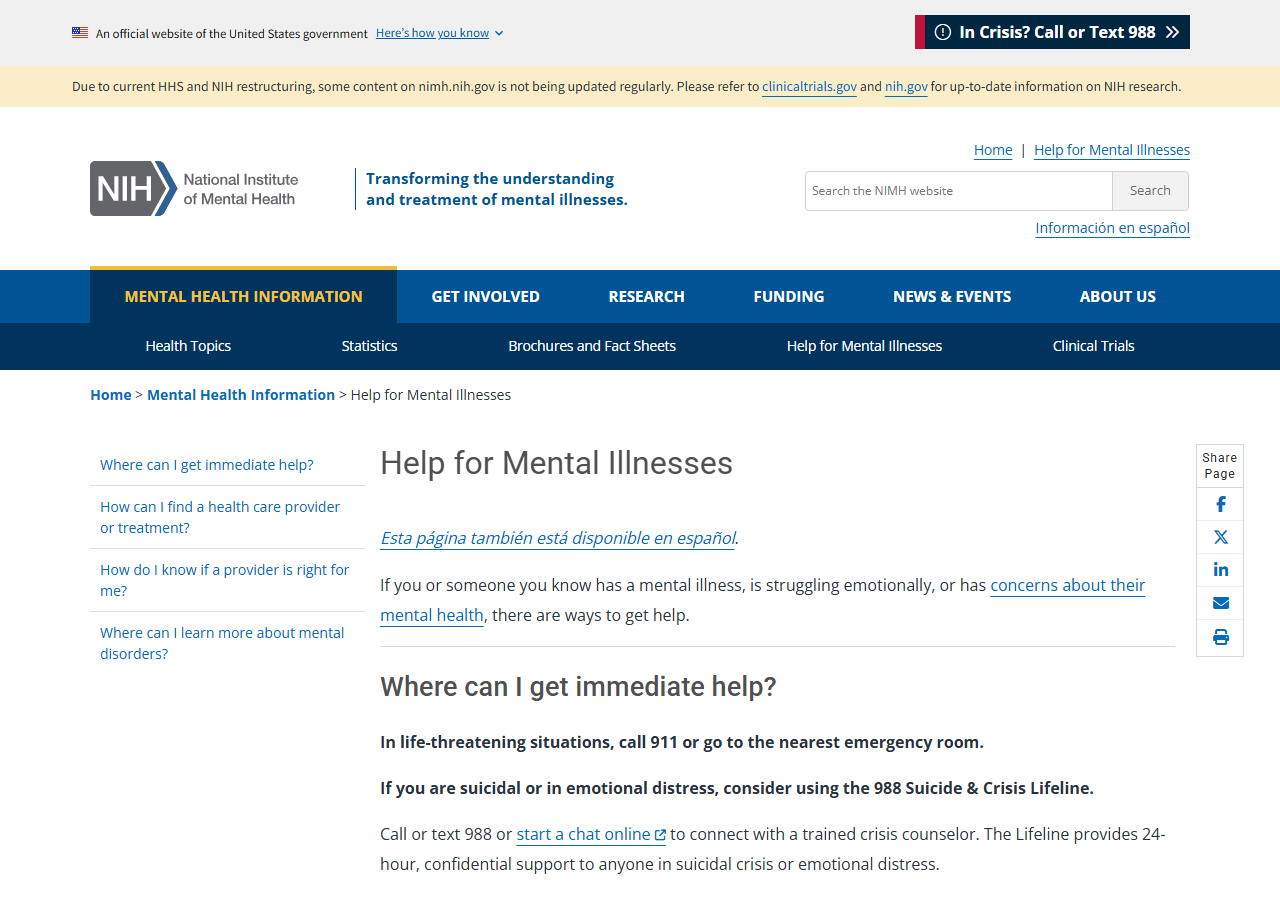
When the person is ready, you can help them take the next step, and you do not have to do it alone. Free, trustworthy tools can find care nearby: FindTreatment.gov from SAMHSA locates mental health and substance use services, findahealthcenter.hrsa.gov finds community health centers that serve everyone regardless of insurance or ability to pay, and dialing 2-1-1 (211.org) connects you to local help with health, housing, and food. NIMH also keeps a list of ways to find help. Our guide on finding a provider walks through it step by step.
You can also call SAMHSA’s National Helpline at 1-800-662-HELP (4357), a free and confidential service open 24 hours a day, every day of the year, in English and Spanish. It does not give therapy over the phone; it points you to treatment, support groups, and community organizations near you, and you can text your ZIP code to 435748 to get options (SAMHSA). Helping the person make that first call, or making it together, can be the push that gets things moving.
You can offer to go with them to the first appointment, sit in the waiting room, or help them make the call. You can help them ask for a free, qualified interpreter so they can speak in their own language, which is their right at no cost. And you can use the chatbot together to prepare questions, practice what to say, or understand a form. For anything high-stakes, a community health worker can guide you both through the system.
Making a first call on their behalf
It is common to help an adult relative or friend by making that first call for them, whether you are a parent calling for an adult child or an adult child calling for a parent. Doing it with their agreement keeps them in control of their own care.
Before you call. Ask the person what they want you to say and what they would rather you not share, and confirm they agree to your calling on their behalf. A clinic may only be able to speak with the person themselves about some things, such as scheduling or their medical details, and that is normal. You can still gather general information, such as hours, languages spoken, cost, and what to bring.
"Hello, my name is ______. I am calling on behalf of ______, my ______, with their permission."
"Do you have any openings, and is an interpreter available in ______?"
"What does ______ need to do to get started?"
"Can I write this down so I can share it with them?"
Bring what you learn back to the person, and when you can, help them make or confirm the next step themselves.
If they are in crisis
Stay with them. Call or text 988, the Suicide and Crisis Lifeline, free and confidential 24 hours a day, or call 911 for immediate danger. Gently move away anything they could use to harm themselves.
If the person talks about harming themselves or seems to be in danger, take it seriously and stay with them. Mental health experts describe five steps you can take: ask directly, keep them safe by reducing access to anything they could use to harm themselves, be there and listen, help them connect to ongoing support, and stay connected by following up afterward (NIMH). It is okay to ask directly, “Are you thinking about suicide?” Asking does not plant the idea or make things worse; it can open the door to getting help. If you can, gently move away medicines, weapons, or anything else they could use to hurt themselves. Call or text 988, the 988 Suicide and Crisis Lifeline, which is free, confidential, and available 24 hours a day. Interpreters cover more than 240 languages and usually join in about 20 seconds, and more than 98% of contacts are handled with support alone, without police or an ambulance (SAMHSA). Call 911 for immediate danger. In the days and weeks after, keep checking in; staying in touch makes a real difference. Our guide on what to do in a crisis has more. You do not have to handle this alone, and reaching out for help is the caring thing to do.
Respecting their choices and their privacy
Support works best when the person feels in control. Let them make their own decisions about care, even if they are not ready yet, and keep what they share private unless their safety is at risk. Your patience and steady presence matter more than any single conversation.
Taking care of yourself
Supporting someone is real work, and your well-being matters too. Rest, lean on people you trust, and set gentle limits so you do not burn out, as MedlinePlus advises caregivers. You are not alone in this. Free family support groups, such as the NAMI Family Support Group, connect you with other families who understand.
You can also reach the NAMI HelpLine at 1-800-950-6264, Monday through Friday, 10 a.m. to 10 p.m. Eastern time, or text “NAMI” to 62640, for free information and peer support (NAMI). And NAMI offers Family-to-Family, a free eight-session class for family and friends of people with mental health conditions, taught by people who have walked this road themselves (NAMI). Learning what to expect can make the whole thing feel less frightening.
When someone refuses help
Sometimes the person is not ready, and that is hard to sit with. You cannot force an adult into care unless they are in danger, so pushing harder often backfires. What helps is keeping the door open. Keep the relationship warm, keep gently offering, and aim for one small, low-pressure step rather than the whole journey at once, such as one phone call or one visit. Let them keep some control over the choice, because feeling in control often makes it easier to say yes later. Keep checking in, since your steady presence over weeks and months matters more than any single conversation (NIMH).
You cannot force an adult into care unless they are in danger. Keep the relationship warm, keep gently offering, and aim for one small, low-pressure step, like one phone call or one visit.
The one exception is safety. If their life is ever at risk, act even if they did not ask you to: call or text 988, or call 911 for immediate danger. And keep caring for yourself while you wait. The support groups and helplines above are there to hold you up too.
Sources
- 211 (United Way Worldwide, not a government service). https://www.211.org/.
- 988 Suicide and Crisis Lifeline. Home. https://988lifeline.org/.
- Centers for Disease Control and Prevention (CDC). About Mental Health. https://www.cdc.gov/mental-health/about/index.html.
- Health Resources and Services Administration (HRSA). Find a Health Center. https://findahealthcenter.hrsa.gov/.
- MedlinePlus. Caregiver Health. https://medlineplus.gov/caregiverhealth.html.
- National Alliance on Mental Illness (NAMI, not a government organization). NAMI Family Support Group. https://www.nami.org/program/nami-family-support-group/.
- National Alliance on Mental Illness (NAMI, not a government organization). NAMI Family-to-Family. https://www.nami.org/programs/nami-family-to-family/.
- National Alliance on Mental Illness (NAMI, not a government organization). NAMI HelpLine. https://www.nami.org/nami-helpline/.
- National Institute of Mental Health (NIMH). 5 Action Steps to Help Someone Having Thoughts of Suicide. https://www.nimh.nih.gov/health/publications/5-action-steps-for-helping-someone-in-emotional-pain.
- National Institute of Mental Health (NIMH). Help for Mental Illnesses. https://www.nimh.nih.gov/health/find-help.
- Substance Abuse and Mental Health Services Administration (SAMHSA). 988 Frequently Asked Questions. https://www.samhsa.gov/mental-health/988/faqs.
- Substance Abuse and Mental Health Services Administration (SAMHSA). 988 Suicide & Crisis Lifeline. https://www.samhsa.gov/mental-health/988.
- Substance Abuse and Mental Health Services Administration (SAMHSA). Find Help and Treatment. https://www.samhsa.gov/find-help.
- Substance Abuse and Mental Health Services Administration (SAMHSA). FindTreatment.gov. https://findtreatment.gov/.
- Substance Abuse and Mental Health Services Administration (SAMHSA). National Helpline. https://www.samhsa.gov/find-help/helplines/national-helpline.
LINC is a research prototype, not a medical or legal service. Translation can be wrong; you have the right to a free, qualified interpreter. For anything high-stakes, do it with a community health worker or someone you trust. In a crisis, call or text 988, or 911 for immediate danger.