Costs, coverage, and eligibility vary by plan and by state, and the rules change. Use this as a general guide, and confirm the details with your insurance plan, the clinic, or a community health worker before you rely on them.
Outpatient care means you live at home and come to the clinic for regular visits. You are not staying in the hospital. This is the most common way people get mental health treatment in the US. The opposite, inpatient care, means staying overnight or longer in a hospital or treatment facility.
Every U.S. state runs its own mental health system, and each state names and organizes its programs in its own way, with its own acronyms. The list of program types in one state can look almost nothing like the list next door, which is confusing even for trained navigators. This guide uses one state, New York, as a worked example. New York’s Office of Mental Health (OMH) sorts its programs into a handful of categories, and seeing them laid out makes the idea of “kinds of programs” clearer. At the end, this guide shows how to find your own state’s version, because the names below are New York’s, not the country’s.
- Every state names its programs differently; New York is the worked example here.
- Five main kinds: emergency and crisis, inpatient, outpatient, residential, and support.
- Most people start with an outpatient assessment and step up or down as their needs change.
For the bigger picture of how the parts fit together, see How mental health care works in the United States and What behavioral health services exist.
The kinds of programs
New York groups its mental health programs by what they are for, running from the most urgent to ongoing, everyday support:
- Emergency / Crisis: help right now, when things feel unsafe or out of control.
- Inpatient: a stay in a hospital bed for safety and close care.
- Outpatient: regular visits while you keep living at home; the most common kind.
- Residential: a place to live with support attached, for as long as you need it.
- Support: ongoing, non-clinical help that keeps recovery going, such as peers, work, and school.
Most people never touch the urgent end; they start with an outpatient visit and move up only if needed.
One idea ties all of these together. Picture the five kinds as rungs on a ladder, often called levels of care, running from the least intensive to the most intensive. Outpatient visits sit near the bottom, programs like Continuing Day Treatment and Partial Hospitalization sit in the middle, and inpatient and crisis care sit at the top. A good clinician tries to place you on the lowest rung that still keeps you safe and moving forward, and changes the rung as your needs change. This step-by-step continuum is a standard way to organize mental health care, described by SAMHSA.
Here are the rungs of that ladder, from least to most intensive:
| Level of care | How intensive | Who it is for |
|---|---|---|
| Outpatient | Least intensive; you live at home and come in for visits | Most people start here; the front door most people use |
| Continuing Day Treatment or Partial Hospitalization | In the middle; more than a weekly visit but not an overnight stay | Someone who needs more support for a while, often stepping down after a hospital stay |
| Inpatient and crisis care | Most intensive; a hospital bed or urgent help right now | For safety and close care when things feel unsafe or out of control |
Moving to a more intensive program is called stepping up, and moving to a lighter one is stepping down. You are not locked onto one rung. Someone might step up to Partial Hospitalization for a few weeks after a hard stretch, then step back down to a weekly visit once things settle. This is normal and expected, not a sign that anything went wrong.
Moving to a more intensive program is "stepping up"; moving to a lighter one is "stepping down." You are not locked onto one rung, and changing as your needs change is normal and expected.
Emergency and crisis programs
When a mental health problem turns into an emergency, help does not wait for an appointment. New York runs a full crisis response system, and most of its crisis programs are voluntary, meaning you choose to use them; several come to you or let you walk in.
Call, text, or chat 988 any time to reach a trained crisis counselor. It is free, confidential, and open 24 hours a day, in English and Spanish, and can add an interpreter in more than 240 other languages.
- 988 Suicide and Crisis Lifeline: the first call for most crises. You can call, text, or chat 988 any time to reach a trained crisis counselor. It is free, confidential, and open 24 hours a day, every day. The 988 service works in English and Spanish and can add an interpreter in more than 240 other languages, so you can speak in your own language (about 988).
- Mobile crisis teams: a team that comes to where you are when you or someone you love is in a mental health or substance use crisis. It is voluntary and available around the clock.
- Crisis stabilization centers: walk-in centers, open 24 hours a day, where anyone in a mental health or substance use crisis can get calm, urgent help and peer support instead of sitting in a regular emergency room.
- Crisis residence: a short stay in a safe, home-like place, not a hospital, to settle a crisis. A stay can last up to 21 days for children and youth and up to 28 days for adults.
- Comprehensive Psychiatric Emergency Program (CPEP): a hospital-based psychiatric emergency room that offers crisis care and short observation beds, where someone can be watched safely for up to 72 hours, about three days, instead of being admitted, and then connected to follow-up care. This matches New York’s program definitions.
Inpatient programs
- Inpatient psychiatric unit of a general hospital: a staffed unit inside an ordinary hospital for a short stay during an acute episode.
- State Psychiatric Center: a hospital run by the state for people who need longer or more specialized inpatient care.
- Private psychiatric hospital: a private hospital that provides the same kind of inpatient psychiatric care.
Outpatient programs
You live at home and come in for visits. This is where most people begin, usually with an assessment that helps a clinician point you to the right next step.
- Outpatient clinic, officially Mental Health Outpatient Treatment and Rehabilitative Services (MHOTRS): the everyday clinic where you see a therapist, a prescriber, or both for assessment, talk therapy, and medication. This is the front door most people use.
- Continuing Day Treatment (CDT): a structured program you attend several days a week to build the skills to stay in the community, for people living with serious mental illness.
- Partial Hospitalization: a short, intensive program close to a full day, for someone who needs more than a weekly visit but not an overnight stay, often as a gentler step down after a hospital stay.
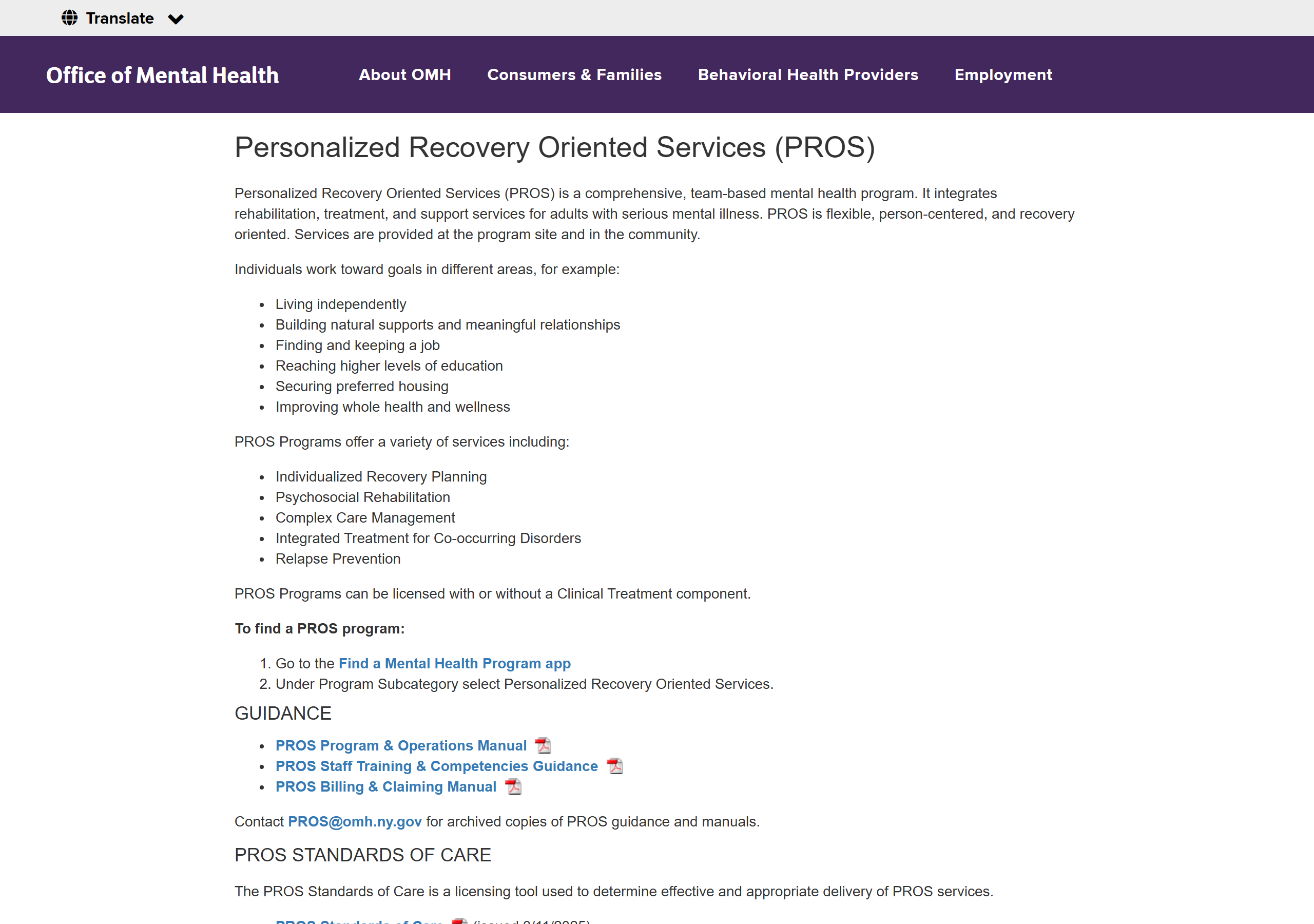
- Personalized Recovery-Oriented Services (PROS): a comprehensive, team-based program that combines treatment, skill-building, and help with work and school under one roof, for adults with serious mental illness. New York describes PROS here.
- Assertive Community Treatment (ACT): a whole team, including a prescriber, that comes to you in the community and is available around the clock, for people with the most serious needs who do better outside a hospital. New York describes ACT here.
- Adult Behavioral Health HCBS and CORE (Community Oriented Recovery and Empowerment): mobile, recovery-focused supports delivered where you live, such as skill-building, peer support, and family support, for eligible Medicaid members. New York describes CORE here.
- Care coordination / Health Home: a care manager who ties the pieces together, tracks your appointments, and speaks up for you when several services are involved. A “Health Home” is not a building; it is a team that coordinates your care, explained by New York State Medicaid.
Residential programs
- Residential Treatment Facility (children and youth): a place where a young person lives and receives intensive mental health treatment when care at home is not enough.
- Supported and “unlicensed” housing: apartments or homes with support staff attached, where adults in recovery live with as much independence as they can manage. “Unlicensed” here just means a housing-support program, not a clinical license; it is still a real, funded program.
Support programs
- Self-help and peer support: help from people who have lived through their own recovery and are trained to walk alongside you.
- Vocational and supported employment: help finding and keeping a job, with coaching along the way.
- Education support: help returning to or staying in school.
You can see how New York defines each of these in its licensed program type definitions.
These are New York’s names, so check your state
Here is the part that matters most. Everything above is how one state labels and sorts its programs. Another state may offer very similar programs under different names, group them into different categories, or not have a given program at all. “PROS,” “CDT,” and “CPEP” are New York terms; your state may call the same idea something else. So use this guide to understand the kinds of programs that exist, not the exact words to expect where you live.
- CPEP
- A hospital-based psychiatric emergency room with short observation beds.
- CDT
- Continuing Day Treatment, a structured program you attend several days a week to build skills for living in the community.
- PROS
- A team-based program that combines treatment, skill-building, and help with work and school for adults with serious mental illness.
- ACT
- Assertive Community Treatment, a whole team that comes to you in the community around the clock.
- CORE
- Mobile, recovery-focused supports delivered where you live, for eligible Medicaid members.
- CFTSS
- Flexible mental health services a child can use on their own or alongside other care.
To find real programs near you:
- New York residents can search the state’s own Mental Health Program Directory, a public, searchable list of real programs by county and category. Other states publish their own program directories through their state mental health agency.
- Everywhere in the United States, FindTreatment.gov, run by SAMHSA, finds mental health and substance use programs by ZIP code.
- Your Medicaid plan or health insurance can tell you which programs it covers for you.
- A community health worker can help you read these lists and pick a place to start. In LINC, a community health worker works alongside the AI assistant, so you are not sorting through acronyms alone.
Most people do not pick a program cold. You usually start with an assessment at an outpatient clinic or through your Medicaid plan, and the clinician there helps match you to the right level of care and moves you up or down as your needs change. For a crisis you do not need a referral: call or text 988 any time. And emergency care is available to everyone, whatever your insurance or immigration status.
Programs for children and youth
Children and teenagers have their own programs, because what helps a child is not the same as what helps an adult. In New York these are mostly Medicaid services for young people under 21, and the goal is to help a child get better while staying at home and in their community whenever possible. New York calls this a “no wrong door” system, meaning a family can enter through a school, a doctor, a clinic, or a crisis line and still be guided to the right service. See New York’s children’s behavioral health system.
- Children and Family Treatment and Support Services (CFTSS): flexible mental health services a child can use on their own or alongside other care. Any child who has Medicaid and a behavioral health need can get them, which gives families more choice about where to start.
- Children’s Home and Community Based Services (HCBS): added supports for children with more complex needs, built to help them stay at home and in the community instead of in an institution.
- Children’s Crisis Residence: a short, home-like place for a young person to settle a crisis safely, for up to 21 days, part of the crisis response system.
- Residential Treatment Facility: for a young person who needs intensive, live-in treatment when care at home is not enough.
In a crisis, 988 is for young people too. A parent, a teacher, or the young person can call or text it.
How to get connected, step by step
You almost never have to choose a program cold. Here is how people usually get connected.
- Start with an outpatient assessment. For anything that is not an emergency, the usual front door is an outpatient clinic. You can often call one yourself, or your regular doctor or your health plan can point you to one. A clinician talks with you, learns what you are dealing with, and recommends a level of care.
- Let the clinician match you, and adjust over time. After that first visit you might stay with weekly therapy, step up to a more intensive program, or step down later as you improve. The plan is built to change as your needs change, which is how the continuum of care is meant to work.
- Use your Medicaid plan or insurance. Many of these New York programs are Medicaid benefits, including CORE, children’s CFTSS and HCBS, and Health Home care coordination. Your plan can tell you what it covers and help you find a provider.
- Ask a community health worker for help. A community health worker can read these lists with you, explain the acronyms, and help you make the first call. In LINC, a community health worker works alongside the AI assistant, so you are not doing this alone.
- In a crisis, skip the steps. You do not need a referral or an appointment. Call or text 988 any time, or go to any emergency room. By federal law, a hospital emergency room must screen you and provide stabilizing care regardless of your ability to pay, your insurance, or where you are from, and it cannot delay your care to ask about payment first, as the emergency physicians’ association explains.
Questions people often ask
Do I need a referral to start? Usually not. For most outpatient programs you can call and ask for an assessment yourself. For a crisis you never need a referral; call or text 988.
Will this cost me anything? Medicaid covers a wide range of these services, and most health insurance covers outpatient and inpatient mental health care. Several New York programs, such as CORE and children’s CFTSS and HCBS, are specifically Medicaid benefits. Ask your plan, or ask a community health worker to check for you.
What if I do not have insurance or legal immigration status? Emergency care is for everyone. A hospital emergency room must give you a medical screening and stabilizing treatment regardless of your ability to pay, your insurance, or your national origin, and it cannot delay care to ask how you will pay (emergency physicians’ association). The 988 line is free and confidential as well.
What is the difference between Partial Hospitalization and inpatient? Partial Hospitalization is intensive daytime treatment, close to a full day, but you go home at night. Inpatient means you stay overnight in a hospital bed. Partial Hospitalization is often the gentler step down after a hospital stay.
How long will it take? A crisis line answers right away. An outpatient assessment can take from a few days to a few weeks to schedule, depending on the clinic. If the wait feels too long or the need is urgent, a community health worker or the 988 line can help you find faster options.
What if I do not speak English well? You have the right to a free, qualified interpreter, and the 988 line works in English and Spanish and can add an interpreter in more than 240 other languages (about 988).
Sources
- American College of Emergency Physicians (ACEP). Understanding EMTALA. https://www.acep.org/life-as-a-physician/ethics—legal/emtala/emtala-fact-sheet.
- Centers for Medicare & Medicaid Services (CMS). Behavioral Health Services (Medicaid). https://www.medicaid.gov/medicaid/benefits/behavioral-health-services.
- Centers for Medicare & Medicaid Services (CMS). Home & Community-Based Services (Medicaid). https://www.medicaid.gov/medicaid/home-community-based-services.
- New York State Department of Health. Medicaid Health Homes: Comprehensive Care Management. https://www.health.ny.gov/health_care/medicaid/program/medicaid_health_homes/.
- New York State Office of Mental Health (OMH). Assertive Community Treatment (ACT). https://omh.ny.gov/omhweb/act/.
- New York State Office of Mental Health (OMH). Children’s Behavioral Health System Transformation. https://omh.ny.gov/omhweb/bho/childrensmc.html.
- New York State Office of Mental Health (OMH). Community Oriented Recovery and Empowerment (CORE) Overview. https://omh.ny.gov/omhweb/bho/core/.
- New York State Office of Mental Health (OMH). Comprehensive Crisis Response System. https://omh.ny.gov/omhweb/bho/crisis-intervention.html.
- New York State Office of Mental Health (OMH). Consumers & Families. https://omh.ny.gov/omhweb/bootstrap/consumers-families.html.
- New York State Office of Mental Health (OMH). Home page. https://omh.ny.gov/.
- New York State Office of Mental Health (OMH). Licensed Program Type Definitions. https://omh.ny.gov/omhweb/licensing/definitions.htm.
- New York State Office of Mental Health (OMH). Mental Health Program Directory (public guest access). https://my.omh.ny.gov/analytics/saw.dll?dashboard&PortalPath=%2Fshared%2FMental%20Health%20Program%20Directory%2F_portal%2FMental%20Health%20Program%20Directory&nquser=BI_Guest&nqpassword=Public123.
- New York State Office of Mental Health (OMH). 988 Suicide and Crisis Lifeline. https://omh.ny.gov/omhweb/crisis/what-is-988.html.
- New York State Office of Mental Health (OMH). Personalized Recovery-Oriented Services (PROS). https://omh.ny.gov/omhweb/pros/.
- Substance Abuse and Mental Health Services Administration (SAMHSA). Find Help and Treatment. https://www.samhsa.gov/find-help.
- Substance Abuse and Mental Health Services Administration (SAMHSA). FindTreatment.gov. https://findtreatment.gov/.
- Substance Abuse and Mental Health Services Administration (SAMHSA). Substance Abuse: Clinical Issues in Intensive Outpatient Treatment (Treatment Improvement Protocol Series 47), Chapter 3: Intensive Outpatient Treatment and the Continuum of Care. https://www.ncbi.nlm.nih.gov/books/NBK64088/.
LINC is a research prototype, not a medical or legal service. Translation can be wrong; you have the right to a free, qualified interpreter. For anything high-stakes, do it with a community health worker or someone you trust. In a crisis, call or text 988, or 911 for immediate danger.