Costs, coverage, and eligibility vary by plan and by state, and the rules change. Use this as a general guide, and confirm the details with your insurance plan, the clinic, or a community health worker before you rely on them.
A deductible is the amount you must pay out of your own pocket each year before your insurance starts paying its share of your bills. For example, if your deductible is $1,000, you pay the first $1,000 of covered medical costs yourself. After you reach that amount, your insurance covers most of the remaining costs.
Worry about cost stops many people from getting mental health care. This guide covers the basics you need before you book, so a surprise bill does not catch you off guard.
- Mental health and substance use care is an essential health benefit, so most plans must cover it.
- Learn three words: premium (paid monthly), deductible (paid before the plan pays), copay (a flat fee for a visit).
- No insurance? Apply for Medicaid any time of year, or use a community health center's sliding fee scale, which cannot turn you away.
Mental health care is covered
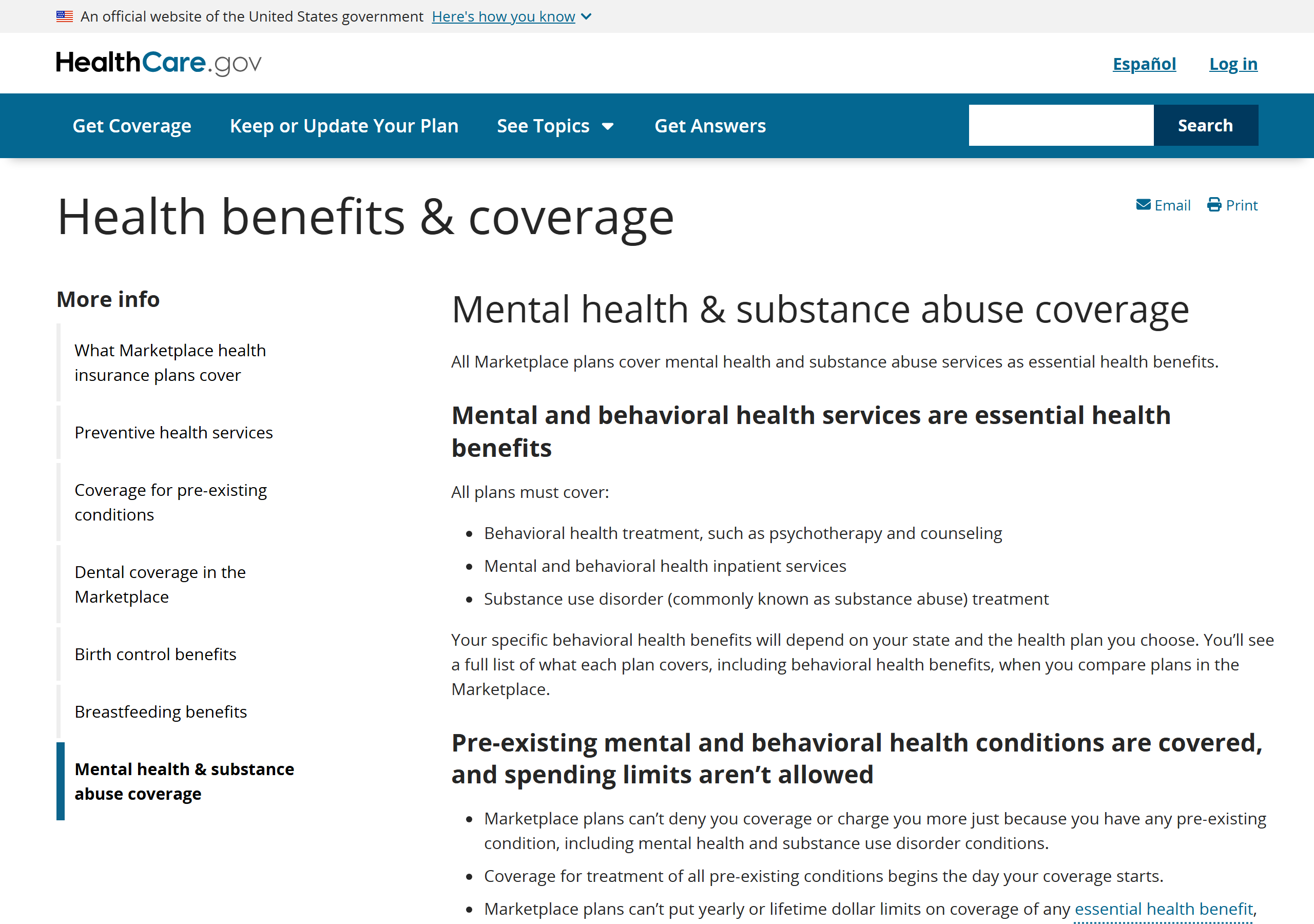
Mental health and substance use services are one of the ten essential health benefits. That means Marketplace plans and most other plans are required to cover them, and a plan cannot deny you because of a pre-existing condition (HealthCare.gov). Covered care usually includes counseling and therapy, care from a psychiatrist, and treatment for alcohol or drug use. Many of these visits can happen by video or phone from home, which helps if you cannot travel, take time off work, or find a provider who speaks your language. Medicare covers mental health visits by video or phone from your home (Telehealth.HHS.gov), and most state Medicaid programs cover telehealth too, though the exact rules vary by state (Telehealth.HHS.gov).
If you are in a crisis right now, help costs nothing. You can call or text 988, the Suicide and Crisis Lifeline. It is free, private, and open 24 hours a day, and it offers interpretation in more than 240 languages (SAMHSA).
The main ways people are covered
- Medicaid: free or low-cost coverage based on income. You can apply at any time of year through your state.
- Marketplace or private plans: bought through HealthCare.gov or your state’s marketplace; many people qualify for savings that lower the monthly cost.
- Employer insurance: coverage offered through a job.
- Medicare: for people 65 and older, and some younger people with disabilities.
- CHIP: low-cost coverage for children whose families earn too much for Medicaid but cannot easily afford private insurance.
Insurance words, in plain language
These terms come from the federal Uniform Glossary, and they appear on almost every plan (HealthCare.gov):
- Premium: what you pay each month to keep the plan.
- Deductible: what you pay yourself before the plan starts paying.
- Copay: a flat fee for a visit, for example $25.
- Coinsurance: a percentage of the cost that you pay after the deductible.
- Out-of-pocket maximum: the most you will pay in a year; after that, the plan pays 100 percent.
- In-network and out-of-network: in-network providers have an agreement with your plan and cost you less, so always ask whether a provider is in your network before you book.
- Prior authorization: approval your plan may require before it will pay for a service. If your plan asks for it, your provider’s office usually sends the request for you.
- Explanation of Benefits
- a summary your plan sends after a visit; it is not a bill, so wait for a separate bill from the clinic
- Sliding fee scale
- a fee set by your income and household size at a community health center, which cannot turn you away
- Good Faith Estimate
- a written estimate of what your care will cost, given before the visit if you are paying yourself
- Financial assistance
- a program at many hospitals and clinics that lowers or erases the bill for people with low income
- No Surprises Act
- a federal law that limits what you pay for emergencies and for out-of-network providers at an in-network hospital
- Open Enrollment
- the yearly window when you can sign up for a Marketplace plan
- Special Enrollment Period
- a chance to sign up outside Open Enrollment after a life change, such as losing coverage or moving
- Generic
- a medicine with the same active ingredient and strength as the brand name, usually costing much less
Your plan cannot treat mental health worse than other care
A federal law, the Mental Health Parity and Addiction Equity Act, is on your side. When a plan covers mental health and substance use care, it cannot make the rules for that care harder than the rules for regular medical care. Your copay for a therapy visit cannot be higher than your copay for a regular doctor visit. The plan cannot cap the number of therapy visits, or add extra approval steps, unless it does the same for medical care (CMS).
This matters most when a plan says no. If your plan denies mental health care, or limits it in a way that feels unfair, you can ask for the reason in writing and file an appeal. You can also call your state insurance department for help. A community health worker can help you write the appeal.
Checking eligibility and applying
Medicaid eligibility and income limits are set by each state, so the same income can qualify you in one state and not in another. Start at Medicaid.gov to check eligibility and find your state’s program.
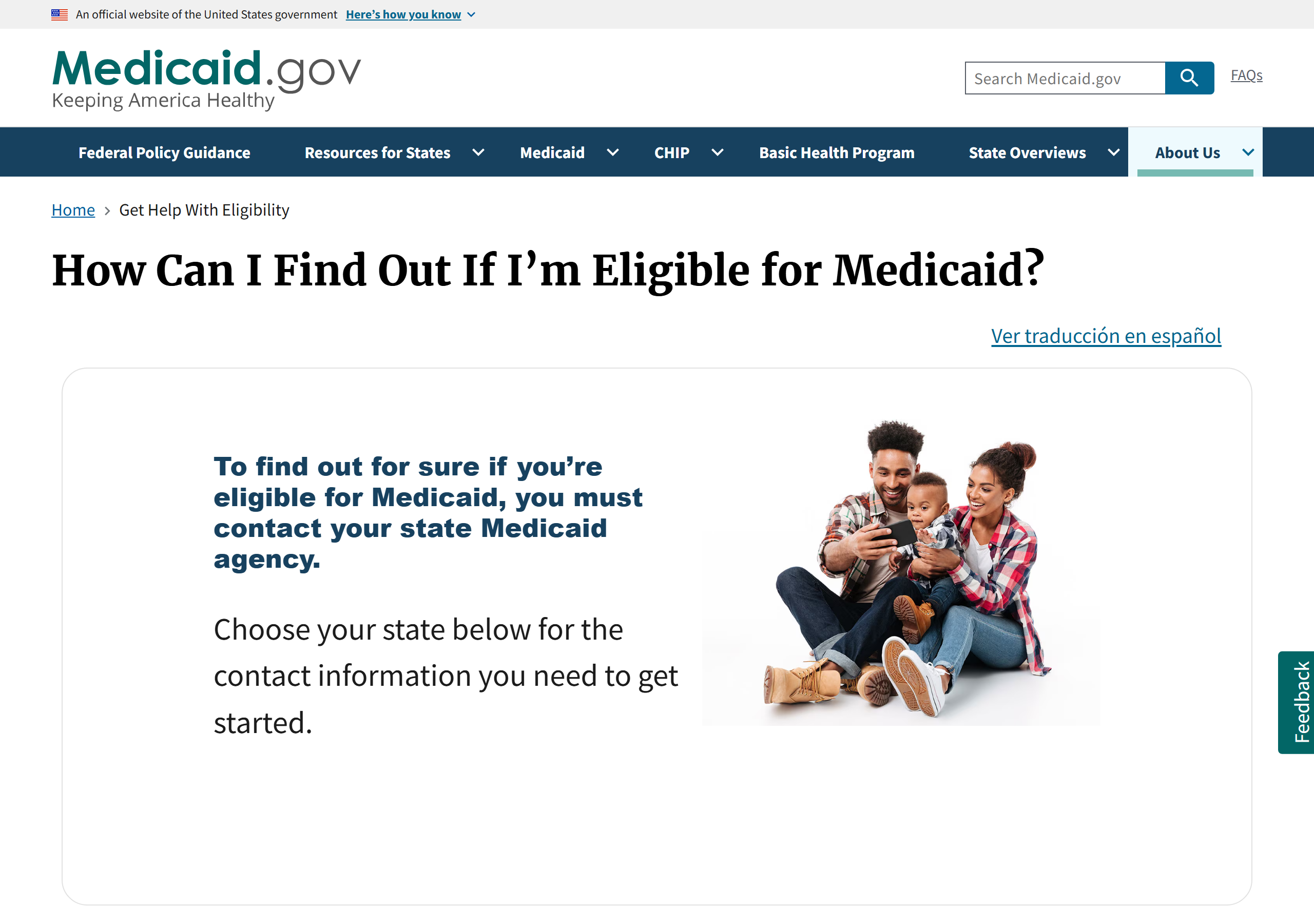
For children’s coverage, call 1-877-KIDS-NOW (1-877-543-7669) or visit InsureKidsNow.gov. For adults, your state Medicaid office can tell you what you qualify for.
Medicaid is the largest payer for mental health care in the country, and every state Medicaid program covers behavioral health, including counseling and treatment for drug or alcohol use (Medicaid.gov). You can apply three ways, any time of year: through your state Medicaid agency, through HealthCare.gov, or by phone. If you qualify, coverage can begin right away.
Marketplace plans: when you can sign up
Unlike Medicaid, you cannot buy a Marketplace plan on just any day. There is a yearly window called Open Enrollment. For 2026 coverage it ran from November 1, 2025 to January 15, 2026 in most states, and a few states set a slightly later end date (KFF). The next window opens around November 1, so it helps to mark your calendar.
Outside that window, you can still sign up if your life changes in a way that qualifies you for a Special Enrollment Period. Losing other coverage, moving to a new area, getting married, or having a baby all count. You usually have 60 days before or after the event to pick a plan. If you lost Medicaid or CHIP, you get 90 days (HealthCare.gov). Most people who buy a Marketplace plan qualify for savings that lower the monthly premium, and some also get help with copays and deductibles, so it is worth applying even if you think a plan will cost too much.
If you do not have insurance
You can still get care. Community health centers charge on a sliding fee scale, which means your fee is based on your income, and they serve everyone regardless of insurance or ability to pay. You cannot be turned away because you cannot pay (HRSA). To find one near you, enter your address at findahealthcenter.hrsa.gov. You can also dial 211 to reach a free local helpline that points you to low-cost care, food, and other help.
Here is how the sliding scale works. Your fee depends on your income and how many people are in your household. If your household income is at or below the federal poverty level, you pay only a small nominal charge. If it is between one and two times the poverty level, you get a partial discount that steps up as income rises. Above two times the poverty level, the discount usually ends (HRSA). To get the discount, bring proof of income, such as a recent pay stub or a benefits letter, and something that shows how many people live in your household. Your immigration status does not change your right to be seen.
- Proof of income, such as a recent pay stub or a benefits letter.
- Something that shows how many people live in your household.
You can apply for Medicaid or CHIP at any time, because there is no special enrollment window for them. See LINC’s guide on free and low-cost care for more.
Questions to ask about cost before you book
Asking a few questions before your first visit protects you from a surprise. When you call, you can ask:
"Do you take my insurance? Is the provider in my network?"
"What will this visit cost me? Do I owe a copay or need to meet a deductible first?"
"If I have no insurance, what is your sliding fee scale, and can I get a good faith estimate in writing?"
"Do you offer financial assistance, a discount, or a payment plan?"
"Can I see the provider by video or phone, and does that cost the same?"
"I need a language other than English. A qualified interpreter is free to me, so please arrange one."
Write down the date, who you spoke with, and what they told you. Keep it with your papers in case a bill later does not match. If you are not sure what to say, a community health worker can make the call with you or help you practice the words first.
Watch for billing mistakes
After a visit, your plan sends an Explanation of Benefits. This is not a bill, so do not pay from it. If a real bill later looks wrong, you can dispute it. LINC’s guide on insurance letters explains how to read these documents.
An Explanation of Benefits is not a bill, so do not pay from it. Wait for a separate bill from the clinic, and if it looks wrong you can dispute it.
Surprise bills and your protections
A federal law called the No Surprises Act protects you from some of the most shocking bills.
- Emergencies. For most emergency care, you pay only your in-network share, even if the hospital or the doctor is out of your network. Out-of-network providers cannot send you a surprise balance bill for that care (CMS).
- In-network hospitals and clinics. If you go to an in-network facility but one of the providers there turns out to be out of network, such as an anesthesiologist or a lab, you still pay only your in-network share for most services.
- No insurance. If you are paying yourself, you have the right to a Good Faith Estimate in writing before your visit. Keep it. If the final bill comes in at least $400 more than the estimate, you can dispute it, as the section below explains.
If you cannot afford a bill
A bill you cannot pay is not the end, and you have rights. You do not have to put it on a credit card or ignore it.
- If you cannot afford the copay at the visit. Tell the front desk before you leave. Many clinics can lower it, set up a plan, or point you to help. At a community health center, you will not be turned away for not paying a copay.
- Ask for financial assistance or charity care. Many hospitals and clinics have programs that lower or erase the bill for people with low income. Ask the billing office, “Do you have a financial assistance program, and can I apply?”
- Ask for a payment plan. You can often pay a large bill in small monthly amounts with no interest.
- If you had no insurance and the bill is much higher than your estimate. If a provider gave you a good faith estimate and your bill is at least $400 more than that estimate, you can dispute it, usually within 120 days of the bill (CMS).
- Get free help. The federal No Surprises Help Desk is 1-800-985-3059. A community health worker or a clinic financial counselor can also sit with you and go through the bill.
Paying for your medicines
Medicine for depression, anxiety, or another condition can add to the cost of care. A few simple steps often make it cheaper.
- Ask for a generic. A generic medicine has the same active ingredient, the same strength, and the same quality as the brand name, and the FDA requires it to work the same way in your body. Generics usually cost far less, often about 80 to 85 percent less than the brand (FDA). Ask your doctor or pharmacist, “Is there a generic for this?”
- Compare pharmacies. The same medicine can cost different amounts at different pharmacies. It is fine to call around and ask the cash price before you fill it.
- Ask about patient assistance. Many drug makers and nonprofits run programs that give medicine for free or at low cost. Your pharmacist or clinic can help you find one.
- Ask about a 90-day supply. Getting three months at once is often cheaper than filling the same medicine one month at a time.
Sources
- Centers for Medicare & Medicaid Services. Health insurance terms you should know. https://www.cms.gov/medical-bill-rights/help/guides/health-insurance-terms.
- Centers for Medicare & Medicaid Services. Know your rights without insurance: good faith estimates and disputes. https://www.cms.gov/medical-bill-rights/know-your-rights/no-insurance.
- Centers for Medicare & Medicaid Services. The Mental Health Parity and Addiction Equity Act (MHPAEA). https://www.cms.gov/marketplace/private-health-insurance/mental-health-parity-addiction-equity.
- Centers for Medicare & Medicaid Services. No surprises: understand your rights against surprise medical bills. https://www.cms.gov/newsroom/fact-sheets/no-surprises-understand-your-rights-against-surprise-medical-bills.
- HealthCare.gov. Getting health coverage outside Open Enrollment: Special Enrollment Period. https://www.healthcare.gov/coverage-outside-open-enrollment/special-enrollment-period/.
- HealthCare.gov. Glossary of Health Coverage and Medical Terms (Uniform Glossary). https://www.healthcare.gov/sbc-glossary/.
- HealthCare.gov. Mental health & substance abuse coverage. https://www.healthcare.gov/coverage/mental-health-substance-abuse-coverage/.
- Health Resources & Services Administration. Chapter 9: Sliding Fee Discount Program. https://bphc.hrsa.gov/compliance/compliance-manual/chapter9.
- Health Resources & Services Administration. Find a Health Center. https://findahealthcenter.hrsa.gov/.
- InsureKidsNow.gov. Find Coverage for Your Family. https://www.insurekidsnow.gov/coverage.
- KFF. When can I enroll in Marketplace health plan coverage? https://www.kff.org/faqs/faqs-health-insurance-marketplace-and-the-aca/marketplace-enrollment-periods/when-can-i-enroll-in-marketplace-health-plan-coverage/.
- Medicaid.gov. Behavioral Health Services. https://www.medicaid.gov/medicaid/benefits/behavioral-health-services.
- Medicaid.gov. Eligibility. https://www.medicaid.gov/eligibility.
- Substance Abuse and Mental Health Services Administration. 988 Suicide & Crisis Lifeline. https://www.samhsa.gov/mental-health/988.
- Telehealth.HHS.gov. Medicare payment policies. https://telehealth.hhs.gov/providers/billing-and-reimbursement/medicare-payment-policies.
- U.S. Food and Drug Administration. Generic drug facts. https://www.fda.gov/drugs/generic-drugs/generic-drug-facts.
LINC is a research prototype, not a medical or legal service. Translation can be wrong; you have the right to a free, qualified interpreter. For anything high-stakes, do it with a community health worker or someone you trust. In a crisis, call or text 988, or 911 for immediate danger.