988 is a three-digit phone and text number for the Suicide and Crisis Lifeline in the United States, similar to calling 911 for a physical emergency. When you call or text, a trained counselor picks up and listens for free, in many languages, at any time of day or night. You do not need to give your name, your insurance, or any documents.
If you are thinking about harming yourself, or you feel you cannot keep going, please reach a person right now. Help is free and confidential, and you can get it in your own language. You do not need insurance, and your immigration status does not matter.
- Call or text 988 right now; it is free, confidential, and open 24 hours a day, and your immigration status does not matter.
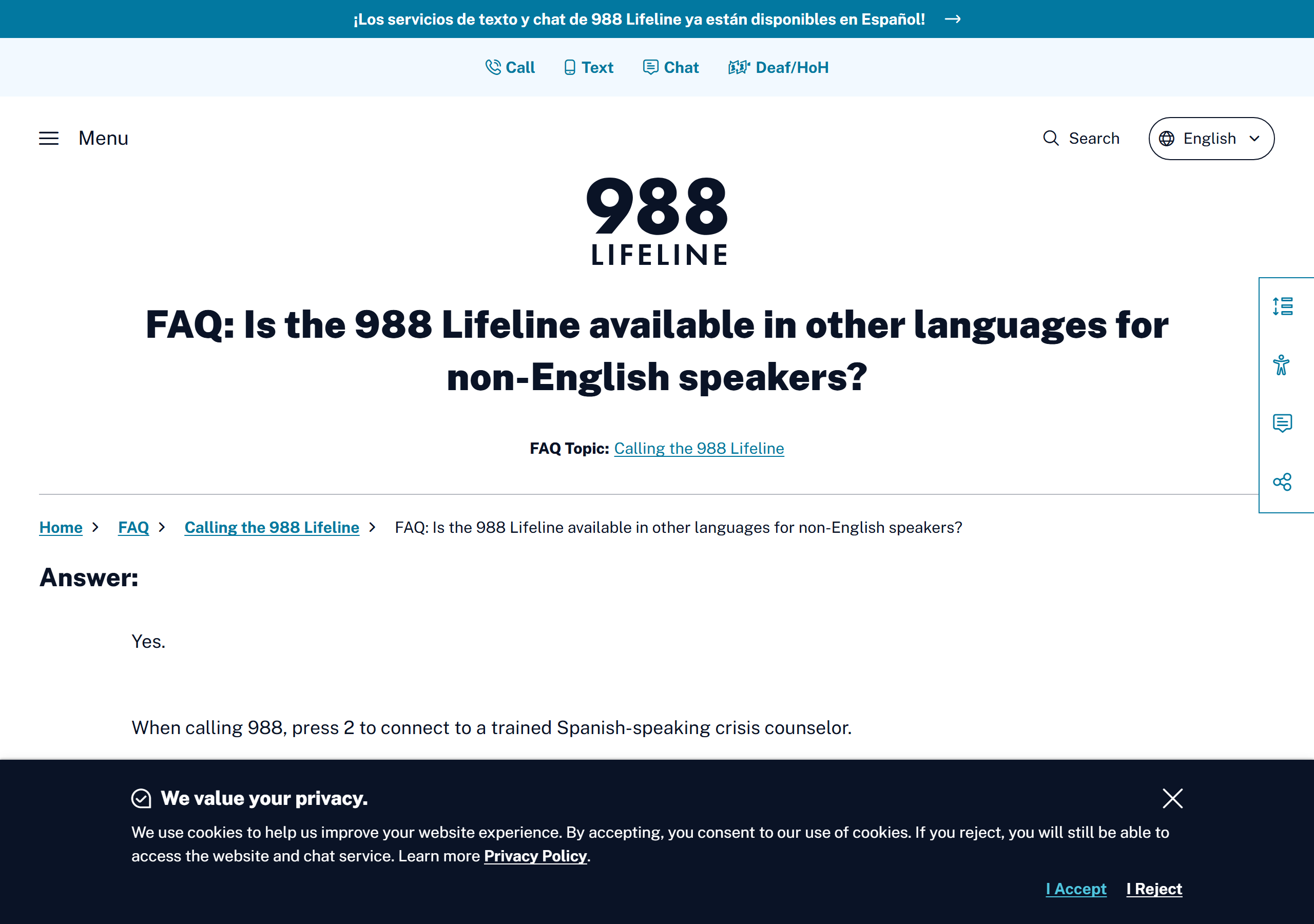
- For Spanish, press 2 or text AYUDA to 988; for other languages, stay on the line and ask, and an interpreter joins in about 20 seconds.
- Fewer than two in a hundred 988 contacts involve emergency services, and 988 will not share what you say with immigration authorities.
Get help right now
Call or text 988 now for free, confidential help, open 24 hours a day. Call 911 if you or someone near you is in immediate danger.
- Call or text 988. This is the 988 Suicide and Crisis Lifeline. It is free, confidential, and open 24 hours a day, every day. A trained counselor will listen and help you stay safe.
- For Spanish, press 2 after you call, or text the word AYUDA to 988. For other languages, stay on the line and ask for your language. The Lifeline adds a phone interpreter in more than 240 languages, usually within about 20 seconds. You can simply say the name of your language.
- If you are a veteran or service member, call 988 and press 1 to reach the Veterans Crisis Line. You can also text 838255. It is free and confidential, even if you are not signed up for VA care.
- You can also text HOME to 741741 to reach the Crisis Text Line, a free, confidential service open 24 hours a day. For Spanish, text HOLA to 741741.
- Call 911 if you or someone near you is in immediate danger, or go to the nearest emergency room.
What happens when you call or text 988
You do not have to be sure it is “bad enough.” You can reach out for any kind of emotional pain. When you connect, a trained counselor will listen without judging you, ask how you are feeling, and help you think through the next safe step. The call is confidential. You can stay anonymous, and you do not have to give your name or any documents. If you ask for an interpreter, the counselor brings one onto the line and the three of you talk together.
Another free option for support and referrals
If you are not in immediate danger but need support, information, or a referral to local services, you can call the SAMHSA National Helpline at 1-800-662-4357 (1-800-662-HELP). It is free, confidential, and open 24 hours a day, in English and Spanish. The people there can point you to treatment and support near you. You do not need insurance to call.
A few things that help
- Tell someone you trust what is happening, and ask them to stay with you until you feel safer.
- Put 988 in your phone now, before you ever need it, so it is ready.
- If you have medicines or other things at home that could be used to hurt yourself, ask someone you trust to hold them for a while.
Reaching out is a strong and caring thing to do for yourself, and you deserve support. Crisis and emergency help in the United States are available to everyone, no matter your insurance or your immigration status.
LINC cannot provide crisis care. If you tell LINC you are in crisis, it will always point you to 988 and 911 and help connect you to a person, because a person can help you in a way that a tool cannot.
If someone else is in crisis
If a friend or family member is talking about wanting to die, or seems in danger of hurting themselves, you can help. The National Institute of Mental Health describes five steps you can take: ask, be there, help keep them safe, help them connect, and stay in touch.
"Are you thinking about suicide?"
"I am here, and I am not going anywhere."
- Ask directly. It can help to ask, “Are you thinking about suicide?” It is not an easy question, but it opens the door and lets the person know you care.
- Stay with them. Do not leave a person alone if you think they are in immediate danger.
- Listen without judging. You do not need the perfect words. Saying “I am here, and I am not going anywhere” is enough.
- Reach 988 together. Offer to call or text the 988 Suicide and Crisis Lifeline with them, and ask for an interpreter if you need one.
- Put away anything dangerous. If you can, move medicines, weapons, or other means of harm out of reach for now.
- Call 911 if they are in immediate danger, and tell the operator it is a mental health emergency.
- Stay in touch afterward. A check-in call or text in the days after a crisis can make a real difference.
You do not have to fix everything on your own. Getting a trained counselor on the line is the goal.
Warning signs to watch for
Sometimes a person shows signs that they may be thinking about suicide, whether in themselves or in someone they love. Watch for these warning signs, especially if the behavior is new, has gotten worse, or started after a painful loss or change:
- Talking about wanting to die or to kill themselves
- Looking for a way to end their life, like searching online or trying to get a gun
- Saying they feel hopeless, trapped, or in unbearable pain
- Saying they feel like a burden to others
- Pulling away from friends and family, or wanting to be left alone
- Sleeping too little or too much
- Using more alcohol or drugs than before
- Acting anxious, agitated, or reckless
- Having extreme mood swings, or showing sudden rage
If you notice these in yourself or someone else, you do not have to wait until it feels “bad enough.” Call or text 988 now.
Making things safer at home
In a crisis, putting time and distance between a person and anything that could cause harm can save a life. Many suicidal moments pass, and even a short delay can give the feeling time to ease and help time to arrive. A 988 counselor can help you make a simple safety plan, step by step.
- Move dangerous things out of reach for now. Ask someone you trust to hold medicines, firearms, or other means of harm until things feel safer. Reducing access to lethal items can help prevent suicide.
- Store any firearm locked and unloaded, with the ammunition locked in a separate place. The Centers for Disease Control and Prevention warns that simply putting a firearm or medicine out of sight or out of reach is not safe storage.
- Lock up medicines, both prescription and the kind you buy without a prescription, and keep only small amounts within reach. A family member can hold the rest and give out safe amounts.
For Deaf and hard of hearing callers
The 988 Lifeline is free, confidential, and open 24 hours a day for Deaf, hard of hearing, and hearing loss callers.
- American Sign Language by video: If you sign, you can connect by video to a counselor who signs. Select “ASL Now” at 988lifeline.org, or, if you have a videophone (VP) number, call 988 with it.
- Text: Send any message to 988 to start a text conversation.
- Chat: Chat online at chat.988lifeline.org.
- TTY: Use your preferred relay service, or dial 711 and then 988.
After the call: what comes next
When you connect, a counselor introduces themselves, asks about your safety, listens to understand how the problem is affecting you, offers support, and may share services or resources that could help.
Reaching out does not mean the police or an ambulance will come. Fewer than two out of every hundred 988 contacts involve emergency services, and that happens only when someone is in immediate danger and a safer plan cannot be made together.
If you are not in a crisis but want ongoing support or a referral, two free lines can help:
- SAMHSA National Helpline, 1-800-662-4357. Free and confidential, 24 hours a day, in English and Spanish, for information and referrals to local treatment and support.
- NAMI HelpLine, 1-800-950-6264. Open Monday through Friday, 10 a.m. to 10 p.m. Eastern time, for free information, resources, and support. You can also text “NAMI” to 62640. This is not a crisis line; in a crisis, use 988.
Your privacy
Reaching out to 988 is confidential and free. You do not need insurance or any documents. The Lifeline will not share what you say with your family, your employer, the police, or immigration authorities, except in the rare case where someone is in immediate danger of harm, or where the law requires it. For most people, the whole conversation stays between you and the counselor.
Sources
- 988 Suicide and Crisis Lifeline. https://988lifeline.org/.
- 988 Suicide and Crisis Lifeline. Confidentiality. https://988lifeline.org/confidentiality/.
- 988 Suicide and Crisis Lifeline. Deaf, hard of hearing, hearing loss. https://988lifeline.org/deaf-hard-of-hearing-hearing-loss/.
- 988 Suicide and Crisis Lifeline. Does Vibrant use police intervention for callers, texters, and chatters to the 988 Lifeline? https://988lifeline.org/faq/about-us/faq-does-vibrant-use-police-intervention-for-callers-texters-and-chatters-to-the-988-lifeline/.
- 988 Suicide and Crisis Lifeline. Is the 988 Lifeline available in other languages for non-English speakers? https://988lifeline.org/faq/calling-the-988-lifeline/faq-is-the-988-lifeline-available-in-other-languages-for-non-english-speakers/.
- 988 Suicide and Crisis Lifeline. Warning signs. https://988lifeline.org/learn/warning-signs/.
- 988 Suicide and Crisis Lifeline. What to expect. https://988lifeline.org/get-help/what-to-expect/.
- Centers for Disease Control and Prevention. Preventing suicide. https://www.cdc.gov/suicide/prevention/.
- Crisis Text Line. https://www.crisistextline.org/.
- National Alliance on Mental Illness. NAMI HelpLine. https://www.nami.org/nami-helpline/.
- National Institute of Mental Health. 5 action steps for helping someone in emotional pain. https://www.nimh.nih.gov/health/publications/5-action-steps-for-helping-someone-in-emotional-pain.
- Substance Abuse and Mental Health Services Administration. National Helpline. https://www.samhsa.gov/find-help/national-helpline.
- Veterans Crisis Line. https://www.veteranscrisisline.net/.
LINC is a research prototype, not a medical or legal service. Translation can be wrong; you have the right to a free, qualified interpreter. For anything high-stakes, do it with a community health worker or someone you trust. In a crisis, call or text 988, or 911 for immediate danger.