Laws and rules change and depend on your situation. Before acting on anything here that could affect your rights or immigration status, confirm with a qualified attorney or an accredited legal representative.
EMTALA is a federal law that says hospital emergency rooms must check and stabilize anyone who arrives with an emergency, no matter whether they have insurance or what their immigration status is. The hospital can ask about payment, but only after you are safe and your emergency is being treated.
If you are undocumented or have no insurance, you can still get mental health care in the United States. Not having papers and not having insurance are common reasons people delay care, and neither one closes the door. Seeking help is safe, and trying is your right. This guide walks through where to go, what it costs, and how to protect your privacy.
- Community health centers (FQHCs) serve everyone, charge on a sliding scale by income, and do not require immigration papers.
- In an emergency, any hospital ER must screen and stabilize you under a law called EMTALA, whatever your status or ability to pay.
- For crisis support, call or text 988, free and confidential, with interpreters in more than 240 languages.
Community health centers are the most reliable door
Community health centers, also called federally qualified health centers or FQHCs, are built for exactly this situation. They serve everyone, including people who are uninsured and people who are undocumented, and they do not require proof of immigration status to treat you. You will not be turned away because you cannot pay; health centers must serve all patients regardless of ability to pay (HRSA).
Instead of a fixed price, they charge on a sliding fee scale based on your income and family size, so you pay what you can afford (HRSA). Many centers have behavioral health and counseling right on site, and they are required to offer interpreters at no cost to you, so you can be seen in your own language.
Here is how the sliding scale usually works. If your household income is at or below the federal poverty guideline for your family size, you get the largest discount, and many centers charge only a small, flat nominal fee at that level. A nominal fee is a token amount set to be affordable from your point of view, not the real cost of the visit (HRSA). If you earn between one and two times the poverty guideline, you still get a partial discount that steps down as your income rises. Above twice the guideline, the sliding discount no longer applies, but you may still qualify for other help. No patient can be denied care for being unable to pay (HRSA).
A health center is more than a doctor’s office. In one place you can often get primary care, counseling and other mental or behavioral health care, dental care, a pharmacy, and enabling services that remove barriers to care, such as case management, help with transportation, health education, and free interpreting (Rural Health Information Hub). These centers are not rare or hard to reach. In 2024 they served more than 32 million people at over 1,350 organizations across every state and territory, and more than one in four of those patients has limited English, so staff are used to working across languages (HRSA). Some clinics are called Health Center Program “look-alikes”; they meet the same rules and offer the same sliding scale even though they do not receive the federal grant, so they count too when you search (Rural Health Information Hub).
You do not need immigration papers to be seen. To set your fee on the sliding scale, a center may ask for proof of income, such as a recent pay stub, but that is about your fee, not your status. If you have no proof of income, ask what else they accept; many centers can still see you.
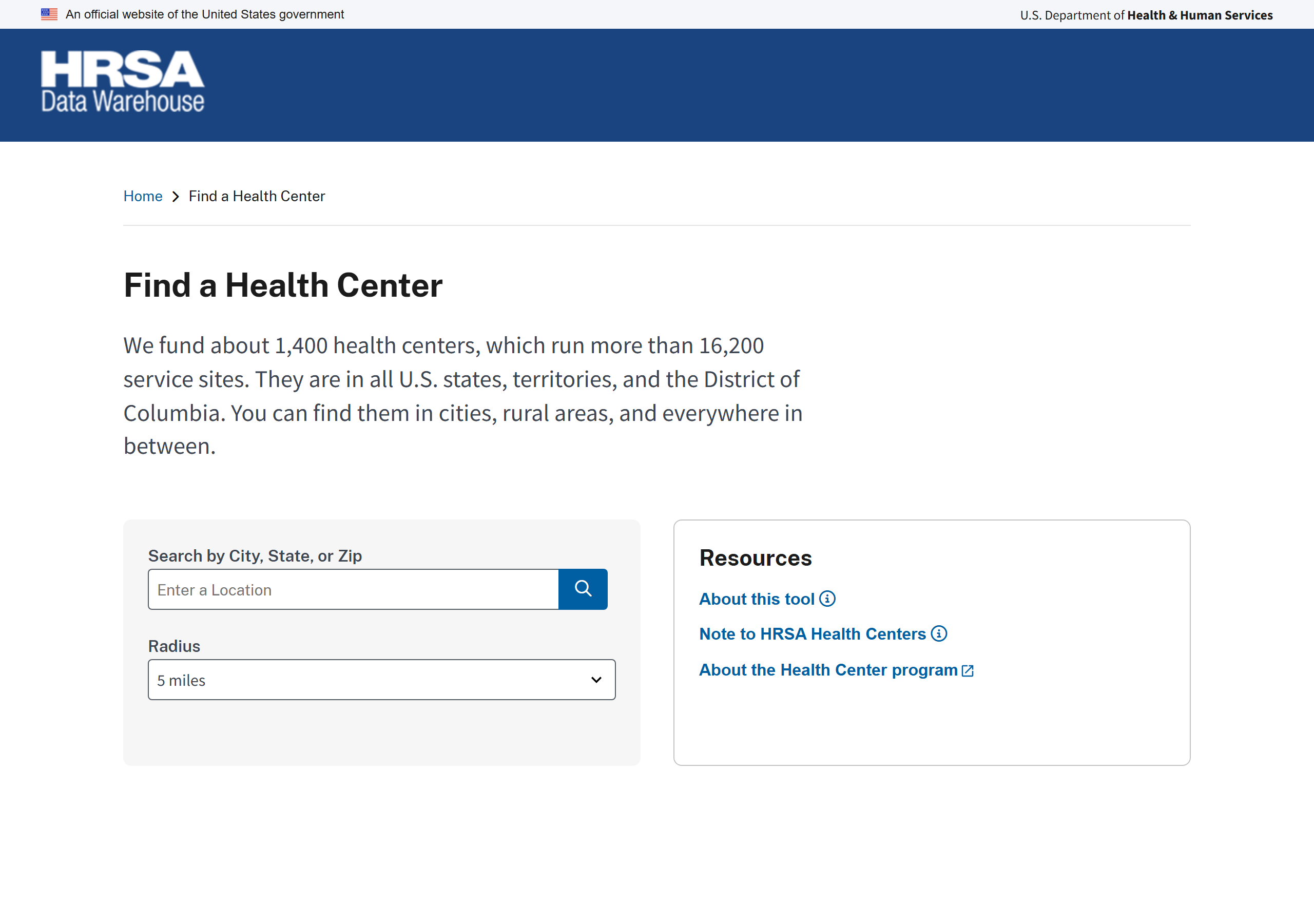
To find one near you, use HRSA’s Find a Health Center tool at findahealthcenter.hrsa.gov. Enter your ZIP code or address and it lists the closest centers with phone numbers. When you call, ask two things: how their sliding fee scale works for your household, and for an interpreter in your language.
"I do not have insurance and I need to see someone about how I am feeling. Do you use a sliding fee scale?"
"What do I need to bring to set my fee? Can you have an interpreter in [your language] ready for my visit?"
Free clinics and a number that knows your area
Beyond health centers, many communities have free and charitable clinics that provide care at no cost or very low cost, often staffed by volunteer clinicians. The National Association of Free & Charitable Clinics keeps a directory of these clinics by location; enter your city or ZIP code to see the ones near you.
You can also dial 2-1-1 from any phone. The free, confidential 211 service connects you to local health and human services, including free and low-cost care, and offers help in many languages (211.org). It is a good first call when you are not sure where to start.
Crisis help and emergencies are for everyone
Crisis support does not depend on your status, your insurance, or your ability to pay.
The 988 Suicide and Crisis Lifeline is free and confidential, 24 hours a day. You can call or text 988, and interpreters are available in more than 240 languages at no cost to you (SAMHSA). For more on what to expect, see If you are in a crisis.
Call or text 988 for the free, confidential Suicide and Crisis Lifeline, 24 hours a day, with interpreters in more than 240 languages. It does not depend on your status, your insurance, or your ability to pay. In a medical or mental health emergency, call 911 or go to the nearest emergency room.
In a medical or mental health emergency, go to the nearest emergency room or call 911. Under a federal law called EMTALA, hospital emergency rooms must screen and stabilize anyone with an emergency, regardless of immigration status or ability to pay, and staff are not required to ask about your citizenship or immigration status (CMS). If you are otherwise unable to get Medicaid because of your immigration status, Emergency Medicaid may still pay for emergency care if you meet your state’s other Medicaid requirements (Medicaid.gov). Emergency Medicaid covers the treatment of a true emergency medical condition, the kind that needs immediate care to prevent serious harm. It does not depend on your immigration status, but you do have to meet your state’s other rules, such as income and living in the state (KFF). To apply, ask the hospital’s financial counselor or your state Medicaid office how it works where you live.
Coverage you may still qualify for
Being uninsured today does not mean you are stuck. Depending on where you live, you may have more options than you expect.
Medicaid and CHIP eligibility varies by state. Some states use their own funds to cover children, and a number cover prenatal and pregnancy care, regardless of immigration status (KFF). A few states also cover some adults regardless of status, and those programs have been changing recently (KFF). These rules change and differ from state to state, so always check the current rule where you live before you assume you do not qualify. The surest way to learn what is true for you right now is to ask a person. A community health worker or your state Medicaid office can check your current eligibility, and USA.gov explains how to apply.
Even if no public program fits, Certified Community Behavioral Health Clinics (CCBHCs) are required to serve anyone who asks for mental health or substance use care, regardless of ability to pay or place of residence (SAMHSA). And sliding-scale fees at community providers mean care is priced to your income. For a fuller walkthrough, read What care costs, and how insurance works and Free and low-cost care: community health centers and sliding scales. To find treatment programs directly, SAMHSA’s FindTreatment.gov lets you search confidentially.
Your privacy and safety
A clinic is a place to get care, not an immigration office. You do not have to share your immigration status to get treatment, and your health information is protected. A good rule is to share only what a specific step actually needs, and do not type your immigration status into apps or AI tools, including this one.
Share only what a specific step actually needs, and do not type your immigration status into apps or AI tools, including this one.
Questions about how care might affect an immigration case are real and important, but they belong with a licensed immigration attorney or a DOJ-accredited representative. LINC does not give legal advice. To understand what protections do and do not change by state, see Can I get mental health care? Your rights, whatever your status.
A gentle next step
You do not have to figure this out alone. A reasonable first move is to find a community health center at findahealthcenter.hrsa.gov, call, and ask about the sliding scale and an interpreter. A community health worker can sit with you through that call, confirm your options, and help you take the next step at a pace that feels safe.
Does getting care hurt my immigration case?
This is one of the most common fears, and for most kinds of care the answer is reassuring. The government uses a test called public charge when it decides some green card and visa cases. It looks at whether a person is likely to depend on cash welfare for basic income, or on long-term care paid for by the government in a place like a nursing home. Everyday health care is not part of that test. Getting Medicaid (except long-term institutional care), CHIP, emergency care, or care at a community health center, and using services like the 988 crisis line, are not counted against you under the current rule (KFF).
Two things still matter. First, rules can change, so if you have a pending immigration case it is worth confirming your own situation. Second, LINC cannot give legal advice, and only a licensed immigration attorney or a DOJ-accredited representative can tell you how a specific benefit affects your specific case. If cost or coverage is your worry, remember that a community health center’s sliding scale lets you get care without signing up for any public program at all.
Common questions, answered
Will going to a health center be reported to immigration? A health center is a place to get care, not an immigration office. Setting your fee is about your income and family size, not your status, and staff are not required to ask about your immigration status. Your health information is protected by federal privacy law. A good rule is to share only what a step actually needs.
What if I have no pay stub? You can still be seen. Ask the center what else it accepts to set your fee. Many will take a letter from an employer, a benefits letter, bank records, or a simple written statement of your income, and some can set your fee based on what you tell them. If you have no income at all, say so; that usually means the largest discount or only a small nominal fee.
What should I say when I call? You can say: “I do not have insurance and I need to see someone about how I am feeling. Do you use a sliding fee scale? What do I need to bring to set my fee? Can you have an interpreter in [your language] ready for my visit?” You do not have to explain your immigration status to make an appointment.
How soon can I be seen? It varies by clinic. Ask, “What is your first available appointment, and do you keep a cancellation or walk-in list?” If you are in crisis while you wait, call or text 988 any time. If it is an emergency, call 911 or go to the nearest emergency room.
Sources
- 211 (United Way). Get connected. Get help. https://www.211.org/
- Centers for Medicare & Medicaid Services. You have rights in an emergency room under EMTALA. https://www.cms.gov/priorities/your-patient-rights/emergency-room-rights
- Health Resources and Services Administration. Am I eligible? https://www.hrsa.gov/get-health-care/affordable/eligibility
- Health Resources and Services Administration. Find a Health Center. https://findahealthcenter.hrsa.gov/
- Health Resources and Services Administration. National Health Center Program Uniform Data System (UDS) awardee data. https://data.hrsa.gov/tools/data-reporting/program-data/national
- Health Resources and Services Administration, Bureau of Primary Health Care. About the Health Center Program. https://bphc.hrsa.gov/about-health-center-program
- Health Resources and Services Administration, Bureau of Primary Health Care. Chapter 9: Sliding fee discount program. Health Center Program Compliance Manual. https://bphc.hrsa.gov/compliance/compliance-manual/chapter9
- KFF. 5 key facts about immigrants and Medicaid. https://www.kff.org/racial-equity-and-health-policy/5-key-facts-about-immigrants-and-medicaid/
- KFF. Potential “chilling effects” of public charge and other immigration policies on Medicaid and CHIP enrollment. https://www.kff.org/medicaid/potential-chilling-effects-of-public-charge-and-other-immigration-policies-on-medicaid-and-chip-enrollment/
- Medicaid.gov, Centers for Medicare & Medicaid Services. Eligibility policy. https://www.medicaid.gov/medicaid/eligibility-policy
- National Association of Free & Charitable Clinics. Find a clinic. https://nafcclinics.org/find-clinic/
- Rural Health Information Hub. Federally qualified health centers (FQHCs) and the Health Center Program. https://www.ruralhealthinfo.org/topics/federally-qualified-health-centers
- Substance Abuse and Mental Health Services Administration. 988 Suicide & Crisis Lifeline. https://www.samhsa.gov/mental-health/988
- Substance Abuse and Mental Health Services Administration. Certified Community Behavioral Health Clinics (CCBHCs). https://www.samhsa.gov/communities/certified-community-behavioral-health-clinics
- Substance Abuse and Mental Health Services Administration. FindTreatment.gov. https://findtreatment.gov/
- USA.gov. How to apply for Medicaid and CHIP. https://www.usa.gov/medicaid-chip-insurance
LINC is a research prototype, not a medical or legal service. Translation can be wrong; you have the right to a free, qualified interpreter. For anything high-stakes, do it with a community health worker or someone you trust. In a crisis, call or text 988, or 911 for immediate danger.