A community health worker is not the same as a professional medical interpreter. A community health worker helps you find care and understand the system, and may speak your language, but they are not there to interpret word for word during a medical appointment. You keep your right to a free, qualified interpreter at the clinic, even when a community health worker is helping you.
When you are new to the health system, the hardest part is often not the doctor’s visit itself. It is everything around it: finding the right clinic, understanding the forms, and knowing what to ask. A community health worker is a person whose job is to help you with exactly that. You do not need to speak English well to work with one, and the help is usually free.
- A community health worker (also called promotor de salud, peer navigator, or outreach worker) is a trusted member of your community who helps you reach and use care.
- They help you find care, understand the system, handle paperwork, and prepare for appointments; some go with you to a visit and follow up.
- The help is usually free, and you do not need insurance or immigration papers.
Who a community health worker is
A community health worker (CHW) is a trusted member of your community who connects people to health and social services. Many community health workers share your language, your culture, and the experience of coming to a new country, so they understand the barriers you face from the inside. The American Public Health Association describes a community health worker as a frontline worker who is a trusted member of, or has a close understanding of, the community served.
You may hear community health workers called by other names. In many Spanish-speaking communities they are promotores de salud (or promotoras). Others go by community health representatives, peer navigators, patient navigators, or outreach workers. The title changes from place to place, but the role is similar.
What a community health worker does
A community health worker helps you reach and use care, step by step. Depending on where they work, one may:
- Help you find care that fits your language, your budget, and your needs.
- Explain how the system works, so terms like referral, sliding scale, and in-network make sense.
- Help with paperwork and applications, such as insurance forms, Medicaid applications, and clinic intake forms.
- Connect you to other resources, including food, housing, transportation, and benefit programs. The CDC notes that community health workers help people by breaking down barriers related to the social conditions that affect health.
- Remind you and prepare you for appointments, and go over the questions you want to ask.
- Go with you to a visit when you want support, and follow up afterward to see how it went and what comes next.
Example: a community health worker helps you apply for Medicaid, books your first counseling appointment, arranges the clinic’s free interpreter, and calls you the day before to remind you what to bring. The U.S. Bureau of Labor Statistics describes this coordinating role across clinics, health departments, and community organizations.
Community health workers across the country have agreed on the main parts of the job. The Community Health Worker Core Consensus (C3) Project lists ten core roles. They include cultural mediation between you and the system, health education in plain words, care coordination and system navigation, coaching and social support, and speaking up for you and your community. Not every community health worker does all ten, but this is the shape of the work.
What a community health worker does not do
It helps to know the limits of the role. A community health worker does not diagnose a condition, provide therapy or counseling, or prescribe medication. For those, you see a provider such as a therapist, a psychologist, or a psychiatrist. LINC’s guide on the different kinds of mental health providers explains who does what.
A community health worker is also not a professional medical interpreter. Even when a community health worker speaks your language and helps you understand the system, you keep your right to a free, qualified interpreter during your medical visit. Interpreting a doctor’s words correctly is a specialized job, and you should not have to give up that right. See Your right to a free interpreter for how to ask.
A community health worker does not diagnose, provide therapy, or prescribe medication, and is not a professional medical interpreter. You keep your right to a free, qualified interpreter during your medical visit.
Why people work with a community health worker
People work with a community health worker for a few simple reasons. There is trust: this is often someone from your own community who understands your situation. There is language: many speak your language and can explain things in plain words. There is time: a community health worker has time to walk through the steps that a busy clinic cannot. And it is usually free, offered as part of a clinic or community program. Community health workers are recognized as part of the health care workforce and often act as a bridge between you and the clinic (Rural Health Information Hub).
Where to find a community health worker
You can find a community health worker in several places, and the help is usually free:
- Community health centers (also called FQHCs), which serve everyone regardless of insurance or ability to pay.
- Ethnic and community-based organizations that serve your community.
- Local health departments, which often run community health worker programs.
- Refugee resettlement agencies, if you arrived as a refugee or asylee.
- The clinic itself. When you book a visit, ask: “Do you have a community health worker, navigator, or promotor who can help me?”
If you are not sure where to start, that is normal. You can ask the chatbot to help you find one, and do the important steps together with a community health worker or someone you trust.
What it is like, and questions to ask
Working with a community health worker usually starts with a simple conversation about what you need. They will ask what is getting in the way, whether that is money, language, transportation, paperwork, or simply not knowing where to go, and then help you take it one step at a time. There is no fee, and you do not need insurance or immigration papers.
When you first meet, it is fine to ask a few questions so you know what to expect.
- What can you help me with, and what is outside your role?
- Is there any cost to me?
- Do you speak my language, or can you help me get a free interpreter at the clinic?
- Will you keep what I share private?
A good community health worker will welcome these questions. If you are not sure where to find one, two quick tools help. Call a community health center near you through findahealthcenter.hrsa.gov and ask if they have a community health worker or promotor, or dial 2-1-1 to reach local organizations, many with staff who speak your language.
Do community health workers really help?
Yes, and there is research behind it. In a study across three health systems in Philadelphia, low-income patients who worked with a community health worker reported better quality of care and spent fewer days in the hospital than patients who did not (Kangovi et al., 2018). A review by the CDC’s Community Guide found that community health worker programs for heart disease and diabetes are a good value for the money spent (Jacob et al., 2019).
For newcomers, the help matters most around mental health, where language and trust are the biggest barriers. A 2025 review of programs for people from many language and cultural backgrounds found that trusted lay workers who share people’s language and culture can lower distress and improve well-being, often just by helping people find and use the care that already exists (Costa et al., 2025). You do not have to take this on trust alone. The help is studied, and it works.
Is it free, and who pays for it?
For you, working with a community health worker is almost always free. You do not pay them, and you do not need insurance. Someone else pays for the service, usually a clinic, a health department, a grant, or a community organization.
More and more, health insurance helps cover this work. As of 2022, over half of state Medicaid programs allowed payment for community health worker services, and more states add coverage each year (KFF). This matters to you in one simple way: it means clinics can afford to offer a community health worker at no charge to you. You should not get a bill for this help. If anyone asks you to pay, stop and check with a clinic or call 2-1-1.
Working with a community health worker is free for you, and you do not need insurance. If anyone asks you to pay for this help, treat it as a warning sign and check with a clinic or call 2-1-1.
Being a community health worker is a real profession. Many states now offer training and certification for the role, though the rules differ from state to state (KFF). You do not need to worry about certification to get help. It is fine to ask, “Are you a trained community health worker?”, and a good program will be glad to answer.
If you came as a refugee or asylee
If you arrived as a refugee or asylee, there are health helpers set up just for you. The federal Office of Refugee Resettlement funds a Refugee Health Promotion program that helps newcomers find and use health care, and it includes a Refugee Mental Health Initiative focused on emotional well-being (Office of Refugee Resettlement). Through these programs, resettlement agencies offer resource navigation, help getting to appointments, peer support, and referrals to mental health care, in your language when they can.
You may hear these helpers called refugee health navigators, community health workers, or community health representatives. Ask your resettlement agency: “Do you have a health navigator or someone who can help me find a doctor and a counselor?” These services are usually available for up to five years after you arrive, and they are free.
Answers to common questions
Is a community health worker really free? Almost always, yes. You do not pay, and you do not need insurance. If someone asks you for money for this help, treat that as a warning sign and check with a clinic or 2-1-1.
Will they tell anyone what I say? They keep your information private. They share only what you allow, and only to help you, such as giving a clinic your name to book a visit. The main exception is if you or someone else is in danger; then they may have to act to keep people safe. You can ask at the start, “What will you keep private, and what might you have to share?”
Do I need insurance or immigration papers? No. Community health workers at community health centers and community organizations help everyone, no matter your insurance or immigration status. You do not have to show papers to get this help.
How is this different from an interpreter? A community health worker helps you find care and understand the system. A professional interpreter converts a doctor’s exact words during your visit. They are different jobs. Even with a community health worker helping you, you keep your right to a free, qualified interpreter. See Your right to a free interpreter.
Can a community health worker come into my appointment with me? Yes, if you want. Many will go with you for support and help you remember your questions. They are still not your interpreter, so ask the clinic for a qualified interpreter for the medical talk.
I do not know where to start. That is normal. Call a community health center through findahealthcenter.hrsa.gov, dial 2-1-1, or ask the chatbot to help you find one and take the first step together.
Sources
- 211 (United Way). Get connected. Get help. https://www.211.org/
- American Public Health Association. Community Health Workers. https://www.apha.org/apha-communities/member-sections/community-health-workers
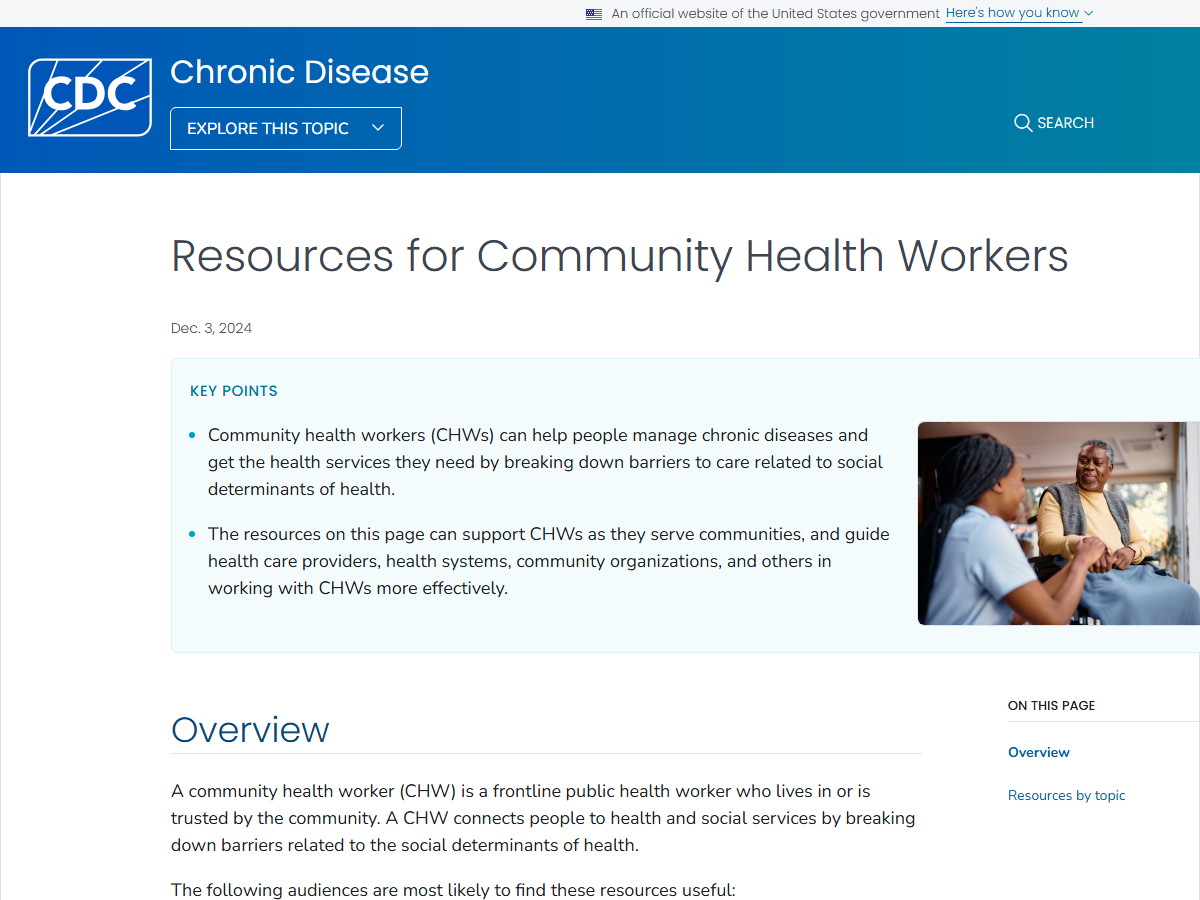
- Centers for Disease Control and Prevention. Resources for Community Health Workers. https://www.cdc.gov/chronic-disease/php/community-health-worker-resources/index.html
- Community Health Worker Core Consensus (C3) Project. Roles & competencies. https://www.c3council.org/roles-competencies
- Costa, N., Olson, R., Mescouto, K., Setchell, J., Plage, S., Dune, T., Creese, J., Suleman, S., Prasad-Ildes, R., & Ng, Z. Y. (2025). Non-clinical psychosocial mental health support programmes for people with diverse language and cultural backgrounds: A critical rapid review. Culture, Medicine, and Psychiatry, 49(3), 585–648. https://doi.org/10.1007/s11013-024-09893-1
- Health Resources and Services Administration. Find a Health Center. https://findahealthcenter.hrsa.gov/
- Jacob, V., Chattopadhyay, S. K., Hopkins, D. P., Reynolds, J. A., Xiong, K. Z., Jones, C. D., Rodriguez, B. J., Proia, K. K., Pronk, N. P., Clymer, J. M., & Goetzel, R. Z. (2019). Economics of community health workers for chronic disease: Findings from Community Guide systematic reviews. American Journal of Preventive Medicine, 56(3), e95–e106. https://doi.org/10.1016/j.amepre.2018.10.009
- Kangovi, S., Mitra, N., Norton, L., Harte, R., Zhao, X., Carter, T., Grande, D., & Long, J. A. (2018). Effect of community health worker support on clinical outcomes of low-income patients across primary care facilities: A randomized clinical trial. JAMA Internal Medicine, 178(12), 1635–1643. https://doi.org/10.1001/jamainternmed.2018.4630
- KFF. (2022). State policies for expanding Medicaid coverage of community health worker (CHW) services. https://www.kff.org/medicaid/state-policies-for-expanding-medicaid-coverage-of-community-health-worker-chw-services/
- Office of Refugee Resettlement. Refugee Health Promotion. Administration for Children and Families. https://acf.gov/orr/programs/refugees/rhp
- Rural Health Information Hub. Community Health Workers in Rural Settings. https://www.ruralhealthinfo.org/topics/community-health-workers
- U.S. Bureau of Labor Statistics. Community Health Workers. Occupational Outlook Handbook. https://www.bls.gov/ooh/community-and-social-service/community-health-workers.htm
LINC is a research prototype, not a medical or legal service. Translation can be wrong; you have the right to a free, qualified interpreter. For anything high-stakes, do it with a community health worker or someone you trust. In a crisis, call or text 988, or 911 for immediate danger.