Serious mental illness, or SMI, is a term used in U.S. health care for mental health conditions that are severe enough to significantly limit everyday activities such as holding a job, keeping relationships, or caring for yourself. Conditions such as schizophrenia, bipolar disorder, and severe depression may qualify as SMI. Having SMI does not mean you cannot improve; it means that more intensive services and care coordination, such as case management and specialty programs, may be available to you.
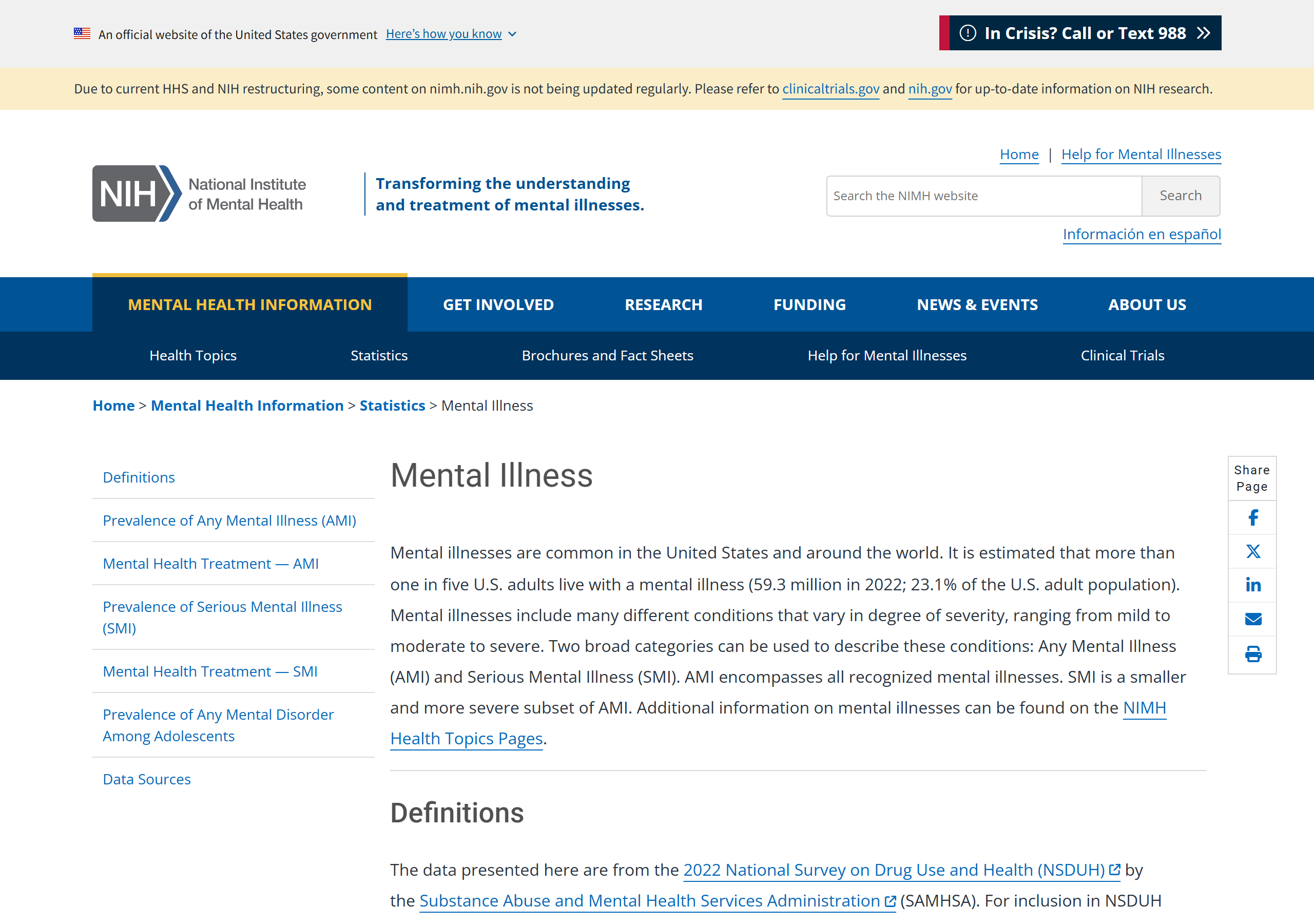
Mental health comes with a lot of names and labels. This guide explains, in plain words, what mental health symptoms and conditions are, from everyday stress to serious illness, and how a diagnosis works. You do not need to label yourself, and you do not need a diagnosis to ask for help. These conditions are common. In 2022, an estimated 59.3 million U.S. adults, more than 1 in 5, lived with some form of mental illness, NIMH reports. Most are treatable, and asking for an assessment is a sign of strength.
- These conditions are common: in 2022, more than 1 in 5 U.S. adults lived with some form of mental illness.
- Most are treatable, and you do not need a diagnosis or a label to ask for help.
- Distress is not only in the mind; it often shows up in the body, as headaches, fatigue, or aches.
What symptoms can look like
A symptom is simply a sign that something is off. Mental health symptoms often show up as changes that last or that get in the way of daily life: a low or heavy mood, big changes in sleep or appetite, worry or fear that is hard to turn off, trouble concentrating, losing interest in things you used to enjoy, or pulling away from people.
Distress is not only in the mind. It very often shows up in the body, as headaches, fatigue, stomach pain, or muscle aches, something researchers call somatization (Kirmayer, 2001). Many immigrants describe their suffering mostly through the body. In one study of Latino primary care patients, people who felt depressed most often spoke of low energy and physical weakness, and some carried real distress even though they did not meet a standard screening cutoff for depression (Caplan et al., 2010). Your symptoms are real whether you feel them in your mood or in your body, and you do not have to match a checklist to deserve care. For how to tell ordinary stress from something more, see Is this stress, or something more?
Common conditions that respond well to care
These are among the most common conditions, and they respond well to care. Anxiety disorders alone affect an estimated 19% of U.S. adults in a given year, NIMH reports, and depression is one of the most common mental disorders in the country. For many immigrants these conditions are tied to migration, loss, or ongoing stress (Kirmayer et al., 2011).
- Depression. What it is: more than feeling sad, a low or empty mood that lasts for at least two weeks. Common signs, NIMH lists, include a persistent sad or empty mood, hopelessness, loss of interest or pleasure, irritability, feeling worthless or guilty, low energy, trouble concentrating or making decisions, changes in sleep or appetite, and physical aches or pains without a clear cause. It is very treatable: “Most people with depression benefit from mental health treatment,” and once you begin, “you should gradually start to feel better,” NIMH explains. Care can be talk therapy, medication, or both.
- Anxiety disorders. What it is: worry or fear that does not go away and is felt in many situations. Common signs: constant worry, restlessness, a racing heart, trouble sleeping. NIMH notes this anxiety “does not go away” and “can get worse over time.” There are a few common forms. Generalized anxiety disorder is worry that is hard to control, more days than not, about many everyday things. Social anxiety disorder is a strong, lasting fear of being judged in social situations. Phobias are intense fears of a specific thing, such as heights or flying. Panic disorder means having sudden, repeated panic attacks, “a sudden wave of fear or discomfort or a sense of losing control even when there is no clear danger or trigger,” with body symptoms such as a pounding or racing heart, sweating, trembling, difficulty breathing, dizziness, chest pain, or nausea, NIMH explains. All of these are treatable, usually with psychotherapy, medication, or both (NIMH).
- Obsessive-compulsive disorder (OCD). A closely related condition marked by “uncontrollable and recurring thoughts (obsessions), repetitive and excessive behaviors (compulsions), or both,” NIMH explains. It often begins between late childhood and young adulthood. There is no simple cure, but treatment helps people manage their symptoms and take part in daily life.
- Post-traumatic stress (PTSD). What it is: lasting distress after a frightening or dangerous event, which many immigrants and refugees have lived through (Kirmayer et al., 2011). Common signs: nightmares, flashbacks, feeling on edge, avoiding reminders. NIMH explains that treatment can help.
When a condition is more serious
Some mental illnesses are more serious. The term serious mental illness (SMI) describes a mental, behavioral, or emotional disorder that causes serious functional impairment, meaning it substantially limits one or more major life activities, NIMH explains. It is less common than milder conditions: about 15.4 million U.S. adults, or 6% of adults, had SMI in 2022 (NIMH).
Examples include severe depression, bipolar disorder, and schizophrenia. Bipolar disorder causes clear shifts in mood and energy. During a manic period a person may feel “extremely ‘up,’ elated, irritable, or energized”; during a depressive period, “very ‘down,’ sad, indifferent, or hopeless,” NIMH explains. It usually needs long-term treatment, but a good treatment plan helps people manage it. Schizophrenia affects how a person thinks, feels, and behaves, and can include losing touch with what is real. It is usually first diagnosed between the ages of 16 and 30, and “gradual changes in thinking, mood, and social functioning often appear before the first episode of psychosis,” NIMH notes, so getting help early can make a real difference.
These conditions are still treatable. With the right care, people living with SMI can work, study, and have relationships, and more intensive services and care coordination exist for them, such as coordinated specialty care and case management. See What behavioral health services exist for how those work.
When alcohol or drugs are part of the picture
Using alcohol or drugs to cope can become its own problem, and it is treated, often with counseling and medication. SAMHSA describes substance use disorder as treatable. It frequently happens alongside a mental health condition, called a co-occurring disorder, and the two are best treated together. SAMHSA explains co-occurring disorders and how integrated care works.
Developmental and neurodevelopmental conditions
Some conditions begin early in life and shape how a person learns, communicates, and pays attention. Autism spectrum disorder affects how people interact, communicate, learn, and behave, NIMH explains. ADHD involves an ongoing pattern of inattention, hyperactivity, or impulsivity. Intellectual and developmental disabilities affect learning and everyday skills; the CDC groups these conditions together. These are assessed and supported, sometimes by different specialists. A good place to start is your primary care provider; for a child, the school can also evaluate and provide support.
How a diagnosis works
You do not have to diagnose yourself. A licensed professional makes a diagnosis by talking with you, sometimes using short questionnaires, and may review your medical history to rule out physical causes, MedlinePlus explains. This first meeting is often called an assessment or intake. The clinician asks about your symptoms, how long they have lasted, your daily life, your history, and your safety. It usually takes about an hour, and you can bring an interpreter and a trusted person.
Clinicians use a shared reference so conditions are named consistently: the DSM-5 (the Diagnostic and Statistical Manual of Mental Disorders), published by the American Psychiatric Association (SAMHSA). The current version is the DSM-5-TR, a text revision published in 2022 (First et al., 2022).
The short questionnaires are called screening tools. They do not by themselves make a diagnosis; they help the clinician measure how strong your symptoms are and check whether they improve over time. Two common ones are the PHQ-9, nine questions about depression over the last two weeks (Kroenke et al., 2001), and the GAD-7, seven questions about anxiety (Spitzer et al., 2006). For each one you say how often a symptom has bothered you, and a higher total points to stronger symptoms.
Good clinicians also pay attention to culture. The words people use for suffering differ from place to place; researchers call these cultural idioms of distress, ways of expressing pain such as “nerves,” spirit possession, or bodily complaints that may not map neatly onto a Western label (SAMHSA). To understand you as a person first, the DSM-5 added a Cultural Formulation Interview, a set of open questions that lets you describe your problem, what you think caused it, and your background in your own words (Bäärnhielm et al., 2024). If a clinician does not ask, you can still tell them how your family or community understands what you are going through.
You can get care for distress even without a formal diagnosis, and a diagnosis is private. You do not need a label to deserve help.
Who diagnoses, and who provides counseling
A licensed clinician (a psychiatrist, psychologist, clinical social worker, or licensed counselor) can assess and diagnose. Talk therapy is provided by therapists, counselors, social workers, and psychologists; medication is managed by psychiatrists or your primary care provider. Who’s who: the different mental health providers explains each role.
What is available varies by state
Which services exist near you depends on where you live, and care for serious mental illness, substance use, and developmental conditions varies a lot by state. To check your own area, search FindTreatment.gov or contact your state Medicaid office to ask what is covered.
When to reach out, and where to start
You do not need a diagnosis or a label to ask for help. If your symptoms are getting in the way of daily life, or they have lasted more than a couple of weeks, that is reason enough to talk to someone.
If you, or someone you love, is thinking about suicide or self-harm, cannot stay safe, or has a sudden and frightening change in thinking or behavior, call or text 988, the Suicide and Crisis Lifeline, any time of day or night. It is free, and interpreters are available in many languages. For immediate danger, call 911.
For care that is not an emergency, three good first steps are:
- Your primary care doctor, who can do an early check and refer you.
- A community health center, which serves everyone, charges based on your income, and offers free interpreters. Find one at findahealthcenter.hrsa.gov.
- Your local public mental health office, or a search on FindTreatment.gov by ZIP code.
You can bring a trusted person or a community health worker with you. Asking for an assessment is a normal, healthy step, and most of these conditions get better with care.
Questions people often ask
Can I get help without a diagnosis? Yes. You can ask for care for distress at any time, and a clinician can help even before, or without, naming a condition. Some people carry real distress that a short screening tool does not capture (Caplan et al., 2010). Your suffering is reason enough.
What if my symptoms are mostly in my body? That is common, and it is real. Tell your provider about the aches, tiredness, or stomach trouble; these can be part of a mental health condition, and naming them helps you get the right care.
Is it normal to feel this way after moving to a new country? Migration, loss, and ongoing stress affect many immigrants and refugees, and they are linked to depression, anxiety, and post-traumatic stress (Kirmayer et al., 2011). Feeling this way does not mean something is wrong with you.
Will I have to take medication forever? Not necessarily. Treatment depends on the condition and on you. Many people improve with talk therapy, medication, or both, and some use medication only for a time. You can ask your provider what to expect.
Is my diagnosis private, and could it affect my immigration case? A diagnosis is protected health information. If you are worried about how getting care could affect an immigration or legal matter, you do not have to guess; talk it through with a community health worker or a trusted legal aid provider before you decide.
Sources
- American Psychiatric Association. (2013). Diagnostic and statistical manual of mental disorders (5th ed.). https://doi.org/10.1176/appi.books.9780890425596.
- Bäärnhielm, S., Rohlof, H., & DeMarinis, V. (2024). Editorial: Clinical implementation of the DSM-5 cultural formulation interview. Frontiers in Psychiatry, 15, 1520122. https://doi.org/10.3389/fpsyt.2024.1520122.
- Caplan, S., Alvidrez, J., Paris, M., Escobar, J. I., Dixon, J. K., Desai, M. M., Whittemore, R., & Scahill, L. D. (2010). Subjective versus objective: An exploratory analysis of Latino primary care patients with self-perceived depression who do not fulfill Primary Care Evaluation of Mental Disorders Patient Health Questionnaire criteria for depression. Primary Care Companion to the Journal of Clinical Psychiatry, 12(5), PCC.09m00899. https://doi.org/10.4088/PCC.09m00899blu.
- Centers for Disease Control and Prevention (CDC). Developmental Disability Basics. https://www.cdc.gov/child-development/about/developmental-disability-basics.html.
- First, M. B., Yousif, L. H., Clarke, D. E., Wang, P. S., Gogtay, N., & Appelbaum, P. S. (2022). DSM-5-TR: Overview of what’s new and what’s changed. World Psychiatry, 21(2), 218-219. https://doi.org/10.1002/wps.20989.
- Health Resources and Services Administration (HRSA). Find a Health Center. https://findahealthcenter.hrsa.gov/.
- Kirmayer, L. J. (2001). Cultural variations in the clinical presentation of depression and anxiety: Implications for diagnosis and treatment. Journal of Clinical Psychiatry, 62(Suppl 13), 22-28. https://pubmed.ncbi.nlm.nih.gov/11434415/.
- Kirmayer, L. J., Narasiah, L., Munoz, M., Rashid, M., Ryder, A. G., Guzder, J., Hassan, G., Rousseau, C., & Pottie, K. (2011). Common mental health problems in immigrants and refugees: General approach in primary care. CMAJ, 183(12), E959-E967. https://doi.org/10.1503/cmaj.090292.
- Kroenke, K., Spitzer, R. L., & Williams, J. B. W. (2001). The PHQ-9: Validity of a brief depression severity measure. Journal of General Internal Medicine, 16(9), 606-613. https://doi.org/10.1046/j.1525-1497.2001.016009606.x.
- MedlinePlus (National Library of Medicine). Mental Disorders. https://medlineplus.gov/mentaldisorders.html.
- National Institute of Mental Health (NIMH). Anxiety Disorders. https://www.nimh.nih.gov/health/topics/anxiety-disorders.
- National Institute of Mental Health (NIMH). Any Anxiety Disorder (statistics). https://www.nimh.nih.gov/health/statistics/any-anxiety-disorder.
- National Institute of Mental Health (NIMH). Attention-Deficit/Hyperactivity Disorder (ADHD). https://www.nimh.nih.gov/health/topics/attention-deficit-hyperactivity-disorder-adhd.
- National Institute of Mental Health (NIMH). Autism Spectrum Disorder. https://www.nimh.nih.gov/health/topics/autism-spectrum-disorders-asd.
- National Institute of Mental Health (NIMH). Bipolar Disorder. https://www.nimh.nih.gov/health/topics/bipolar-disorder.
- National Institute of Mental Health (NIMH). Depression. https://www.nimh.nih.gov/health/topics/depression.
- National Institute of Mental Health (NIMH). Depression (patient booklet). https://www.nimh.nih.gov/health/publications/depression.
- National Institute of Mental Health (NIMH). Generalized Anxiety Disorder: When Worry Gets Out of Control. https://www.nimh.nih.gov/health/publications/generalized-anxiety-disorder-gad.
- National Institute of Mental Health (NIMH). Mental Illness (statistics; defines Any Mental Illness and Serious Mental Illness). https://www.nimh.nih.gov/health/statistics/mental-illness.
- National Institute of Mental Health (NIMH). Obsessive-Compulsive Disorder (OCD). https://www.nimh.nih.gov/health/topics/obsessive-compulsive-disorder-ocd.
- National Institute of Mental Health (NIMH). Panic Disorder: When Fear Overwhelms. https://www.nimh.nih.gov/health/publications/panic-disorder-when-fear-overwhelms.
- National Institute of Mental Health (NIMH). Schizophrenia. https://www.nimh.nih.gov/health/topics/schizophrenia.
- National Institute of Mental Health (NIMH). Traumatic Events and Post-Traumatic Stress Disorder (PTSD). https://www.nimh.nih.gov/health/topics/post-traumatic-stress-disorder-ptsd.
- Spitzer, R. L., Kroenke, K., Williams, J. B. W., & Löwe, B. (2006). A brief measure for assessing generalized anxiety disorder: The GAD-7. Archives of Internal Medicine, 166(10), 1092-1097. https://doi.org/10.1001/archinte.166.10.1092.
- Substance Abuse and Mental Health Services Administration (SAMHSA). Co-Occurring Disorders and Other Health Conditions. https://www.samhsa.gov/substance-use/treatment/co-occurring-disorders.
- Substance Abuse and Mental Health Services Administration (SAMHSA). Cultural Formulation in Diagnosis and Cultural Concepts of Distress. In Improving Cultural Competence (Treatment Improvement Protocol 59). NCBI Bookshelf. https://www.ncbi.nlm.nih.gov/books/NBK248426/.
- Substance Abuse and Mental Health Services Administration (SAMHSA). DSM-5 Changes: Implications for Child Serious Emotional Disturbance (NCBI Bookshelf). https://www.ncbi.nlm.nih.gov/books/NBK519711/.
- Substance Abuse and Mental Health Services Administration (SAMHSA). FindTreatment.gov. https://findtreatment.gov/.
- Substance Abuse and Mental Health Services Administration (SAMHSA). Substance Use Disorder. https://www.samhsa.gov/substance-use.
LINC is a research prototype, not a medical or legal service. Translation can be wrong; you have the right to a free, qualified interpreter. For anything high-stakes, do it with a community health worker or someone you trust. In a crisis, call or text 988, or 911 for immediate danger.