Laws and rules change and depend on your situation. Before acting on anything here that could affect your rights or immigration status, confirm with a qualified attorney or an accredited legal representative.
Section 1557 is the part of the Affordable Care Act that gives you the right to language help at hospitals, clinics, and health plans that receive federal money. It requires them to provide a free, qualified interpreter and to translate important forms into your language. You can file a complaint with the HHS Office for Civil Rights if a covered provider refuses.
When a clinic gives you a free interpreter, that is not a favor. It comes from a stack of laws and policies built up over sixty years. You do not need to memorize them, but knowing their names helps you ask with confidence and helps a navigator advocate for you. This is the companion to our plain guide on your right to a free, qualified interpreter; here we explain where that right comes from.
- Your right to a free, qualified interpreter rests on two laws: Title VI of the Civil Rights Act and Section 1557 of the Affordable Care Act.
- A qualified interpreter must be trained, accurate, neutral, and private; a clinic cannot make you bring your own or lean on your child.
- The 2025 order making English the official language did not repeal Title VI or Section 1557, so your underlying right remains.
Title VI of the Civil Rights Act of 1964: the foundation
This is the bedrock. Title VI is a law passed by Congress in 1964 that says no program receiving federal money may discriminate based on race, color, or national origin. In 1974 the Supreme Court (Lau v. Nichols) read this to mean that leaving people who do not speak English without language help can itself be national-origin discrimination, so federal agencies have required “meaningful access” for people with limited English proficiency ever since. For you, this matters because almost every hospital, clinic, and community mental health center takes some federal money through Medicaid, Medicare, or grants, which puts them under this rule. The U.S. Department of Justice explains Title VI, and HHS describes how it applies on its Limited English Proficiency page.
Section 1557 of the Affordable Care Act: the health-specific rule
Section 1557 takes those civil rights protections and applies them directly to health care. It requires covered health programs to give people with limited English proficiency meaningful access: free qualified interpreters, translation of vital documents, and a notice telling you language services are available. It is enforced by the HHS Office for Civil Rights. This is the rule most directly behind your right to a free interpreter at a mental health visit, and behind getting your forms in a language you understand. HHS lays it out in its Section 1557 fact sheet on language access. Whatever kind of help you get, the 2024 Section 1557 final rule says it must be free to you, accurate, and provided in time to matter, and it must protect your privacy and your right to make your own decisions about your care (National Health Law Program, 2024).
What counts as a “qualified interpreter”
Not just anyone who happens to speak some of your language. Under the 2024 rule, a “qualified interpreter” has to meet a real standard. The person must speak and understand both English and your language well, including medical words. They must interpret everything accurately and completely, without adding, leaving out, or changing what is said, and they must keep your tone and feelings intact. They must stay neutral, and they must follow a code of ethics that includes keeping what you say private (National Health Law Program, 2024). The same standard applies to the phone and video interpreter companies a clinic hires, so a distant interpreter still has to be qualified, not just bilingual. Knowing this helps you ask clearly: you can say you want a qualified medical interpreter, not a bilingual staff member who was pulled in to help.
When family, friends, or your kids can (and cannot) interpret
Many people are handed a relative to interpret because it is quick. The rule limits this on purpose. A covered clinic cannot require you to bring your own interpreter or pay for one yourself. It cannot lean on your child to interpret. And it cannot lean on a family member or friend who is not a trained interpreter, with only two narrow exceptions (National Health Law Program, 2024):
- A true emergency, when someone’s safety is at immediate risk and no qualified interpreter is available yet, such as in a trauma or emergency room.
- When you yourself ask for a specific adult you trust to interpret, that adult agrees, and it makes sense in the situation. The clinic is supposed to write down that you asked.
A minor child may be asked to interpret only in that kind of emergency, never just because it is easier for the clinic. There is a reason for these limits. A relative may not know the medical words, may feel too embarrassed to say them, or may soften or change your words to protect you. You have the right to a neutral, trained interpreter even when a family member is standing right next to you. If you would rather have your own relative interpret, that choice is yours to make, but it should never be forced on you.
Video and phone interpreters: what good ones look like
The rule lets a clinic use an in-person, phone, or video interpreter, as long as the interpreter is qualified. If the clinic uses video, the rule sets quality standards so it actually works for you (National Health Law Program, 2024). The video and sound must be real time and clear, with no freezing, choppy or blurry picture, or long gaps. The image has to be sharp and large enough to see faces. The audio has to be clear. And staff have to be trained to set it up and run it. So if the screen keeps freezing or the sound cuts in and out, that does not count as real language access, and you can ask for a better connection or an in-person interpreter. The same rule also says that if a clinic uses machine or automated translation for something important, like your rights, a consent form, or a complex document, a qualified human has to check the translation. Machine translation alone is not enough when the words really matter.
If the video keeps freezing or the sound cuts in and out, that does not count as real language access. You can ask for a better connection or an in-person interpreter.
Notices and taglines: how to spot your rights
You can often see your rights before you even ask. Covered clinics have to post two kinds of notices (National Health Law Program, 2024). The first is a short message, sometimes called a “tagline,” in your language, saying free language help is available. The rule now calls this the Notice of Availability, and it must appear in English plus at least the fifteen most common languages in your state, on the clinic’s website and in visible places, and on key papers like intake forms, consent forms, and complaint forms. The second is a Notice of Nondiscrimination, which says the clinic does not discriminate and tells you how to get language help, who the clinic’s civil rights (Section 1557) coordinator is, how to file a grievance, and how to file a complaint with the HHS Office for Civil Rights. In other words, the notice itself is a small map to your rights. Look for it at the front desk, on the forms you sign, and on the clinic’s website. If you see a line in your language telling you free help is available, that is your cue to ask for it.
The National CLAS Standards: the quality blueprint
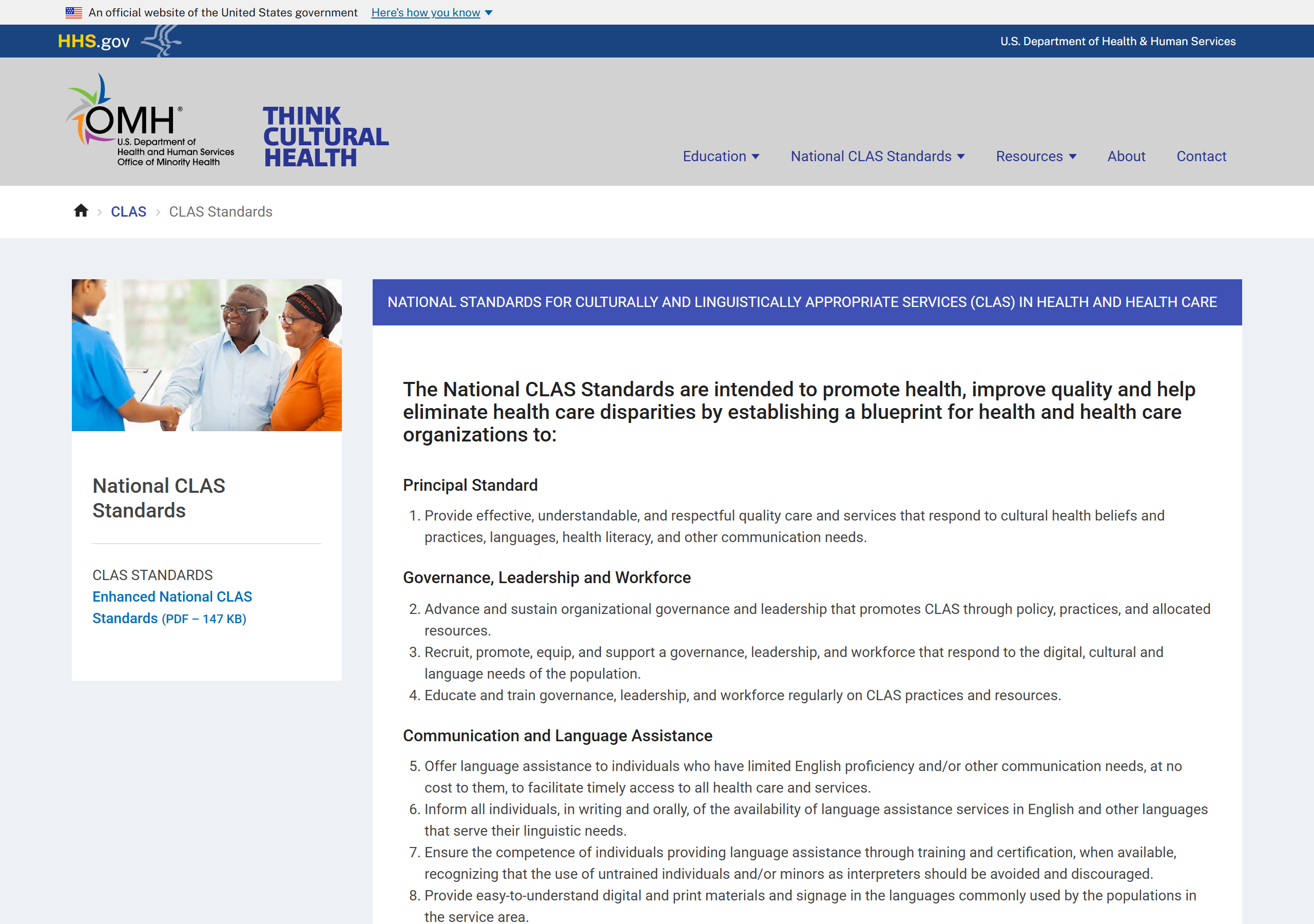
The CLAS Standards (National Standards for Culturally and Linguistically Appropriate Services) are not a law. They are guidance from the HHS Office of Minority Health, fifteen action steps that tell clinics how to do this well: offer competent language assistance at no cost, post notices about it, and provide materials people can actually understand. When a clinic follows CLAS, the interpreters are trained, the signs are in your language, and the forms make sense. You can ask whether a clinic follows the CLAS Standards. They live on the Office of Minority Health’s Think Cultural Health site.
Executive Order 13166 and LEP.gov: the coordination layer
Signed in 2000, Executive Order 13166 told every federal agency and every recipient of federal funds to improve access for people with limited English proficiency, reinforcing Title VI. The Department of Justice ran a shared website, LEP.gov, as the clearinghouse for this work. Here is an honest update, because this piece changed recently. In March 2025, Executive Order 14224 designated English as the official language of the United States and revoked Executive Order 13166, and the Department of Justice then suspended LEP.gov while it reviews its guidance. What this change does not do is repeal Title VI or Section 1557, which are laws passed by Congress and cannot be undone by an executive order. Your underlying right to language help in federally funded health care rests on those two statutes and remains in place, though how strongly the rules are enforced can shift over time. You can still read about the now-revoked order on the DOJ’s Executive Order 13166 page. If you are ever unsure of your rights, a community health center or a community health worker can help you sort it out.
Who pays for the interpreter: Medicaid, and your state
The law makes interpreters free to you, but someone still pays the interpreter. Medicaid can help with that cost. States have the option to draw federal matching funds to reimburse interpreter services, and by one national count 18 states, including the District of Columbia, either reimburse providers directly for language services or use their Medicaid managed care contracts to promote access to them (National Health Law Program, 2024). Medicare and most private insurance generally do not reimburse a clinic for interpreter costs, so the money most often comes from Medicaid or the clinic’s own budget (National Health Law Program, 2024). Where a state reimburses, clinics find it easier to offer interpreters; where it does not, community health centers are still your most reliable door. CMS explains the option on its Medicaid translation and interpretation services page.
This varies a lot by state
Federal law sets the floor. On top of it, states add their own language-access laws and decide whether Medicaid pays for interpreters, so what you can actually get depends on where you live. Even in a state that has made English its official language, that federal floor still stands. Federal law comes first, so a state or local rule that gives you less protection does not override Title VI or Section 1557 in a program that takes federal money (National Health Law Program, 2024). You can call your state Medicaid office to ask what is covered for you right now.
What to do if you are refused an interpreter
Knowing the law helps most when you can act on it. If a clinic will not give you a free interpreter:
"I have the right to a free, qualified interpreter under Section 1557. Please arrange one."
- Ask again, plainly. Say: “I have the right to a free, qualified interpreter under Section 1557. Please arrange one.” You do not have to pay, and you should not be asked to bring your own.
- Ask for the person in charge. Larger providers have a Section 1557 or civil rights coordinator and a grievance process. Ask for them by name.
- Get help from a community health worker or a community health center. They handle these requests every day.
- Check your state. Your state Medicaid office can tell you what interpreter coverage applies to you.
- File a complaint if you need to. You can report it to the HHS Office for Civil Rights, for free. The step-by-step is just below.
How to file a complaint, step by step
If a covered clinic, hospital, or health plan denies you meaningful language access, you can file a civil rights complaint with the HHS Office for Civil Rights. You do not need a lawyer, and it costs nothing (HHS Office for Civil Rights, n.d.).
- Write down what happened. Note the date, the place, who was involved, what you asked for, and what they said or did. Keep any papers or messages.
- Watch the timing. File within 180 days of when you learned the problem happened. If more time has passed, you can still ask, because the Office for Civil Rights can extend the deadline for good cause.
- File online. The easiest way is the OCR Complaint Portal. You can also file by mail, by fax, or by email at OCRComplaint@hhs.gov.
- You can get help, or have someone file for you. A family member, a community health worker, or an advocate can file on your behalf. You will sign the complaint and a short consent form, which you can do online.
- You are protected. A provider is not allowed to punish you or retaliate against you for filing a complaint.
After you file, the Office for Civil Rights reviews your complaint and may investigate the provider. Filing does not fix your visit that day, so keep asking for an interpreter in the meantime and lean on a community health worker or community health center for immediate help.
Sources
- Centers for Medicare & Medicaid Services. Translation and interpretation services (Medicaid). https://www.medicaid.gov/medicaid/financial-management/medicaid-administrative-claiming/translation-and-interpretation-services.
- Executive Office of the President. Executive Order 14224: Designating English as the official language of the United States. Federal Register, 90, 11363 (March 6, 2025). https://www.federalregister.gov/documents/2025/03/06/2025-03694/designating-english-as-the-official-language-of-the-united-states.
- National Health Law Program. Medicaid and CHIP reimbursement models for language services: 2024 update. https://healthlaw.org/resource/medicaid-and-chip-reimbursement-models-for-language-services-2024-update/.
- National Health Law Program. What is required under Title VI and Section 1557 to ensure language access for individuals with limited English proficiency? (2024). https://healthlaw.org/wp-content/uploads/2024/05/T-VI-and-Sec-1557-explainer-2024.pdf.
- U.S. Department of Health and Human Services, Office for Civil Rights. How to file a civil rights complaint. https://www.hhs.gov/civil-rights/filing-a-complaint/complaint-process/index.html.
- U.S. Department of Health and Human Services, Office for Civil Rights. Limited English proficiency (LEP). https://www.hhs.gov/civil-rights/for-individuals/special-topics/limited-english-proficiency/index.html.
- U.S. Department of Health and Human Services, Office for Civil Rights. Nondiscrimination in health programs and activities (final rule), 89 Fed. Reg. 37522 (May 6, 2024). https://www.federalregister.gov/documents/2024/05/06/2024-08711/nondiscrimination-in-health-programs-and-activities.
- U.S. Department of Health and Human Services, Office for Civil Rights. Section 1557: Ensuring meaningful access for individuals with limited English proficiency. https://www.hhs.gov/civil-rights/for-individuals/section-1557/fs-limited-english-proficiency/index.html.
- U.S. Department of Health and Human Services, Office of Minority Health. National CLAS standards (Think Cultural Health). https://thinkculturalhealth.hhs.gov/clas/standards.
- U.S. Department of Justice, Civil Rights Division. Executive Order 13166. https://www.justice.gov/crt/executive-order-13166.
- U.S. Department of Justice, Civil Rights Division. Title VI of the Civil Rights Act of 1964. https://www.justice.gov/crt/fcs/TitleVI.
LINC is a research prototype, not a medical or legal service. Translation can be wrong; you have the right to a free, qualified interpreter. For anything high-stakes, do it with a community health worker or someone you trust. In a crisis, call or text 988, or 911 for immediate danger.