Intake forms are the papers the front desk asks you to fill out when you arrive at a health visit. They collect your name, insurance information, health history, and list of medications. You are allowed to ask why any information is needed, to leave a question blank if it does not apply, and to ask for help filling out the form in your language.
A first mental health visit is mostly talking. The provider wants to understand what you are going through and how they can help. You are in charge the whole time: nothing is decided without you, and you can take it at your own pace. A little preparation makes the visit calmer and more useful.
- A first visit is mostly talking, and nothing is decided without you.
- Bring your insurance card, a list of your medicines, and notes about your symptoms.
- Confirm a free interpreter the day before; federal law gives you the right.
What to bring
Gather these the night before so you are not rushing:
- Your insurance card and a photo ID, if you have them.
- A list of your medicines, or the bottles, including anything from your home country, plus any vitamins or herbal remedies.
- Notes about your symptoms: when they started, how often they happen, and how they affect your day.
- Notes about big stresses right now, such as money, housing, work, family, or your immigration situation.
- Three to five questions you want to ask (see the next section).
- Any past records or a previous diagnosis, if you have them.
- The interpreter arrangement you asked for when you booked.
You can also bring a trusted friend or family member for support if you want one. It is your choice.
Confirm your interpreter
Call the day before to make sure the interpreter is arranged. You have the right to a free, qualified interpreter under federal civil rights law (HHS Office for Civil Rights, Section 1557). If none has been set up, ask for one again and ask to reschedule rather than go ahead without it. A conversation about your mental health needs to be clear in your own language.
On the phone, you can say, “I need a [your language] interpreter for my appointment. Can you confirm one is booked?” A trained medical interpreter is the right choice for this visit (Think Cultural Health). It is better than asking a family member or a child to interpret, because the conversation is private and detailed, and a trained interpreter is there to pass on everything accurately.
Once your interpreter is confirmed, the section “Working with your interpreter” below shows how to make the conversation go smoothly.
Prepare your questions
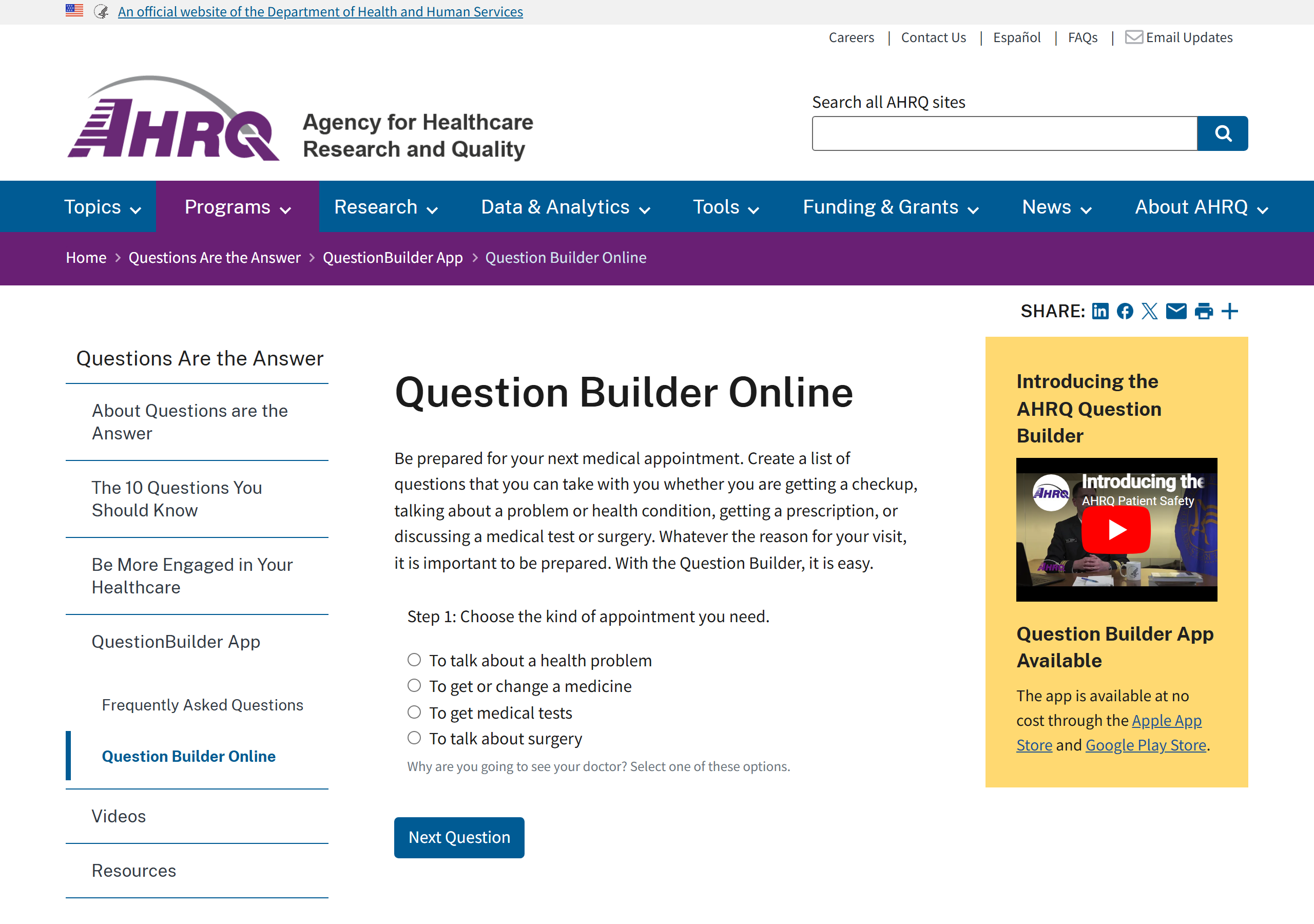
Write down three to five questions before you go. The AHRQ Question Builder can help you put them together. Useful ones include:
- What might be going on with me?
- What are my options, and do I have to take medicine or are there other choices like talk therapy?
- What are the benefits and risks of each one?
- What happens next, and when?
- How much will this cost?
- Will what I tell you stay private?
If medicine comes up, it also helps to ask what the side effects are, how long it takes to work, and whether it is safe with anything you already take. If you feel nervous starting the visit, you can simply say, “This is my first time here, and I am a little nervous. Can you tell me how today will go?”
What happens at the visit
A first visit is usually longer than a regular checkup, because the provider is getting to know you. Plan for extra time, and more still if you have an interpreter, since everything is said twice, once by you and once by the interpreter (Think Cultural Health).
When you arrive, the front desk will give you intake forms to fill out. These are the papers that ask for your name, your insurance, your health history, and your list of medicines. You can ask for help filling them out in your language, you can leave a question blank if it does not apply to you, and you can ask why any information is needed.
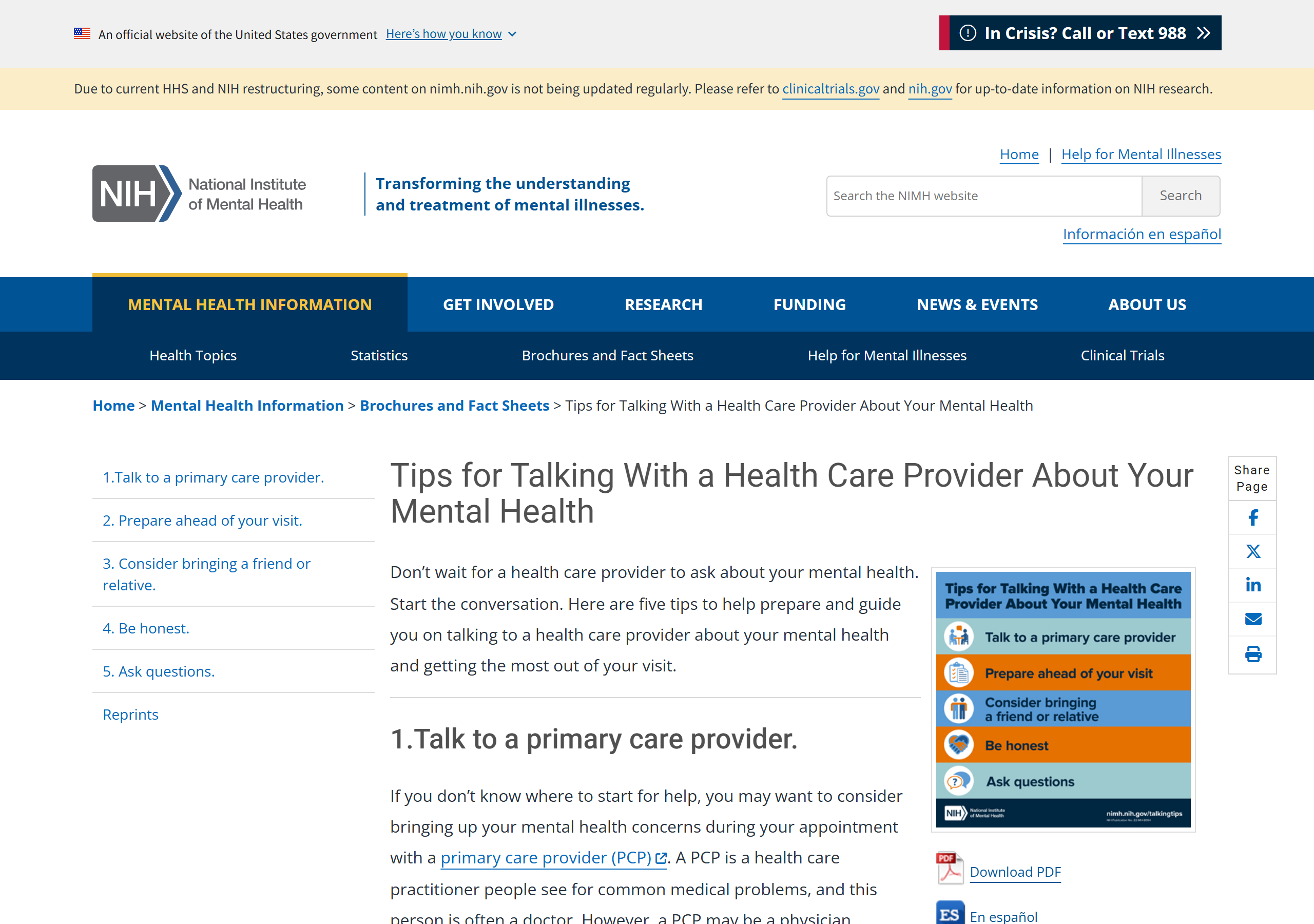
Most of the visit is questions and talking. The provider will ask about your feelings, mood, sleep, and appetite, and about what is going on in your life (MedlinePlus). They will also ask about your past, every medicine you take, and any alcohol or drug use. Answer as honestly as you can. There is no single treatment that fits everyone, so the provider needs the full picture (NIMH).
You may be handed one or two short questionnaires to fill in and then talk through. One common one is called the PHQ-9. It asks how often things like low mood, poor sleep, low energy, or a poor appetite have been bothering you (MedlinePlus, Depression Screening). Another, the GAD-7, asks how often you have felt nervous, anxious, on edge, or unable to stop worrying (Rutter & Brown). There are no right or wrong answers. They simply help the provider see how you have been feeling.
The provider may also ask, gently, whether you have had thoughts of hurting yourself. This is a normal, caring question that they ask many people, and answering honestly helps them keep you safe and find the right support (MedlinePlus, Suicide Risk Screening). If your answer is yes, it is okay to say so.
It is fine to say, “I do not understand, please explain that again,” and to ask the interpreter to repeat something. You can bring a trusted person for support. The provider will suggest options, but the decisions are yours: nothing is decided without you.
If cost or getting there worries you
Money and travel should not stop you from going. A few things help:
- Ask when you book: “What will this visit cost me?” and “Do you have a sliding scale based on income?” Many clinics lower the fee for people with little or no income.
- If you have no insurance, a community health center serves everyone and charges based on what you can afford, with free interpreters. Find one at findahealthcenter.hrsa.gov.
- If you are uninsured or paying for the visit yourself, you can ask for a written estimate of the cost before you go. See “Asking for a cost estimate before you go,” below.
- If getting there is hard, ask whether the visit can be done by phone or video. See “If your visit is by phone or video,” below.
You do not have to wait. Call or text 988 any time, free, with interpreters in many languages.
Before you leave
Before you go, write down the plan and the date of your next appointment. It helps to say back what you understood, in your own words: “So the plan is…, is that right?” This is called teach-back, and it makes sure nothing was lost in translation (Think Cultural Health). Also ask, “Who do I call if I feel worse before my next visit?” If anything was unclear, you can ask the chatbot to help you write a follow-up question in your language, and then confirm the important answers with a person.
It is normal to feel nervous before a first visit. Going in prepared, with your questions ready and your interpreter confirmed, helps you walk out with answers instead of more worry.
Working with your interpreter
A trained interpreter is there to pass on everything you and the provider say. A few simple habits make it work well:
- Speak to the provider, not to the interpreter. Look at and talk to the provider, even though you also hear the interpreter’s voice (Think Cultural Health).
- Speak in short pieces, then pause, so the interpreter can catch every word. Long, run-on sentences are easy to lose (Think Cultural Health).
- Speak as “I,” in the first person, and the interpreter will do the same. You do not need to say “tell her that I…,” just say what you mean (Think Cultural Health).
- Ask the interpreter to say everything, and to leave nothing out or shorten it.
- It is fine to stop and say, “Please repeat that,” or “I did not understand.” A good interpreter will not mind.
A trained interpreter keeps what you say private, the same as the provider does.
Your privacy and its limits
What you tell a mental health provider is private. A federal law called HIPAA protects your health information, and in most cases the clinic needs your permission before it shares your information with anyone else (HHS Office for Civil Rights). You can ask, “Who will see what I tell you?” and the clinic must explain.
There are a few narrow exceptions where a provider may share without your permission. The main ones are if you are in serious and immediate danger of harming yourself or someone else, or if a child or a vulnerable adult is being abused. In those cases the law lets the provider act to keep people safe (HHS Office for Civil Rights). Outside of situations like these, what you say stays between you and your care team.
Seeking mental health care is private. It is not posted on any public list, and it does not, by itself, affect your immigration status. Using health coverage such as Medicaid, or going to a community health center, is not counted against you when you apply for a green card or citizenship (U.S. Citizenship and Immigration Services). If you are still worried, you can pay for the visit yourself and ask about the cost first.
Asking for a cost estimate before you go
If you do not have insurance, or you plan to pay for the visit yourself, you have the right to a written estimate of the cost before you go. This is called a Good Faith Estimate, and it comes from a federal law called the No Surprises Act (CMS).
You can say, “I am uninsured and paying myself. Can you give me a Good Faith Estimate of the cost in writing?” The clinic must give you one when you ask, and when you schedule your visit at least three business days ahead (CMS).
Keep the estimate. If the final bill turns out to be at least 400 dollars more than the estimate, you can dispute the charge through a federal process (CMS).
If your visit is by phone or video
If getting to the clinic is hard, ask whether your first visit can be done by phone or video. A few things help it go smoothly:
- Pick a quiet, private place where you feel comfortable talking openly (Telehealth.HHS.gov).
- Check that your internet and your phone or computer are working before the visit, and for a video visit, sign on about fifteen minutes early in case something needs fixing (Telehealth.HHS.gov).
- Keep a pen and paper nearby for notes, and have your list of questions ready (Telehealth.HHS.gov).
- Ask ahead of time how much the visit will cost (Telehealth.HHS.gov).
- You still have the right to a free interpreter on a phone or video visit. Ask for one when you book, the same as for an in-person visit (HHS Office for Civil Rights, Section 1557).
Try not to have your visit while you are driving or busy with other things, so you can focus (Telehealth.HHS.gov).
Sources
- Agency for Healthcare Research and Quality (AHRQ). Questions Are the Answer: Question Builder (Online). https://www.ahrq.gov/questions/question-builder/online.html.
- Centers for Medicare & Medicaid Services (CMS). No Surprises Act: For Consumers. https://www.cms.gov/nosurprises/consumers.
- Health Resources and Services Administration (HRSA). Find a Health Center. https://findahealthcenter.hrsa.gov/.
- HHS Office for Civil Rights. HIPAA Privacy Rule: Information Related to Mental and Behavioral Health. https://www.hhs.gov/hipaa/for-professionals/special-topics/mental-health/index.html.
- HHS Office for Civil Rights. Section 1557: Ensuring Meaningful Access for Individuals with Limited English Proficiency. https://www.hhs.gov/civil-rights/for-individuals/section-1557/fs-limited-english-proficiency/index.html.
- MedlinePlus (National Library of Medicine). Depression Screening. https://medlineplus.gov/lab-tests/depression-screening/.
- MedlinePlus (National Library of Medicine). Mental Health Screening. https://medlineplus.gov/lab-tests/mental-health-screening/.
- MedlinePlus (National Library of Medicine). Suicide Risk Screening. https://medlineplus.gov/lab-tests/suicide-risk-screening/.
- National Institute of Mental Health (NIMH). Tips for Talking With a Health Care Provider About Your Mental Health. https://www.nimh.nih.gov/health/publications/tips-for-talking-with-your-health-care-provider.
- Rutter, L. A., & Brown, T. A. (2016). Psychometric properties of the Generalized Anxiety Disorder Scale-7 (GAD-7) in outpatients with anxiety and mood disorders. Journal of Psychopathology and Behavioral Assessment, 39(1), 140–146. https://pmc.ncbi.nlm.nih.gov/articles/PMC5333929/.
- Telehealth.HHS.gov. What Should I Know Before My Telehealth Visit? https://telehealth.hhs.gov/patients/what-should-i-know-before-my-telehealth-visit.
- U.S. Citizenship and Immigration Services (USCIS). Fact Sheet: How Receiving Public Benefits Might Impact the Public Charge Ground of Inadmissibility. https://www.uscis.gov/sites/default/files/document/fact-sheets/How_Receiving_Public_Benefits_Might_Impact_the_Public_Charge_Ground_of_Inadmissibility_Fact_Sheet.pdf.
- U.S. Department of Health and Human Services, Office of Minority Health, Think Cultural Health. Working Effectively With an Interpreter. https://thinkculturalhealth.hhs.gov/assets/pdfs/resource-library/working-effectively-with-interpreter.pdf.
LINC is a research prototype, not a medical or legal service. Translation can be wrong; you have the right to a free, qualified interpreter. For anything high-stakes, do it with a community health worker or someone you trust. In a crisis, call or text 988, or 911 for immediate danger.