An 'involuntary hold' is when a hospital keeps a person for a short evaluation period for safety reasons, even if that person does not agree to stay. The rules for how long and who can authorize it are different in every state. It is a temporary safety step, not a punishment, and you still have rights, including the right to a free interpreter.
Many people carry a quiet fear of the emergency room or a psychiatric hospital, picturing the worst. The reality is usually calmer and more ordinary. Emergency mental health care exists to keep you safe through a hard moment and then help you find your footing. This guide explains what tends to happen, what your rights are, and how cost and immigration status fit in.
- Not every crisis needs an ER; call or text 988 first, and 988 can send a mobile crisis team to you.
- Go to the ER or call 911 when someone is in immediate danger.
- Under a law called EMTALA, any hospital ER must screen and stabilize you regardless of immigration status or ability to pay.
When to call 988, when to call a mobile crisis team, and when to go to the ER
If someone is in immediate danger, has seriously hurt themselves or is about to, call 911 now and do not leave the person alone. You can say it is a mental health emergency. For emotional distress that is not life-threatening, call or text 988 first.
Not every hard moment needs an emergency room. If you are struggling, in emotional pain, or worried about yourself or someone else, you can call or text 988 to reach the 988 Suicide and Crisis Lifeline. It is free and confidential, open 24 hours a day, and you can ask for an interpreter in your language. A trained counselor will talk it through with you, and for many people that conversation is enough.
If you need more than a phone call but it is not life-threatening, 988 can often send a mobile crisis team, a small group of trained responders who come to you. Their goal is to help you stay safe and get support without a hospital trip when one is not needed.
It can help to picture how crisis care is built. It rests on three simple ideas: someone to contact, someone to respond, and a safe place for help. Calling 988 is the first door, and it can open the others when you need them.
Go to the nearest emergency room, or call 911, when there is immediate danger: someone has seriously hurt themselves, is about to, or cannot stay safe right now (MedlinePlus). When you call 911, you can say it is a mental health emergency and ask for help that is trained for that. If someone has already tried to hurt themselves, call 911 right away and do not leave the person alone (MedlinePlus).
What happens in a psychiatric emergency at the ER
At the ER, a staff member first checks how urgent things are. For a mental health emergency, a doctor, nurse, or behavioral health clinician will talk with you about how you are feeling, your safety, your history, and any medicines you take (NIMH). They may check your physical health too, since some symptoms have medical causes. The aim is to understand what is happening and keep you safe while you are there.
After the evaluation, the most common next step is going home with a plan and a referral for follow-up care. Sometimes the team recommends a short stay in the hospital or a crisis unit so you can be supported until the hardest part passes. This is a treatment step, not a punishment.
One thing to be ready for is waiting. Emergency rooms are busy, and there are not always enough psychiatric beds nearby, so it can take several hours, and sometimes longer, before you are fully evaluated or moved to the right place. This waiting even has a name, boarding, and it is common across the country. It does not mean you are forgotten. You can ask staff for updates, ask for water or a quieter spot, and ask for your interpreter at any point. Bringing a phone charger and a little patience helps.
Voluntary and involuntary hospitalization, in plain terms
Most hospital stays are voluntary: you agree to stay because it will help, and you take part in decisions about your care. Involuntary (emergency) hospitalization is when a person is kept for evaluation or care for a short time because there is serious concern for safety, even if they do not agree in that moment. The exact rules, who can authorize it, and the time limits vary by state. This guide is not legal advice; for your specific situation, a community health worker or a legal aid organization can help you understand your state’s process.
When a hold is used, it is usually short. Many states allow an emergency hold of up to about 72 hours for evaluation, though the real limit is shorter or longer depending on where you live, and the rules differ a great deal from state to state (National Alliance on Mental Illness). If a longer stay is proposed, many states give you the right to a court hearing, to have someone speak for you, and to appeal the decision. You can ask for your interpreter at every step.
Either way, you keep important rights. You have the right to be told what is happening, to be treated with respect, and to a free, qualified interpreter in healthcare settings (HHS Office for Civil Rights). You can ask for one at any point, and you should not have to rely on a family member to interpret.
Everyone gets screened and stabilized, whatever your status or money
A federal law called EMTALA protects you in any emergency room at a hospital that takes Medicare, which is almost all of them. When you arrive, the staff must give you a medical screening exam to find out whether you have an emergency, and if you do, they must treat you to stabilize it or arrange a safe transfer to a hospital that can. They cannot delay that exam to ask about payment, and they cannot demand money up front before they screen you. This is true even if you have no insurance, and even if you are not a U.S. citizen (CMS). The hospital can ask about insurance, but only in a way that does not hold up your care.
Cost worries are understandable, and there is help. Even if your immigration status keeps you from regular Medicaid, Emergency Medicaid may pay for emergency care if you meet your state’s other Medicaid rules such as income and residency (Medicaid.gov). A hospital financial counselor or a community health worker can help you apply. For more, see Getting care if you are undocumented or uninsured.
There is also a law about surprise bills. The No Surprises Act protects you from most surprise out-of-network charges for emergency care, so an emergency visit should not cost you extra just because a doctor there was not in your plan’s network. One gap to know: a ride in a ground ambulance is often not covered by this protection, so it can still bring a separate bill. If any bill worries you, ask for a hospital financial counselor and ask about a payment plan or charity care.
What to bring and who can come
None of the following is required to be seen, but if there is time, bringing what you have helps.
- An ID and insurance card, if you have them.
- A list of your medicines.
- The phone number of someone you trust.
A family member or friend can usually come and wait with you, and can help you ask for an interpreter, though they should not be the interpreter.
After you leave
Discharge usually comes with a follow-up plan: an appointment or referral, any medicines, and often a simple safety plan that lists your warning signs, coping steps, and people to call, including 988. Keep that paper. To set up ongoing care, see Behavioral health services and where to find them, and for crisis support any time, If you are in a crisis.
A safety plan is short and personal, and you make it with a staff member. It usually has a few parts: the warning signs that a hard moment may be coming, things you can do on your own to feel steadier, people and places that take your mind off the pain, people you can call, and crisis numbers like 988. It also includes making your space safer by lowering your access to things you could use to hurt yourself. Keep it somewhere easy to find, and share it with someone you trust so you are not the only one holding it.
You do not have to plan all of this alone. You can ask the chatbot (“Ask Chatbot”) to explain a word, list questions to ask, or help you rehearse what to say, and then take the real steps with a community health worker or someone you trust.
Answers to common worries
Will I be locked up if I go to the ER? For most people, no. The usual path is to be evaluated and go home the same day with a plan. A hospital stay happens only when there is a serious safety concern, and even then it is care, not punishment. If you are kept for a short hold, it is usually a matter of hours to a few days, it varies by state, and you keep your rights.
Who pays for the ambulance and the ER? You will be screened and stabilized no matter what you can pay. The ER may still send a bill later, but there is help. You may qualify for Emergency Medicaid or hospital financial aid, and the No Surprises Act protects you from most surprise out-of-network charges for emergency care. A ground ambulance ride is often not covered by that protection, so ask about the cost and about payment plans. A hospital financial counselor or a community health worker can help.
Will the hospital call immigration? A hospital is there to care for you, and by law it must screen and stabilize an emergency no matter your citizenship or status. Your health information is protected. A legal or immigration question is one for a legal aid organization. See Getting care if you are undocumented or uninsured.
Can my family stay with me? Usually a person you trust can wait with you and help you speak up, including asking for your interpreter. They should not be the one interpreting. If you would rather they not hear private details, you can ask for a professional interpreter and some privacy.
Sources
- 988 Suicide & Crisis Lifeline. Help yourself: Create a safety plan. https://988lifeline.org/help-yourself/
- American Psychiatric Association. Boarding of mentally ill patients in emergency departments: American Psychiatric Association resource document. Focus. https://psychiatryonline.org/doi/10.1176/appi.focus.23022001
- Centers for Medicare & Medicaid Services. No surprises: Understand your rights against surprise medical bills. https://www.cms.gov/newsroom/fact-sheets/no-surprises-understand-your-rights-against-surprise-medical-bills
- Centers for Medicare & Medicaid Services. You have rights in an emergency room under EMTALA. https://www.cms.gov/priorities/your-patient-rights/emergency-room-rights
- HHS Office for Civil Rights. Section 1557: Ensuring meaningful access for individuals with limited English proficiency. https://www.hhs.gov/civil-rights/for-individuals/section-1557/fs-limited-english-proficiency/index.html
- Medicaid.gov, Centers for Medicare & Medicaid Services. Eligibility policy. https://www.medicaid.gov/medicaid/eligibility-policy
- MedlinePlus (U.S. National Library of Medicine). Suicide and suicidal behavior. https://medlineplus.gov/ency/article/001554.htm
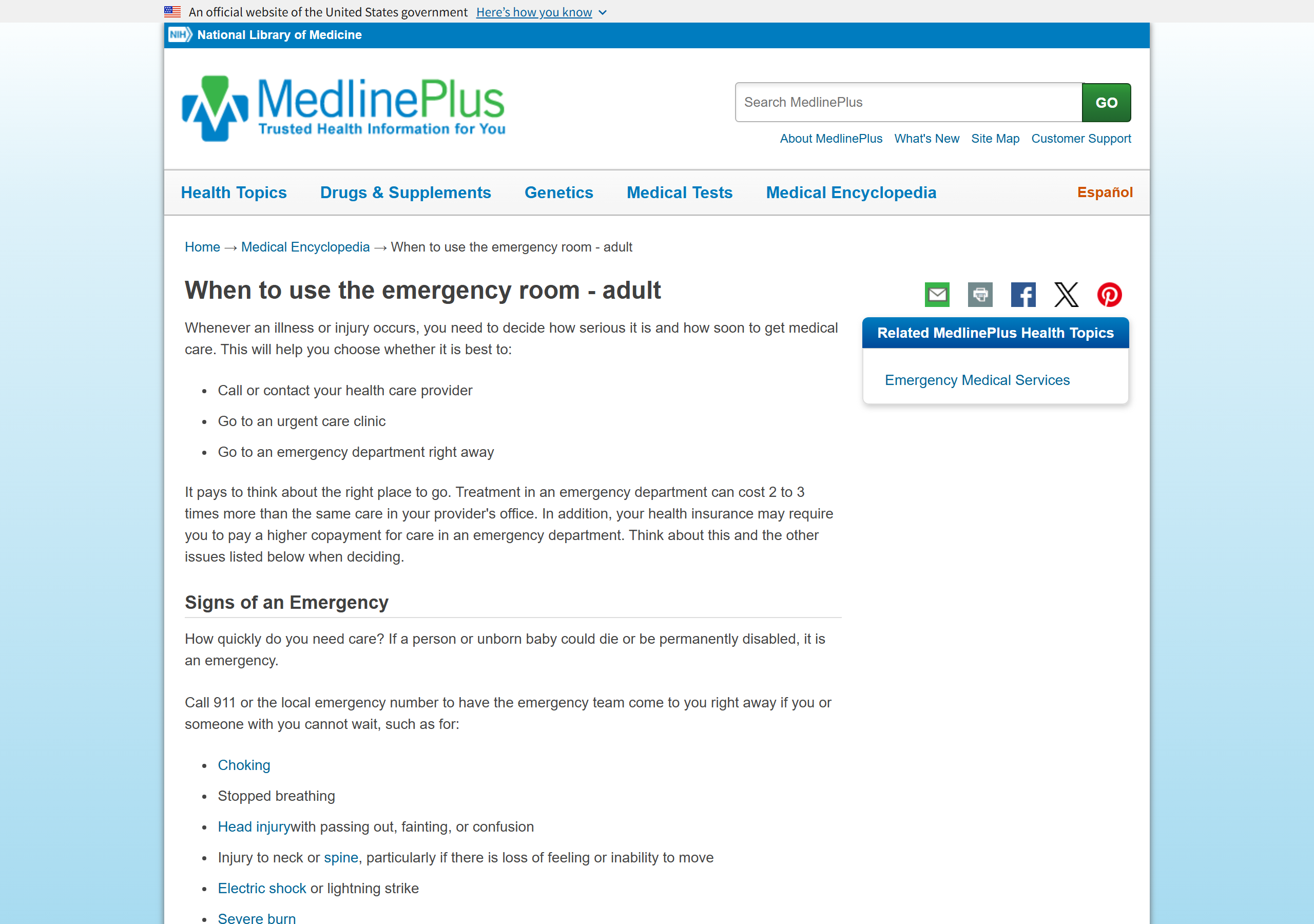
- MedlinePlus (U.S. National Library of Medicine). When to use the emergency room - adult. https://medlineplus.gov/ency/patientinstructions/000593.htm
- National Alliance on Mental Illness. Involuntary civil commitment. https://www.nami.org/advocacy/policy-priorities/improving-health/involuntary-civil-commitment/
- National Institute of Mental Health. Help for Mental Illnesses. https://www.nimh.nih.gov/health/find-help
- Substance Abuse and Mental Health Services Administration. 988 Frequently Asked Questions. https://www.samhsa.gov/mental-health/988/faqs
- Substance Abuse and Mental Health Services Administration. 988 Suicide & Crisis Lifeline. https://www.samhsa.gov/mental-health/988
- Substance Abuse and Mental Health Services Administration. 2025 national guidelines for a behavioral health coordinated system of crisis care (PEP24-01-037). https://988crisissystemshelp.samhsa.gov/sites/default/files/2025-04/national-guidelines-crisis-care-pep24-01-037.pdf
LINC is a research prototype, not a medical or legal service. Translation can be wrong; you have the right to a free, qualified interpreter. For anything high-stakes, do it with a community health worker or someone you trust. In a crisis, call or text 988, or 911 for immediate danger.