'Public charge' is a rule used in some immigration decisions. It asks whether a person relies mainly on the government for support. Using Medicaid for health care, including mental health care, is generally not counted as public charge, but the policy has changed before, so confirm with a real person before making decisions based on this.
Immigration and public charge rules change and depend on your exact situation. This is general information, not legal advice. Before you act on anything here that could affect your immigration status, talk with a qualified immigration attorney or an accredited legal representative. To find free or low-cost help, use the National Immigration Legal Services Directory or call 211.
Many people put off getting mental health care because they worry it could hurt their immigration case or expose them. This guide explains what is true. Some things are the same everywhere in the United States, and some things depend on your state, so read both parts.
- You can get mental health care in the US regardless of your immigration status.
- Emergency rooms must treat anyone in a crisis, community health centers serve everyone without proof of status, and 988 is open to all.
- Using Medicaid for regular health care is generally not counted as public charge, but the rules can change, so confirm your situation with a person.
Care that is available to everyone, in every state
A few protections do not change from state to state:
- Emergency care is for everyone. Under a federal law known as EMTALA, any hospital emergency room that takes Medicare (nearly all of them) must give you a medical screening exam and treat you until you are stable if you have an emergency, and it must do this regardless of your immigration status, your insurance, or your ability to pay (Centers for Medicare & Medicaid Services). This covers a mental health emergency too. Separately, many states have a program called Emergency Medicaid that can help pay a hospital for emergency care for people who meet the income rules but do not have a qualifying immigration status, including undocumented immigrants (KFF, 2025). You do not sign up for it in advance; the hospital or a caseworker can help you apply after an emergency.
- Community health centers (also called federally qualified health centers, or FQHCs) serve everyone, including people who are uninsured or undocumented, and charge on a sliding scale based on your income. They do not require proof of immigration status to treat you, and they offer mental health care and interpreters. The federal Health Resources and Services Administration explains what a health center is.
- Crisis lines are open to anyone. You can call or text 988 at any time, in many languages, no questions about status.
Crisis lines are open to anyone. You can call or text 988 at any time, in many languages, with no questions about your immigration status.
These are real doors into care that do not depend on where you live or what your papers say.
Will using care hurt my immigration case?
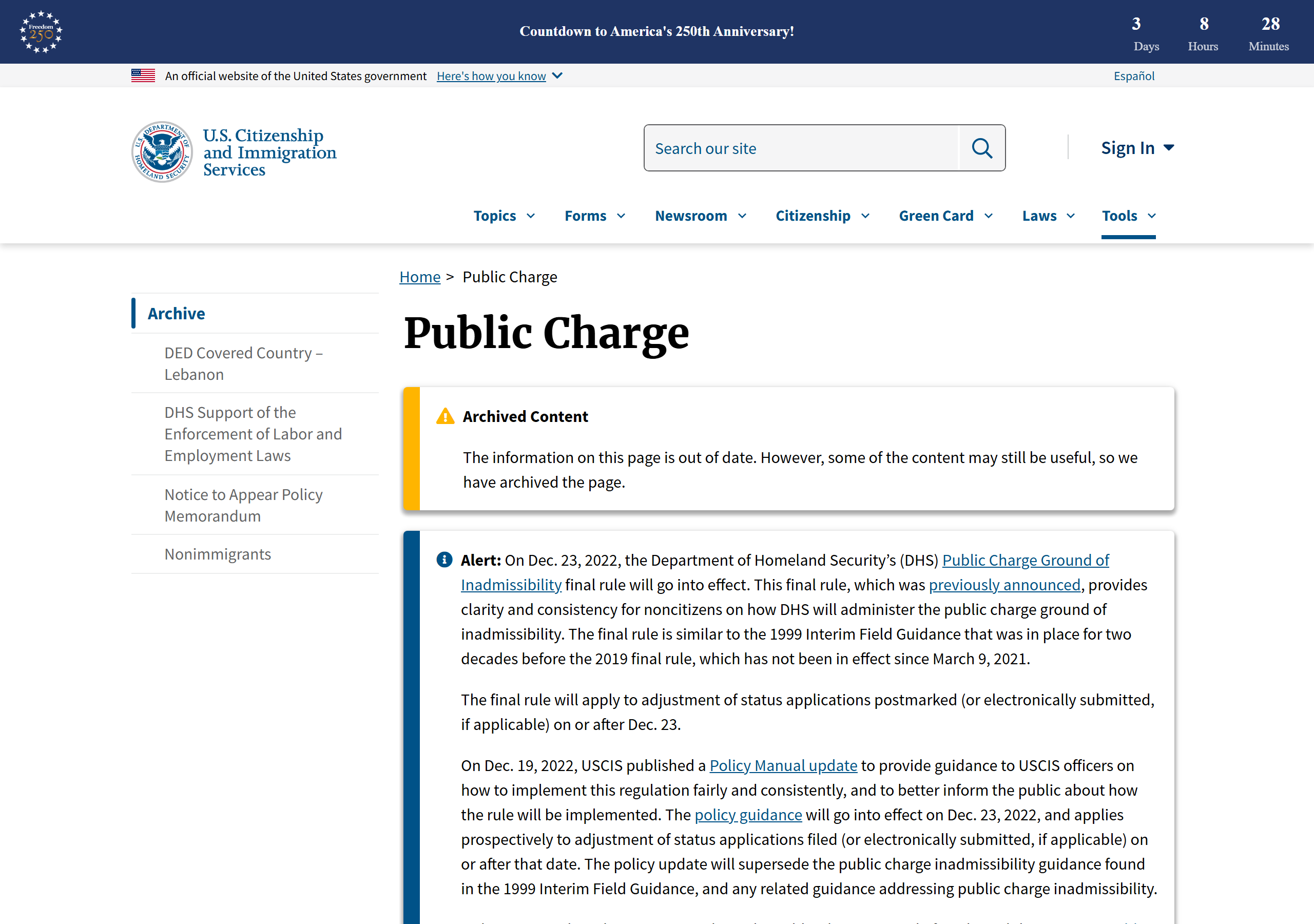
The public charge rule is what most people are afraid of. According to U.S. Citizenship and Immigration Services, most health programs are not counted in a public charge decision. This includes Medicaid (except long-term institutional care), the Children’s Health Insurance Program (CHIP), and most health, nutrition, and housing programs. Having health insurance or using a clinic does not, by itself, make you a “public charge.”
Under the rule in effect since December 2022, an official looks only at whether a person depends mainly on the government to live, shown by two narrow things: cash aid for income support (such as SSI or TANF), or long-term care in an institution paid for by the government. It does not count using Medicaid for regular health care including mental health care, CHIP, food help like SNAP or WIC, school meals, housing help, tax credits, or any care you received during a public health emergency (KFF, 2022). Getting counseling, seeing a doctor, or filling a prescription is not the kind of thing this rule looks at.
Using Medicaid for regular health care, including mental health care, is not counted in a public charge decision. Having health insurance or using a clinic does not, by itself, make you a "public charge."
Because public charge policy has shifted in the past and can change again, confirm your own situation with a person before making a decision based on it. This is exactly the kind of question to bring to a community health worker, and any question tied to a specific immigration case belongs with a licensed immigration attorney or a DOJ-accredited representative, not with an AI assistant. LINC does not give legal or immigration advice and will route these questions to a person.
Public charge policy has shifted before and can change again. Before you make a decision based on it, confirm your own situation with a community health worker, and take any question about a specific immigration case to a licensed immigration attorney or a DOJ-accredited representative.
What coverage you can get depends on your state
This is the part that varies a lot, so do not rely on a single national rule.
At the federal level, lawfully present immigrants can buy Marketplace coverage and may qualify for lower costs, and many qualify for Medicaid or CHIP (some after a five-year wait; refugees and asylees generally have no wait). HealthCare.gov lists which immigration statuses qualify for Marketplace coverage. U.S. citizen or lawfully present children may qualify for Medicaid or CHIP even when a parent does not.
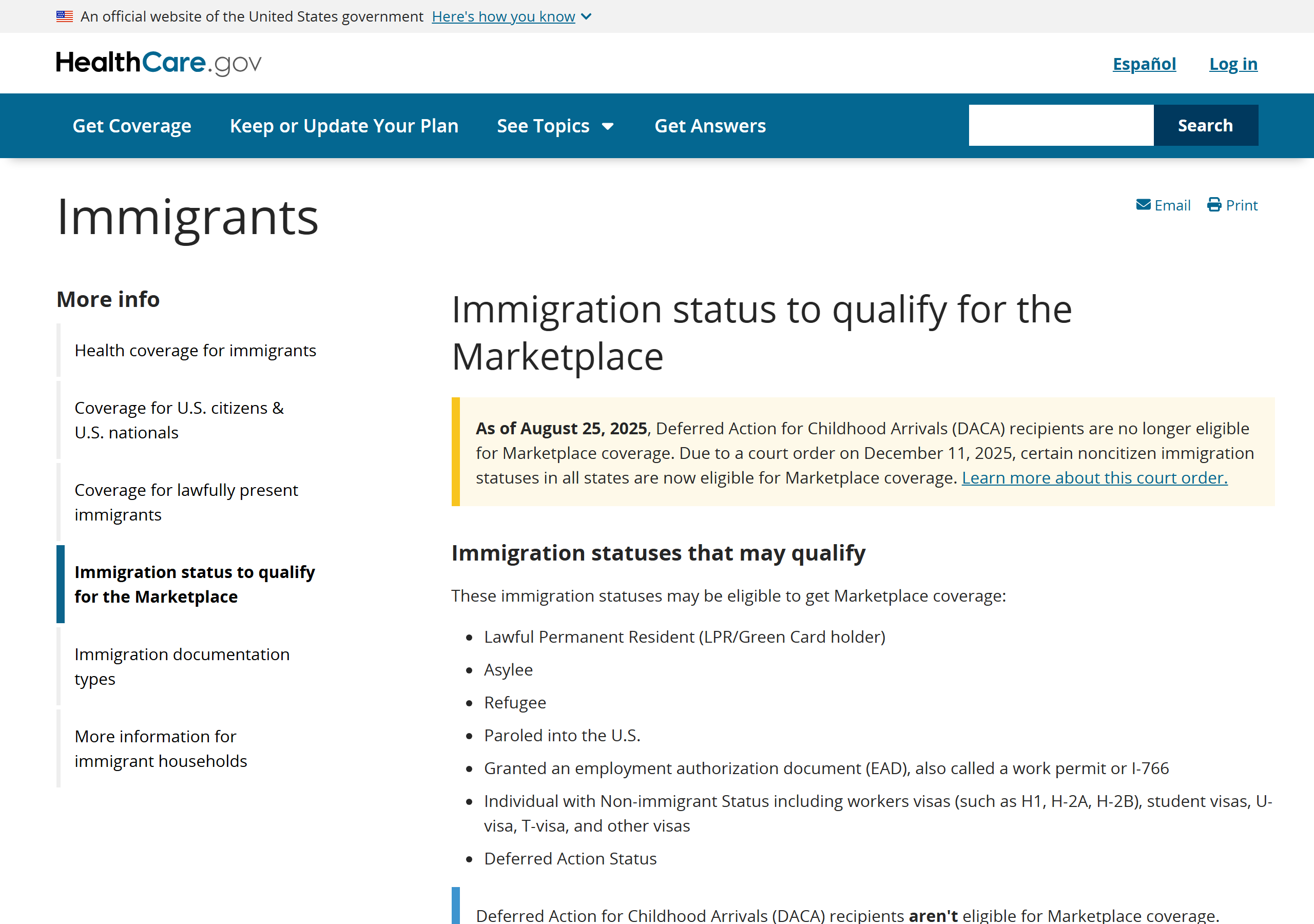
Beyond that federal baseline, states differ a great deal. Some states use their own funds to cover more immigrants, including some adults regardless of status, while others cover far less. These rules have also been changing recently at both the federal and state levels, and who qualifies for some programs has shifted from one year to the next. This is time-sensitive, so confirm it for your own situation rather than assume it. For this reason there is no single answer that fits every reader.
To find out what is true for you right now, do two things:
- Confirm with a person. A community health worker or your state Medicaid office can tell you your current eligibility. LINC connects you to a community health worker for this.
- Find care that serves everyone. Find a community health center near you at findahealthcenter.hrsa.gov, which serves everyone and offers interpreters. You can also dial 211, or visit 211.org, for a free, confidential connection to local health and social programs, including ones that serve immigrant families. 211 does not ask about your immigration status.
Your privacy at the clinic
A clinic is a health care provider, not an immigration office. Clinics should not require your immigration status in order to treat you, and your health information is protected by a federal privacy law called HIPAA, which limits who can see your records.
A few practical things follow from this:
- A community health center does not ask for proof of immigration status to see you. If a form asks for a Social Security number or immigration status and you do not want to answer, you can usually leave it blank and still be treated. It is fair to ask, “Do I have to fill this in to be seen?”
- The interpreter is part of your confidential care. A qualified interpreter is bound to keep what you say private, the same as the provider.
- You can bring a trusted person to the visit for support. For anything about your specific immigration case, that person should be a licensed immigration attorney or a DOJ-accredited representative, not the clinic staff and not an AI assistant.
To understand exactly who can see your records, read Your privacy: who can see your mental health records.
Sources
- 211 (United Way). Get connected. Get help. https://www.211.org/
- Centers for Medicare & Medicaid Services. Emergency health services for undocumented aliens. https://www.cms.gov/newsroom/fact-sheets/emergency-health-services-undocumented-aliens
- Centers for Medicare & Medicaid Services. Health coverage options for immigrants. https://www.cms.gov/marketplace/technical-assistance-resources/health-coverage-options-immigrants.pdf
- Health Resources and Services Administration. What is a health center? https://bphc.hrsa.gov/about-health-center-program/what-health-center
- HealthCare.gov. Find out what immigration statuses qualify for coverage in the Marketplace. https://www.healthcare.gov/immigrants/immigration-status/
- HealthCare.gov. Health coverage for immigrants. https://www.healthcare.gov/immigrants/
- HealthCare.gov. Health coverage for lawfully present immigrants. https://www.healthcare.gov/immigrants/lawfully-present-immigrants/
- KFF. (2022). 2022 changes to the public charge inadmissibility rule and the implications for health care. https://www.kff.org/racial-equity-and-health-policy/2022-changes-to-the-public-charge-inadmissibility-rule-and-the-implications-for-health-care/
- KFF. (2025). 5 key facts about immigrants and Medicaid. https://www.kff.org/racial-equity-and-health-policy/5-key-facts-about-immigrants-and-medicaid/
- U.S. Citizenship and Immigration Services. Public charge. https://www.uscis.gov/green-card/green-card-processes-and-procedures/public-charge
LINC is a research prototype, not a medical or legal service. Translation can be wrong; you have the right to a free, qualified interpreter. For anything high-stakes, do it with a community health worker or someone you trust. In a crisis, call or text 988, or 911 for immediate danger.