AI literacy training for community health workers
Train-the-trainer materials for the community health workers (CHWs) who help clients use AI-assisted navigation to reach mental health care.
What this hub is
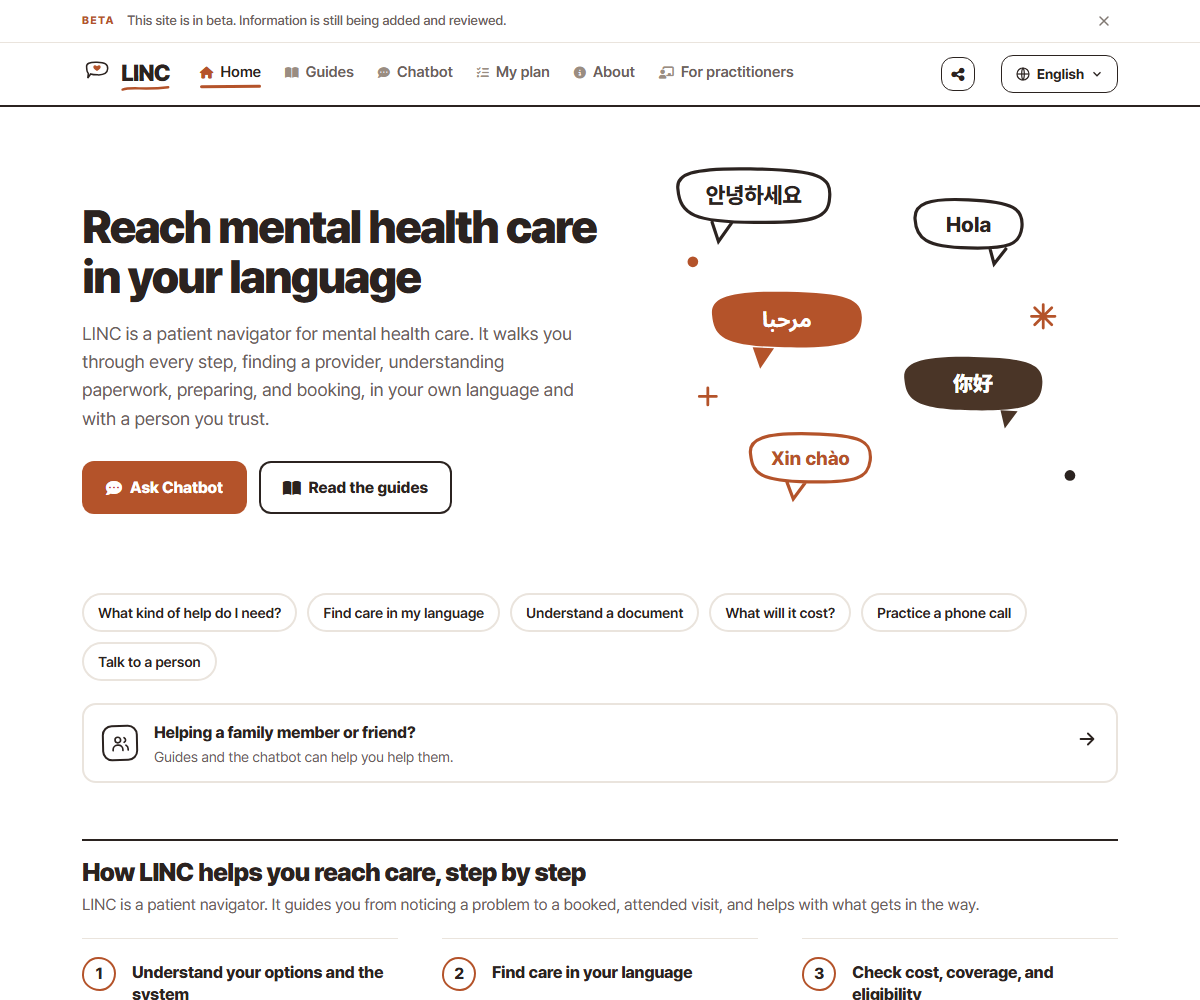
LINC helps immigrant adults with limited English proficiency reach mental health care in their own language, using a chatbot that is grounded in plain-language guides and reviewed by a person they trust. The person they trust is a bilingual community health worker. This hub trains those CHWs. This training is about generative AI: the chatbots and assistants that produce text, such as the LINC assistant and tools like ChatGPT, Claude, Gemini, and Copilot, not every kind of AI.
The model is train-the-trainer. The project lead trains bilingual CHWs in English. Each CHW then delivers a client group session in the community's own language. The evidence for this design is strong: a 2025 Lancet trial (Alegria and colleagues) found that CHW-delivered, language-concordant group psychoeducation improved depression and anxiety in exactly this population, and community-embedded delivery outperformed remote delivery in a separate media-literacy trial. Your job as a CHW is not to be an AI expert. Your job is to model calm, careful use, to check AI answers together with the client, and to know where the limits are. Two design lessons come from the wider evidence: unaccompanied digital training can fall flat or even backfire in low-trust, low-literacy settings (Guess and colleagues, 2020), while the same kind of tool paired with a live navigator holds up (Han and colleagues, 2025). LINC pairs AI grounded in the guides with a CHW for exactly this reason.
Who this is for
Bilingual community health workers, promotores, patient navigators, and peer supporters who will facilitate the LINC client session and support clients between sessions. The training is delivered in English because the train-the-trainer workshop is in English; CHWs then work with clients in the community's language. No clinical license is assumed or required. What is assumed is warmth, trust in the community, and a willingness to say "let me check that with a supervisor."
The modules
Each module runs 45 to 60 minutes and can be delivered as one workshop day or spread across sessions.
- 1
What AI can and cannot do
Set realistic expectations. What AI is useful for in navigation, where it fails, and how to spot a confident wrong answer.
45–55 min - 2
Teaching calibrated trust
Coach the habits: make your own guess first, treat AI answers as drafts, and expect the tool to say "I'm not sure."
45–55 min - 3
The language gradient and interpreter rights
Why AI answers are often worse in the client's language, and how to assert the right to a free qualified interpreter.
50–55 min - 4
Privacy and immigration-status protection
What clients should never enter, how LINC handles data, and honest, calibrated reassurance about safety.
45–50 min - 5
Facilitating the client group session
Walk through the 2.5–3 hour client session and practice teach-back, the core comprehension skill.
60 min - 6
Boundaries and escalation
The do-not-do list, recognizing red flags, and routing crisis and out-of-scope situations to a licensed supervisor.
50–55 min
The kits
Use these alongside the modules for practice, quality monitoring, and safety.
Scripted client scenarios plus an observation checklist with a pass or remediate note.
Per-session checklist, an audio-rating sampling protocol, a supervision template, and the booster schedule.
A printable red-flag card: what to do now, what to escalate, and the standing rules.
How to use this hub
The curriculum is a system, not a single class. One session is the front door; the platform and CHW boosters are what make it stick.
One session is the front door. Observed practice and the recurring booster are what make the skills stick.
- Step 1 Workshop Work through the modules and practice each role-play in the kit.
- Step 2 Observed practice Co-facilitate or deliver a session while a trainer rates you with the observation checklist.
- Step 3 Solo delivery Deliver on your own once the safety items on the checklist are met, with supervision available.
- Step 4 Boosters Return at 6–8 weeks for a short refresher on the do-not-do items and spot-the-error practice.