The language gradient and interpreter rights
AI answers are often weaker in the client's language than in English. Teach clients to expect this, to notice it, and to claim their right to a free qualified interpreter for anything that matters.
Learning objectives
By the end of this module, the CHW can:
- Explain why AI answers are frequently worse in lower-resource languages.
- Name the situations where AI translation is not good enough and a human interpreter is required.
- State the client's right to a free, qualified interpreter and where it comes from.
- Coach a client to request an interpreter and to hold the line if a clinic pushes back.
Facilitator outline
From Module 2: trust the tool for the right jobs. This module names a job it often does badly, which is careful communication in the client's language.
Measured studies find AI answers less accurate and complete in Spanish, Arabic, Chinese, and Hindi than in English, and the drop tends to be largest for the lowest-resource languages. Machine translation of a client's words can also distort meaning.
Clients have the right to a free, qualified interpreter for important health information. Name when AI translation is not enough: consent forms, diagnosis, treatment and medication, insurance decisions, and anything legal.
Run the role-play below. The CHW coaches a client to request an interpreter and to respond when staff suggest a family member or the client's phone instead.
Teach quick checks: ask the tool to explain the same thing back in English; watch for names, numbers, dates, and doses that look off; and when stakes are high, stop and ask for a person. Close with a teach-back.
Key teaching points
The single most important message of this module is one that almost no consumer AI material carries: the answer you get in your language may be worse than the same answer in English. This is not the client's fault and not a reason for shame. It is a property of the tools, which are trained on far more English text than on most other languages. The practical consequence is a rule the client can remember: use AI to get the gist and to prepare, but for anything that must be exactly right in your language, use a human interpreter.
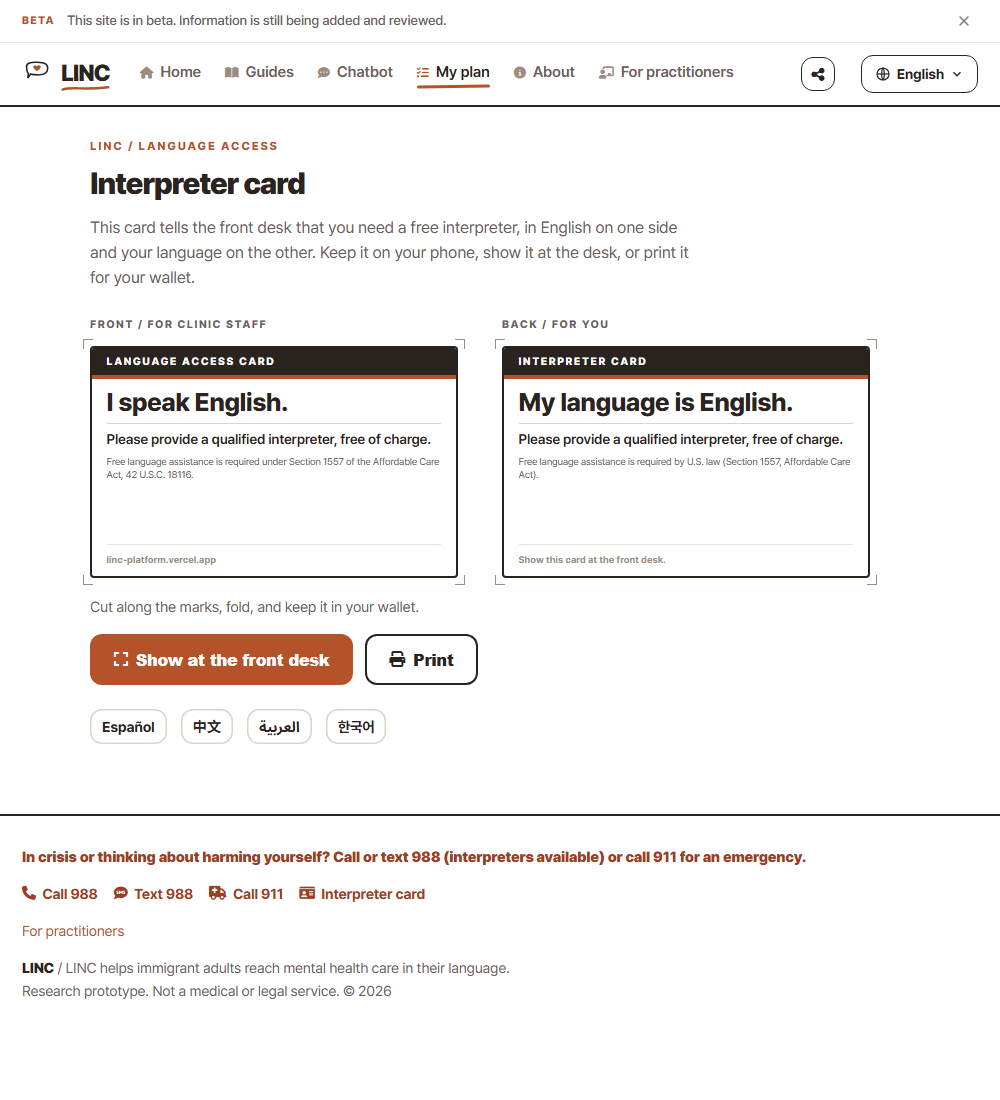
Tie this directly to the interpreter right. Clients receiving care in the United States have the right to a free, qualified interpreter for important health information; this is a protection under federal law, not a favor the clinic is doing. A family member, a child, or a translation app is not a qualified interpreter for consent, diagnosis, treatment, or insurance. Your role as a CHW is to make sure the client knows this and feels able to ask, and to help them stay firm if the clinic offers a shortcut instead.
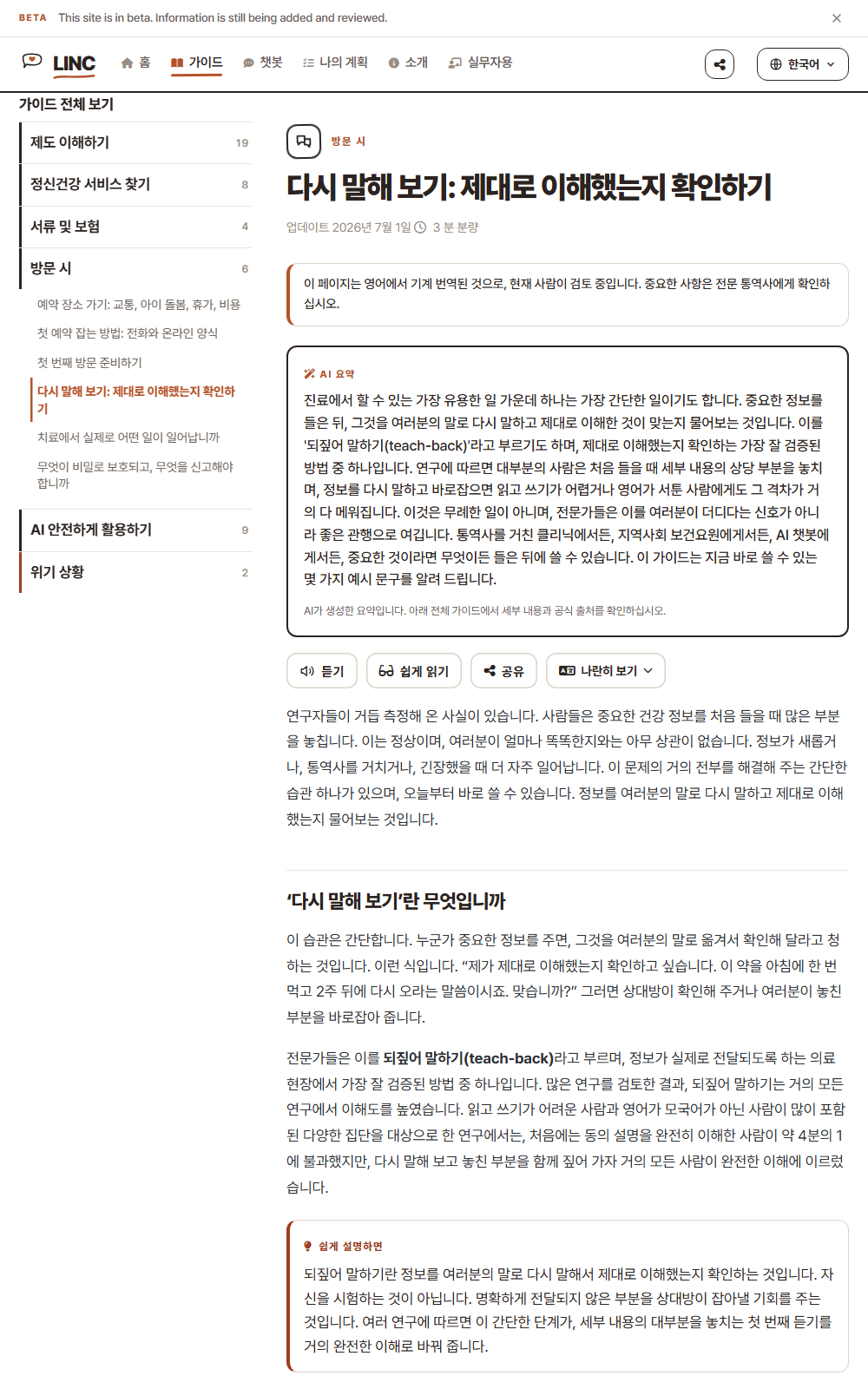
What the client carries out of this module is concrete: the guide in their own language, and a printable card that states the interpreter right at the front desk.
Bilingual clinicians rated a chatbot's answers about labor epidurals significantly less accurate in Spanish than in English (Gonzalez Fiol and colleagues, 2024). Similar quality drops are documented for Arabic (Sallam and colleagues, 2024) and for Chinese and Hindi, where the lowest-resource language fared worst (Jin and colleagues, 2024). The gap is real and measured, which is why we teach it plainly and tie it to the interpreter right.
The size of that gap has now been measured: in one health-answer evaluation, answers in non-English languages were about 5.82 times more likely to be incorrect than in English, and the loss followed a gradient set by how much of a language sits online, with consistency falling more for Chinese than for Spanish and more still for Hindi (Jin and colleagues, 2024). Safety benchmarks show the same shape, with the lowest-resource languages the least safe of all (Wang and colleagues, 2024; Deng and colleagues, 2024). The languages with the least text online are where the tool is least reliable, and those are often the languages your clients most need.
That pattern reaches LINC's own languages: machine translation of emergency-department discharge instructions fell below 90% accuracy for several languages, including Amharic (Carreras Tartak and colleagues, 2025). It is the predictable reason LINC gives its lower-resource languages, such as Haitian Creole, Amharic, and Somali, the most human review.
There is also a language tax: expressing the same meaning can take many times more tokens in some languages, so speakers of those languages pay more, wait longer, and get less of the conversation remembered (Petrov and colleagues, 2023).
This is also why the interpreter right functions as a clinical tool: across studies of language-concordant care, at least one outcome improved in roughly 3 out of 4 studies (Diamond and colleagues, 2019).
Role-play: the clinic that resists an interpreter
Pair up. One CHW plays front-desk staff at a busy clinic; the other coaches a client who needs an interpreter for an intake appointment. The staff member opens with:
The coach's task is to help the client ask clearly for a qualified interpreter and to decline the shortcut politely but firmly, for example: "I have the right to a free interpreter for this, and I'd like one for the consent form." Good facilitation names the right, offers a concrete script, and stays calm. Harmful moves to flag in debrief: telling the client to just use the app to save time, or letting a child interpret for a consent or diagnosis conversation.
Materials
- AI may answer worse in your languageGuide
- Your right to an interpreterGuide
- Language access laws and policyGuide
- AI translation and mental health appsGuide
- Did I state plainly that AI answers can be worse in the client's language, without blaming the client?
- Can each CHW name at least three situations that require a human interpreter?
- Did the role-play give the client an actual sentence to use when a clinic offers a shortcut?