Facilitating the client group session
Walk through the 2.5 to 3 hour client session end to end, and practice teach-back, the single best-evidenced way to confirm a client actually understood.
The client session is one part of a longer arc. You run it during solo delivery, and the recurring booster keeps the safety skills sharp.
Learning objectives
By the end of this module, the CHW can:
- Describe the arc of the 2.5 to 3 hour client session and the purpose of each part.
- Run hands-on practice on clients' own phones and manage a mixed digital-literacy group.
- Perform the teach-back loop correctly, putting the effort on themselves, not the client.
- Use teach-to-goal: keep cycling until the client can show understanding.
Facilitator outline
You facilitate practice; you do not deliver therapy. The session activates clients toward care and gives them a plan, in their language, with a person they trust.
Walk the session flow below. It is one group session of 6 to 10 participants, about 2.5 to 3 hours, in the community's language, with hands-on practice throughout and an optional follow-up.
Pair stronger and newer phone users, slow down for hands-on steps, keep instructions to one action at a time, and circulate. Offer childcare, a light meal, and transportation support so people can attend and focus.
Teach the loop and its wording. The point is to check your own explanation, not to test the client. Then teach-to-goal: if understanding is incomplete, re-explain differently and check again.
Run the trio practice below with the observation checklist. Rotate roles so every CHW practices facilitating.
Surface what made teach-back feel natural versus like a quiz, and set each CHW one thing to practice before observed delivery.
The client session, part by part
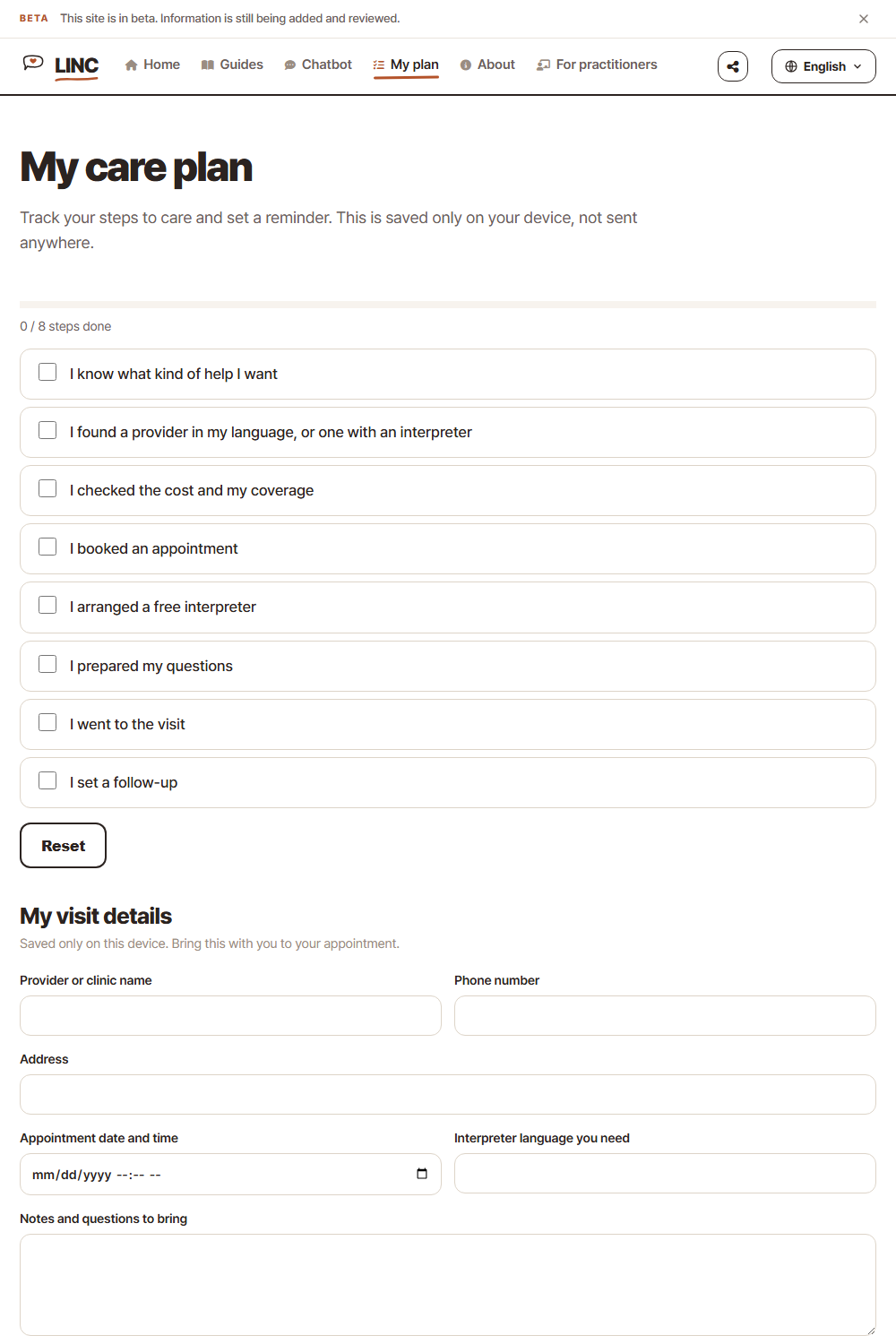
The client session is the front door of the LINC system. It is deliberately hands-on: participants use their own phones the whole way through, and they leave with a written plan in their language and the CHW's follow-up contact.
- Welcome and consent. Introduce yourself, confirm the working language, arrange interpretation if needed, and obtain consent in a way that respects immigration precarity. No pressure, clear about what is voluntary.
- What AI can and cannot do. The Module 1 message in plain client terms, with the spot-the-error example.
- Hands-on: find care and understand documents. Practice using AI to search for a language-concordant or interpreter-supported provider and to make sense of an intake form or insurance letter, always verifying what the tool returns.
- Hands-on: prepare and self-advocate. Draft questions for a provider and a phone script for booking; rehearse asking for an interpreter.
- Stay safe. The privacy rule from Module 4, and a personal rule for when to use AI and when to ask a person.
- Action plan and follow-up. Each participant leaves with a concrete next step written in their language and knows how to reach you.
Teach-back is one of the best-supported comprehension techniques: a review of 20 studies found it effective in 19 of them (Talevski and colleagues, 2020), and a "teach-to-goal" approach reached near-complete understanding even in a low-literacy, mixed-language group (Sudore and colleagues, 2006). Yet it is almost never used with clients who have limited English: one video study found it in zero of 101 encounters (Gutman and colleagues, 2018). Building it into this session closes a documented gap.
The single-session, CHW-delivered, language-concordant group format is the design an RCT supports for this population (Alegria and colleagues, 2025, Lancet). One session is enough for knowledge, confidence, and intention; the platform and boosters carry the rest.
Teach-back practice in trios
Work in threes: a facilitator, a client, and an observer with the observation checklist. The facilitator explains one concrete thing from the session, for example how to ask a clinic for a free interpreter, then uses the teach-back loop:
If the client's version is incomplete, the facilitator re-explains a different way and checks again (teach-to-goal), never moving on until the client can show it. The observer rates rapport, plain language, whether teach-back was actually used, and whether the effort stayed on the facilitator rather than turning into a test of the client. Rotate so all three practice facilitating.
Materials
- Repeat it back: making sure you understoodGuide
- What to ask AI, and what to ask peopleGuide
- Prepare for your first visitGuide
- What a community health worker doesGuide
- Observation checklistRole-play kit
- Did my teach-back put the effort on me ("did I explain that well") rather than testing the client?
- Can each CHW run one full teach-to-goal cycle without moving on too early?
- Do I have a concrete plan for pairing stronger and newer phone users in the client session?